Today in Fascism

What McKinley Understood That Morgan Could Not Afford

McKinley’s argument was not complicated. It was structural. Built from the ground up the same way he built everything else. From the facts in front of him.

He had watched his father work blast furnaces. He had grown up in working-class Ohio towns. He had seen what happened to working people when foreign competition undercut American wages. He had defended the miners who could not afford a lawyer.

He understood something that took him twenty years in Congress to build into policy. A government funded by tariffs on foreign trade does not need to borrow from private banks. A workforce protected from foreign wage competition has leverage against the men who own the factories. Those two things connected directly. Tariffs were not just economic policy. They were the mechanism that kept both the government and the worker independent of the men who controlled capital.

He said it himself, documented in the Ohio History Journal archives: tariff protection “encourages the development of skill, labor, and inventive genius as part of the great productive forces.” He was not quoting theory. He was reading wage data.

Between 1897 and 1901, manufacturing output in the United States increased 50 percent. Real wages for manufacturing workers rose 1.5 percent annually. Outpacing every decade before. Unskilled laborers saw hourly pay climb from 15 cents to nearly 20 cents by 1900. A 33 percent nominal increase in three years. Annual earnings for industrial workers hit $437 by 1900, up from $380 in 1897.

Those numbers came from the Dingley Tariff Act of 1897. The highest protective tariff in American history. Signed by McKinley seven months into his first term.

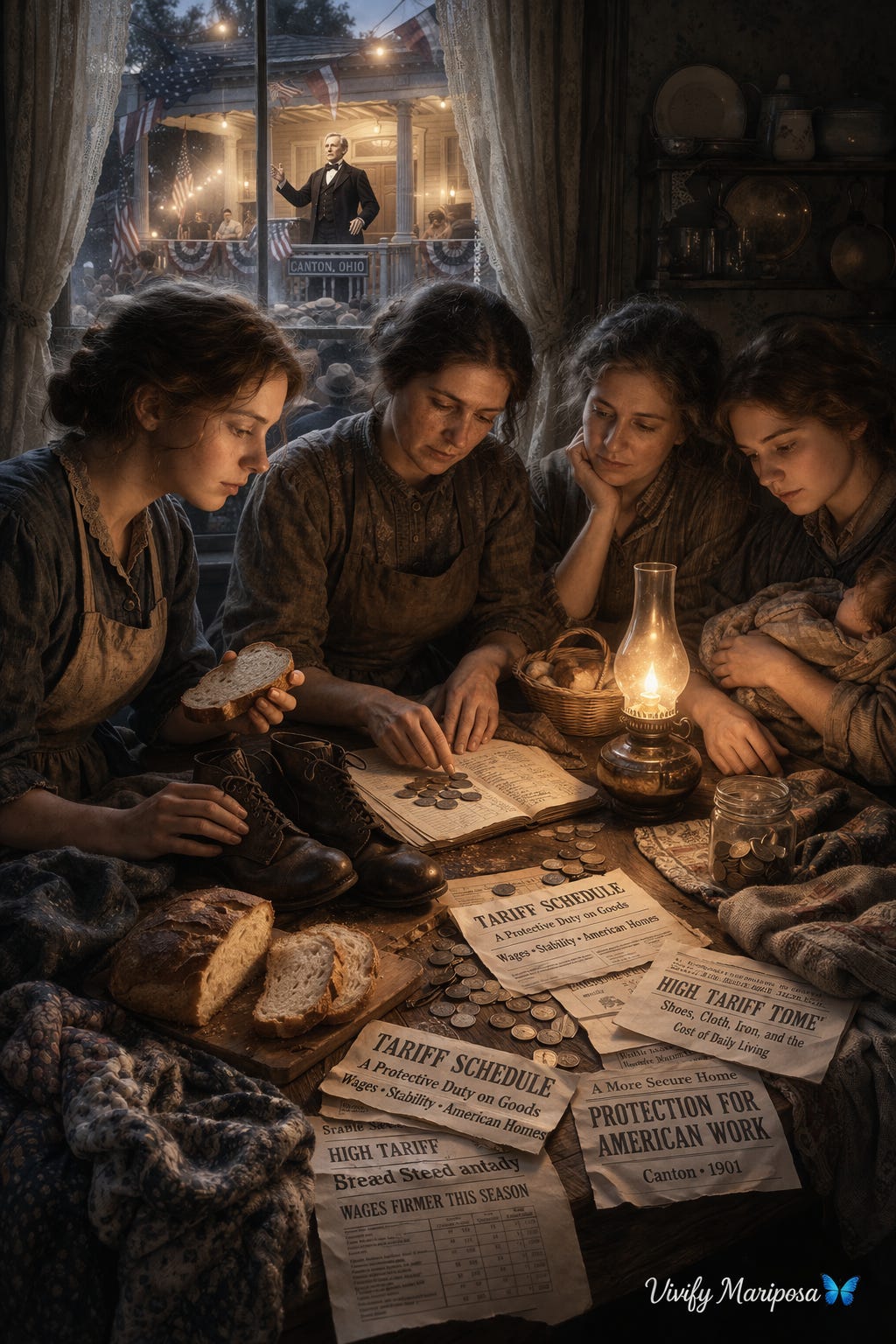
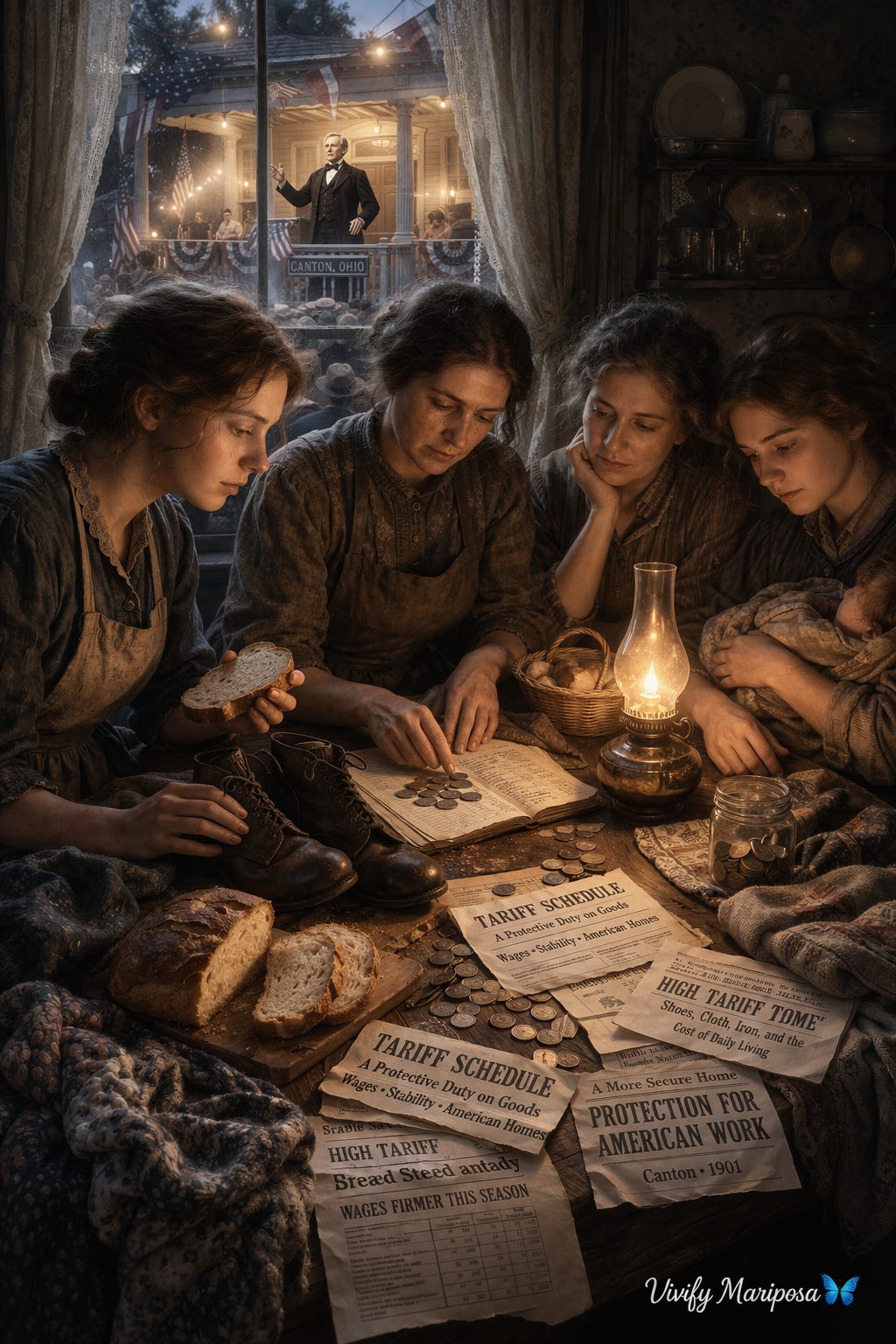
750,000 people made the pilgrimage to Canton, Ohio to hear McKinley speak from his front porch. Not to a rally. Not to a convention. His house. Factory workers. Miners. Tradesmen. Farmers. They came because they felt it. More money in their pockets. More stability in their lives. A government that paid for itself through trade instead of taxing their labor or borrowing from bankers.

And the women came too. Women who had no vote. Who could not go to the polls. Who made the trip to Canton anyway. Because the tariff system showed up in their household budgets before it showed up in any newspaper. More money meant food. Stability meant their children had shoes. They felt McKinley’s system at the kitchen table before any economist published a paper about it. A man whose economic policy was so visibly working for working families that women without voting rights walked to his front porch to show their support. That is not a footnote. That is the human proof that the system was real.

Labor and capital both supported his tariff system. Because it worked for both simultaneously.


Now look at who is reading this right now.

You are working harder than your grandfather did. You have less to show for it. Your grandfather had a pension. You have a 401k that moves with a market you do not control. Your grandfather’s factory job paid enough to own a house and raise a family on one income. You need two incomes and still cannot afford a house in the city where you work. Your grandfather’s dollar bought more every decade. Yours buys less every year.

That is not an accident. That is 112 years of architecture working exactly as designed.

McKinley’s tariff system was on a trajectory. Wages rising. Manufacturing expanding. Government surplus. No income tax on your labor. No private banking system controlling the money supply. That trajectory was pointing toward you. Toward the life your grandfather had. Toward the life that was possible when the government worked for the people who built it.

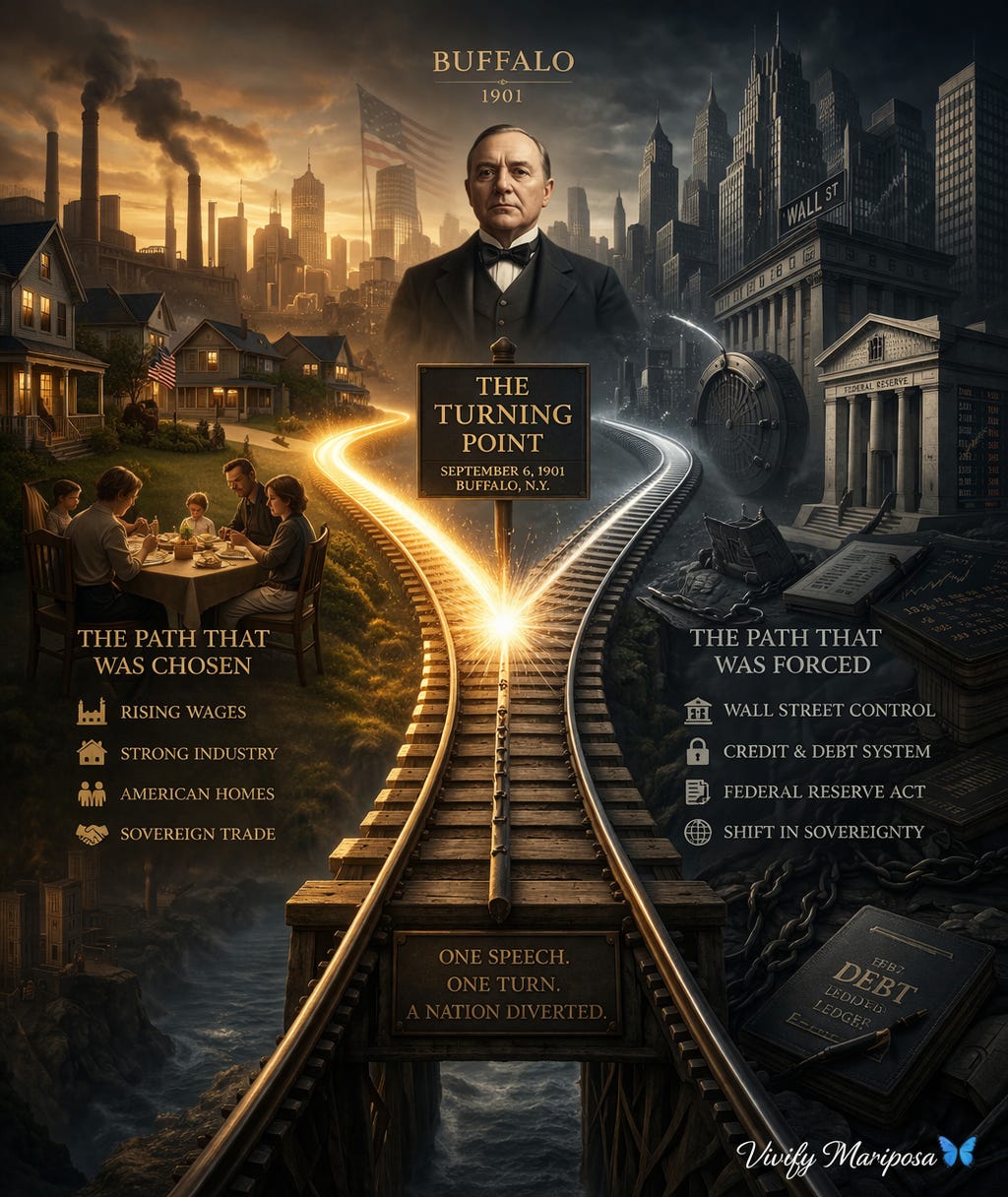
One bullet in Buffalo redirected that trajectory. Toward Wall Street. Away from Canton. Away from the kitchen table where the women were already counting what McKinley’s system had put there.

That is what Morgan needed to end.

Not just McKinley the man. The proof that his system worked. And the direction that proof was pointing.

 

The Fight Is 235 Years Old

This fight did not start with McKinley. It started with the first Secretary of the Treasury in 1789.

Alexander Hamilton understood what McKinley would still be saying 110 years later. Political independence without economic independence is theater. You can wave your flag all you want. If your money is controlled by someone else your freedom is an illusion. Hamilton built the First Bank of the United States. He pushed for protective tariffs on foreign manufactured goods. He wrote in his Report on Manufactures that America needed to make its own goods or remain a colony in everything but name.

His argument and McKinley’s argument are the same argument separated by a century. Hamilton said America cannot be economically free if it depends on British manufactured goods. McKinley said America cannot be economically free if it depends on private banking debt. Same root. Same fight. Same enemies. Because the enemies were the same people.


Aaron Burr shot Hamilton in 1804. Burr had spent his Senate career opposing Hamilton’s financial system. The same financial system that kept America independent from London capital. The First Bank expired in 1811. Three years after the bullet. The British financial network that had never accepted American economic independence outlasted the man who designed it.

McKinley picked up the same argument in 1876 as a congressman from Ohio. Same fight. Same enemies. Different century. Different bullet.

When JP Morgan sat at Jekyll Island in 1910 designing the Federal Reserve on the Bank of England model, he was finishing what the British financial network started the morning Aaron Burr pulled the trigger on Alexander Hamilton.

The fight is 235 years old.

They have been winning it since 1804.
 

The Chain Nobody Teaches

JP Morgan did not build his financial empire from nothing. He inherited it. From a network that ran directly through London. To the heart of British financial power. To the institution that had been trying to control American money since before the Revolution.

Here is the chain. Fact by fact.

George Peabody. Born in Massachusetts in 1795. Moved to London in 1835. Set up George Peabody and Company. The firm that became the foundation of what eventually became JP Morgan and Company, JPMorgan Chase, Morgan Stanley, and Morgan Grenfell. JPMorgan Chase confirmed this in its own 2021 published records: “J. Pierpont Morgan, Sr. was associated with George Peabody & Company and J.S. Morgan & Company before he founded Drexel Morgan & Company, which ultimately became part of JPMorgan Chase.”

That is not a conspiracy theory. That is the bank’s own statement about its own origins.

Now here is what the bank does not advertise.

When George Peabody arrived in London in 1835, he was a man of modest means operating in the most powerful financial city on earth. London was not just the financial capital of Britain. It was the financial capital of the world. The Rothschilds and Barings sat at the top of that world like kings. As one observer recorded at the time, to be asked for lunch was like being received in audience by a king.

Shortly after Peabody arrived, he was summoned to an audience with Baron Nathan Mayer Rothschild. Not invited. Summoned. Rothschild made Peabody a proposition. Rothschild would bankroll Peabody’s social life. The dinners. The entertainments. The lavish hosting that opened doors in London. And Peabody would serve as Rothschild’s acceptable American face. The London aristocracy disliked Rothschild. They would not dislike a charming American patriot who threw magnificent Fourth of July dinners celebrating independence.


Every drop of wine at those dinners was paid for by Rothschild. Every guest who drank it and laughed at Rothschild’s manners was drinking Rothschild’s money without knowing it.

George Peabody became the most popular American in London. Freeman of the City of London. Queen Victoria’s favorite American. There is no statue of George Peabody on Wall Street. There is one in London. Directly opposite the Bank of England.

By 1861, Peabody was the largest trader of American securities in the world. Operating with 500,000 pounds sterling of capital. Rothschild capital behind the scenes.

In 1854, Peabody took on a partner. Junius Spencer Morgan. Father of John Pierpont Morgan. The firm became Peabody, Morgan and Company. When Peabody retired in 1864 it became JS Morgan and Company. Junius ran London. His son JP worked as the New York representative of a London firm. Learning the business as his father’s American agent. For fourteen years. Before he ever ran anything independently.

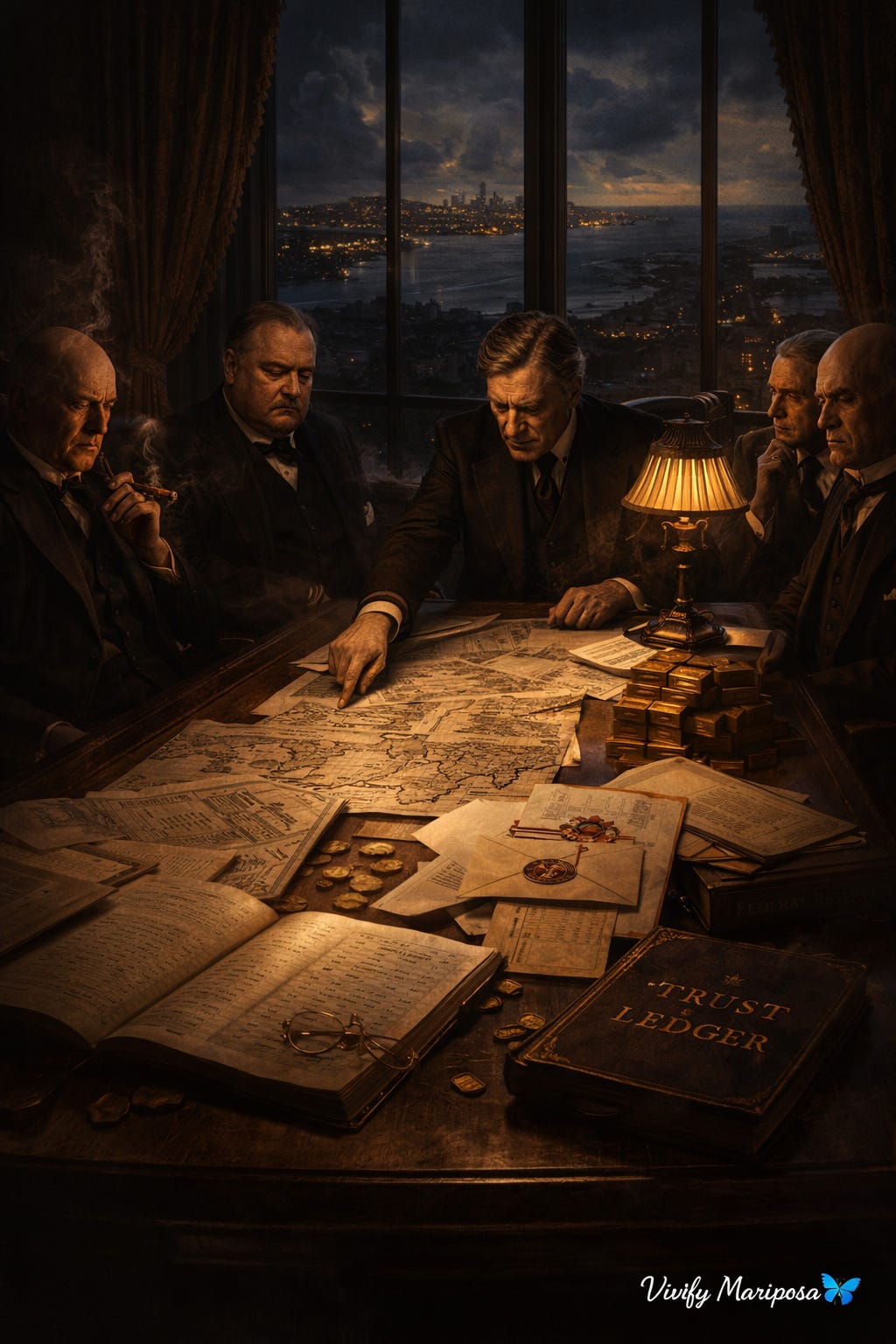
In 1873, JP Morgan coordinated with the Rothschilds to supply gold to the US Treasury during the Panic of 1873. The Library of Congress documents this directly. Morgan and the Rothschilds. Working together. Stabilizing American finance. On their terms.

In 1895, with the US Treasury nearly depleted of gold reserves, Morgan demanded a meeting with President Cleveland. He told the president the United States could default that day. Then he used a Civil War statute to arrange for Morgan and the Rothschilds to sell 3.5 million ounces of gold directly to the US Treasury in exchange for a 30-year bond issue. The government of the United States borrowed from Morgan and Rothschild to survive. On their terms. At their price.


A congressman said it in 1833. He was still right in 1895. “The barometer of the American money market hangs up at the stock exchange in London.”

During the 1907 Panic, when Morgan stepped in as the rescuer of the American financial system, Lord Rothschild sent word from London. The New York Times recorded it on October 26, 1907. Rothschild said Morgan was “worthy of his reputation as a great financier and a man of wonders.” Researchers at the time noted this was the only instance ever recorded of a Rothschild publicly praising a banker outside his own family.

The only one.

The man who rescued America from financial panic was praised by the London banking dynasty that had funded his predecessor, trained his father, and worked alongside his firm for decades.

That is not the story of an American banker who happened to do business with British capital. That is the story of a British financial network operating through an American face. The same technique Rothschild used with Peabody. Applied again. Scaled up. Taken all the way to the Federal Reserve.

McKinley’s tariff system was what stood between that network and the American government. A government that funded itself through trade did not need Morgan. Did not need Rothschild. Did not need London.

That is why McKinley had to be removed.
 
The impending demise of 60 Minutes is of compelling interest to all Americans (and to the rest of the world, for that matter). Dismissing it as "dirty employment laundry" shows your bias.
It is not compelling. 60 minutes has been a leftist echo chamber for decades. When you do not play it straight you lose the trust of the people...except those like you who prefer to be spoon fed the latest leftist talking point.
 
It is not compelling. 60 minutes has been a leftist echo chamber for decades. When you do not play it straight you lose the trust of the people...except those like you who prefer to be spoon fed the latest leftist talking point.
I haven't watched it in years. Many others have though -- the ratings for the show have continued to be strong. I wonder if the Ellison family is willing to liquidate their best asset (CBS in general) just to have the opportunity to kiss ass in the Oval Office.
 
I haven't watched it in years. Many others have though -- the ratings for the show have continued to be strong. I wonder if the Ellison family is willing to liquidate their best asset (CBS in general) just to have the opportunity to kiss ass in the Oval Office.
60 minutes may start really making money once you get rid of the leftist bias. If they produce a straight news show they will bring in the audiences they have lost.
 
I haven't watched it in years. Many others have though -- the ratings for the show have continued to be strong. I wonder if the Ellison family is willing to liquidate their best asset (CBS in general) just to have the opportunity to kiss ass in the Oval Office.
Interviews: The show's viewership can spike significantly based on high-profile interviews. For example, a recent high-profile interview with President Donald Trump brought in 14 million viewers, making it the highest single-day total for the program in several years.

Why wouldn't they kiss the Oval offices ass.
 
THAT SEEMS LIKE A LOT: Judicial Watch Sues California to Clean Up 873,000 Inactive Voter Registrations on Rolls. “Under the National Voter Registration Act of 1993 (NVRA), states are required to make reasonable efforts to remove ineligible voters from the voter rolls, including those who have died or moved. The lawsuit also alleges, again citing admissions by California officials, that the state takes no effective action to require counties to comply with the NVRA. As a result, they do not comply.”

The counties don’t want to comply and Sacramento doesn’t want them to comply, which tells you there’s a reason nobody wants to comply.


CA mails out ballots to all registered voters. So at a min there are almost 900k extra ballots floating around during election season. Corrupt? Yep.
 
I'm waiting for the impending demise of "The View."
Wait, what? Did their backstage catering get cut off?

All kidding aside, they're not a news show so their entitled to their opinions. The fact that their as stupid as shit also provides fodder to a lot of conservative commentators. They do infect the minds of the unemployed who have nothing to do during the day and the pampered women with white guilt that like to virtue signal for "marginalize" groups that they have no relationship to. In the spirit of full disclosure my wife does record and watch the View on occasion, mostly for the drama. Sometimes I will hate watch it with her before I get kicked out of the room for my running commentary.
 
It is not compelling. 60 minutes has been a leftist echo chamber for decades. When you do not play it straight you lose the trust of the people...except those like you who prefer to be spoon fed the latest leftist talking point.
60 minutes may start really making money once you get rid of the leftist bias. If they produce a straight news show they will bring in the audiences they have lost.
On occasion they have some good segments. Like this segment on Palmer Luckey. Only 33 and a genius.
 
Back
Top