What McKinley Understood That Morgan Could Not Afford
McKinley’s argument was not complicated. It was structural. Built from the ground up the same way he built everything else. From the facts in front of him.
He had watched his father work blast furnaces. He had grown up in working-class Ohio towns. He had seen what happened to working people when foreign competition undercut American wages. He had defended the miners who could not afford a lawyer.
He understood something that took him twenty years in Congress to build into policy. A government funded by tariffs on foreign trade does not need to borrow from private banks. A workforce protected from foreign wage competition has leverage against the men who own the factories. Those two things connected directly. Tariffs were not just economic policy. They were the mechanism that kept both the government and the worker independent of the men who controlled capital.
He said it himself, documented in the Ohio History Journal archives: tariff protection “encourages the development of skill, labor, and inventive genius as part of the great productive forces.” He was not quoting theory. He was reading wage data.
Between 1897 and 1901, manufacturing output in the United States increased 50 percent. Real wages for manufacturing workers rose 1.5 percent annually. Outpacing every decade before. Unskilled laborers saw hourly pay climb from 15 cents to nearly 20 cents by 1900. A 33 percent nominal increase in three years. Annual earnings for industrial workers hit $437 by 1900, up from $380 in 1897.
Those numbers came from the Dingley Tariff Act of 1897. The highest protective tariff in American history. Signed by McKinley seven months into his first term.
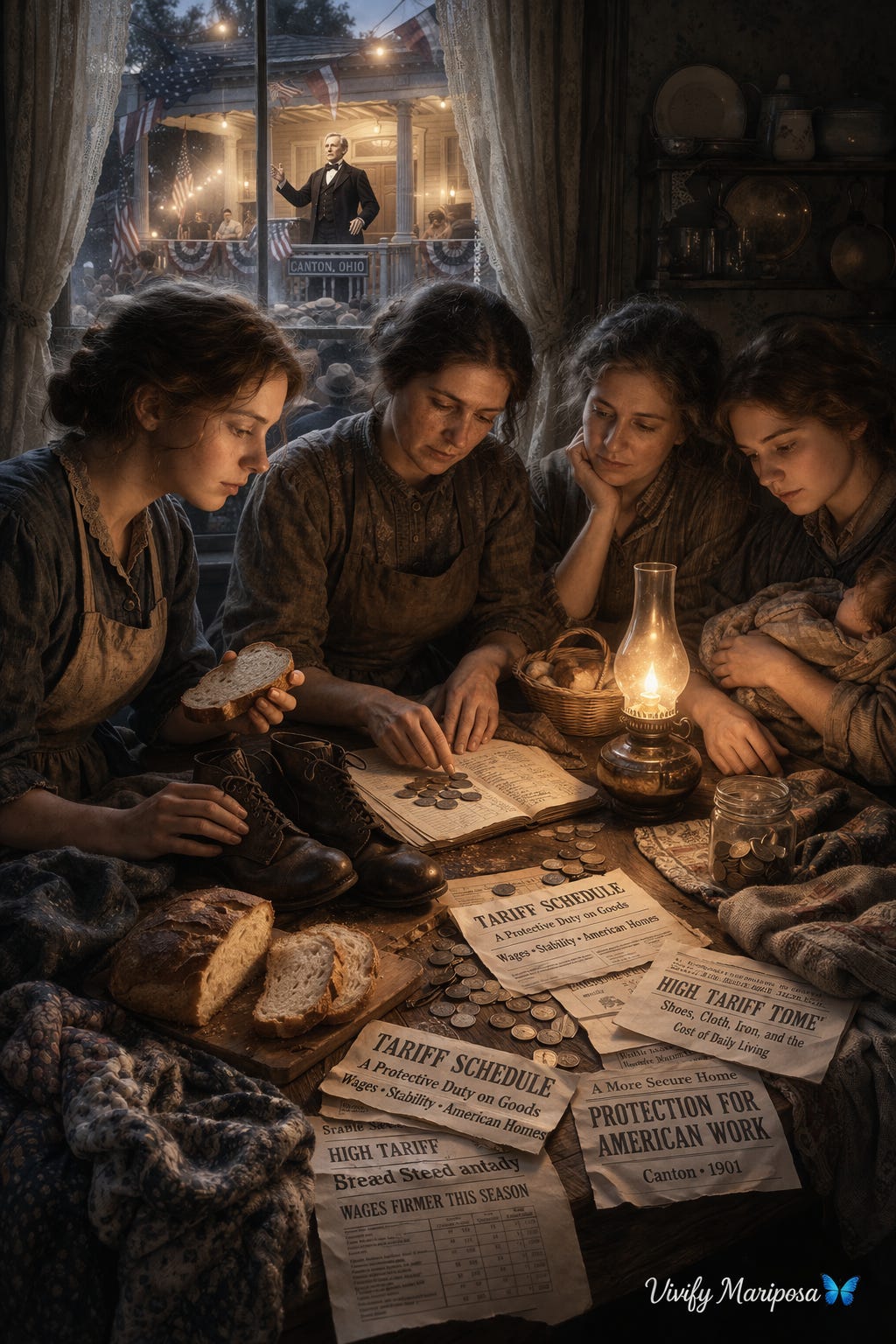
750,000 people made the pilgrimage to Canton, Ohio to hear McKinley speak from his front porch. Not to a rally. Not to a convention. His house. Factory workers. Miners. Tradesmen. Farmers. They came because they felt it. More money in their pockets. More stability in their lives. A government that paid for itself through trade instead of taxing their labor or borrowing from bankers.
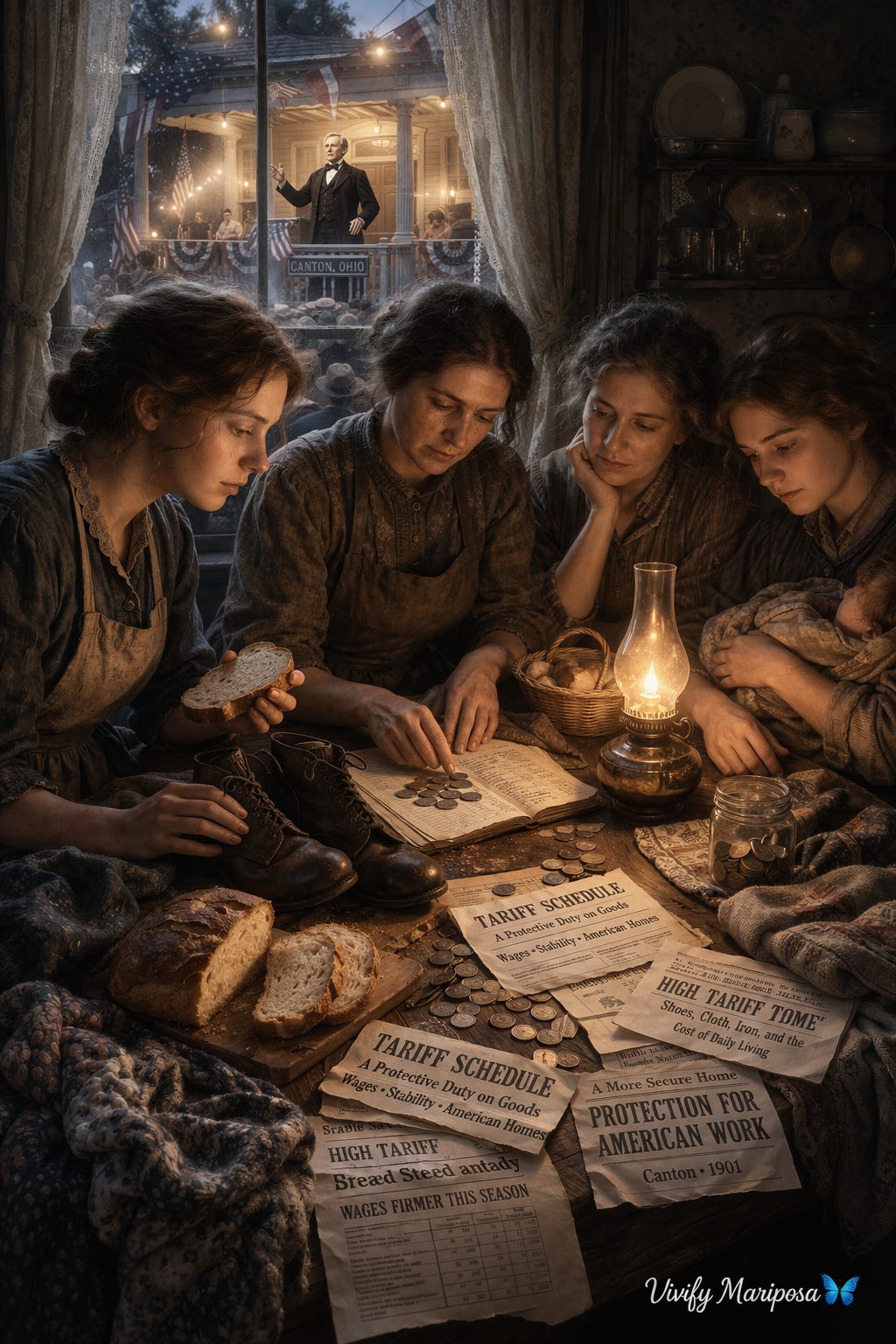
And the women came too. Women who had no vote. Who could not go to the polls. Who made the trip to Canton anyway. Because the tariff system showed up in their household budgets before it showed up in any newspaper. More money meant food. Stability meant their children had shoes. They felt McKinley’s system at the kitchen table before any economist published a paper about it. A man whose economic policy was so visibly working for working families that women without voting rights walked to his front porch to show their support. That is not a footnote. That is the human proof that the system was real.
Labor and capital both supported his tariff system. Because it worked for both simultaneously.
Now look at who is reading this right now.
You are working harder than your grandfather did. You have less to show for it. Your grandfather had a pension. You have a 401k that moves with a market you do not control. Your grandfather’s factory job paid enough to own a house and raise a family on one income. You need two incomes and still cannot afford a house in the city where you work. Your grandfather’s dollar bought more every decade. Yours buys less every year.
That is not an accident. That is 112 years of architecture working exactly as designed.
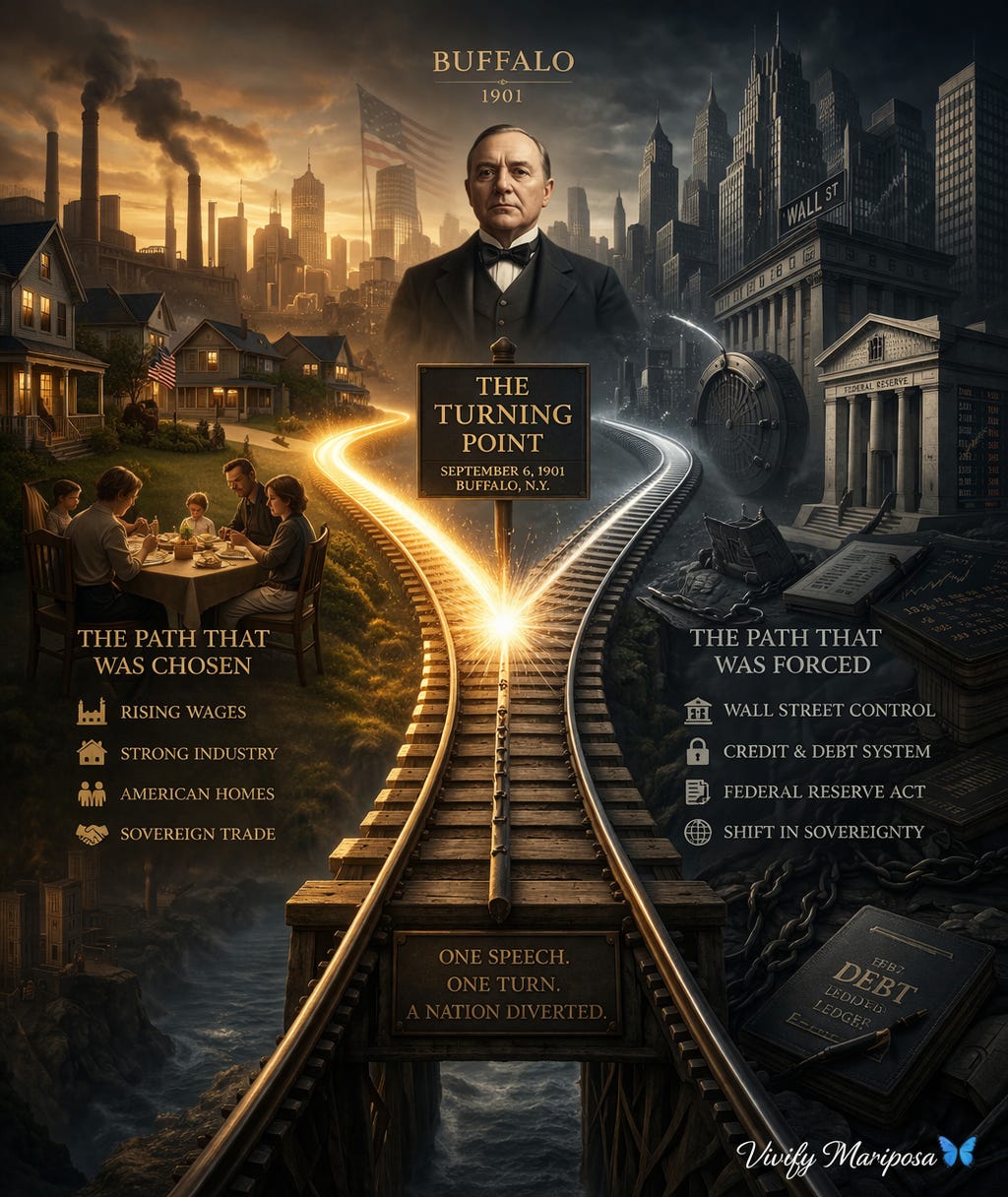
McKinley’s tariff system was on a trajectory. Wages rising. Manufacturing expanding. Government surplus. No income tax on your labor. No private banking system controlling the money supply. That trajectory was pointing toward you. Toward the life your grandfather had. Toward the life that was possible when the government worked for the people who built it.
One bullet in Buffalo redirected that trajectory. Toward Wall Street. Away from Canton. Away from the kitchen table where the women were already counting what McKinley’s system had put there.
That is what Morgan needed to end.
Not just McKinley the man. The proof that his system worked. And the direction that proof was pointing.