

You are using an out of date browser. It may not display this or other websites correctly.
You should upgrade or use an alternative browser.
You should upgrade or use an alternative browser.
Today in Fascism
- Thread starter Hüsker Dü
- Start date
Chelsea dad g09
SILVER
“The Palestinian people
does not exist. The creation
of a Palestinian state is only
a means for continuing
our struggle against the
state of Israel for our Arab
unity. In reality today there
is no difference between
Jordanians, Palestinians,
Syrians and Lebanese. Only
for political and tactical
reasons do we
speak today about the
existence of a Palestinian
people, since Arab national
interests demand that we
posit the existence of a
distinct ‘Palestinian people’
to oppose Zionism.” 8
— Zahir Muhsein
P.L.O. Executive Committee member 1977
does not exist. The creation
of a Palestinian state is only
a means for continuing
our struggle against the
state of Israel for our Arab
unity. In reality today there
is no difference between
Jordanians, Palestinians,
Syrians and Lebanese. Only
for political and tactical
reasons do we
speak today about the
existence of a Palestinian
people, since Arab national
interests demand that we
posit the existence of a
distinct ‘Palestinian people’
to oppose Zionism.” 8
— Zahir Muhsein
P.L.O. Executive Committee member 1977



Bruddah IZ
DA
1. HORMUZ: THE SECOND TOLL BOOTH.
 THE CLIP
Last issue left you with paragraph ten, the moment Washington took the insurance pen back from London. This week Tehran answered with a pen of its own. Documents seen by Lloyd’s List show Iran’s newly created Persian Gulf Strait Authority requiring vessels to carry PGSA-issued coverage, free for the first sixty days of the memorandum, priced after that. On June 25 a drone struck the Singapore-flagged cargo ship Ever Lovely off Oman. On June 26, CENTCOM struck Iranian missile and drone storage and coastal radar sites in response, the first American strikes since the ceasefire extension. Trump’s own words on Truth Social: “One of the Drones solidly hit the upper deck of a large and very expensive Cargo Carrying Ship... Obviously, this is a foolish violation of our Ceasefire Agreement.” Asked whether Iran would face consequences, he said only, “You’ll find out.”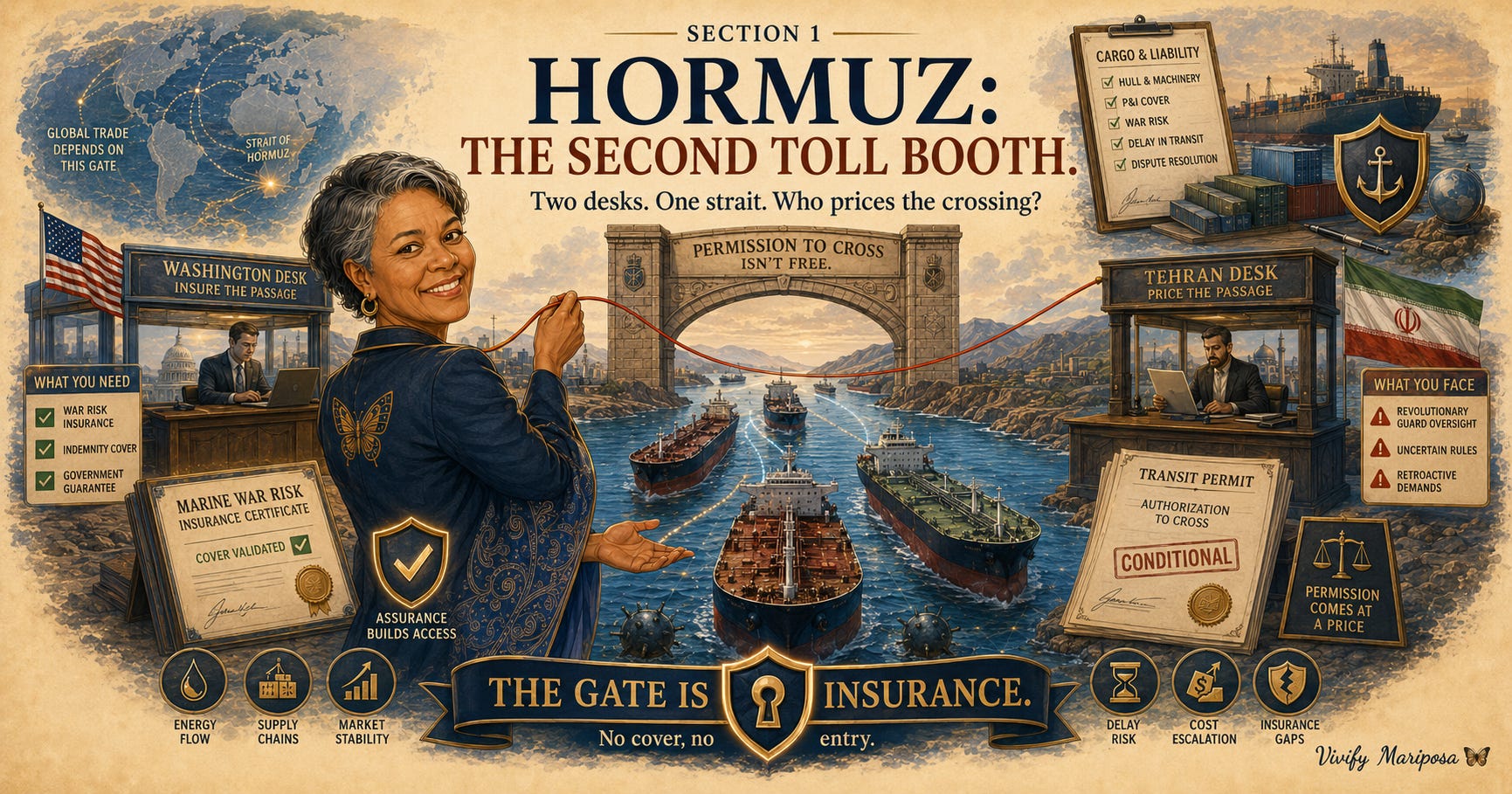
And here is the part the missile coverage skips. Chatham House’s own reporting puts an estimated eighty mines still in the Strait, mostly Maham 3 and Maham 7 blast mines built to dodge sonar, drawn from a pre-war stockpile of five to six thousand. Traffic is running at roughly twenty-five ships a day against a pre-war average near a hundred twenty-five, split across a northern route Iran controls and a southern route the United States backs along the Omani coast, both narrow, both a gamble. And by Chatham House’s own account, the United States currently has only one minesweeping ship in the entire Middle East. That is the real reason Washington needs the UK-France coalition it has been assembling since spring. The insurance fight gets the headline. The mine count is why the water still is not actually open.
 THE RECORD
The City That Owns Everything and Answers to No One and The Empire That Never Died are still the desk’s biography, three centuries of pricing the risk of war and collecting on every premium. What is new is that the desk now has a rival. The American reinsurance facility from last issue, roughly forty billion dollars of revolving capacity through the Development Finance Corporation and Chubb, is still standing. Tehran’s PGSA is the answer to it, a second address trying to open in the same water.My own Square Mile series already named the mechanism underneath this fight. The 1901 D’Arcy concession priced Persia at sixteen cents on the dollar before a single barrel was sold, and every squeeze since, the 1951 nationalization, the 1953 coup, the sanctions after 1979, has run on the same instinct I traced there: a Persia at peace is a low-premium strait and a thin order book. A Persia cornered and lashing out is a high-premium strait and a full one. The desk does not fear the friction at Hormuz. It sells it. Watch the premium, not just the missile.
 THE SEQUENCE
The public watches the drone and the retaliation. The shipowner watches which toll he has to pay to cross. Two governments now claim the right to price the same twenty miles of water, and neither one is London. That is the story underneath the missile: London still writes most of the world’s marine war-risk insurance, but the old single address is no longer the only one taking calls. What replaces that monopoly is not peace, it is competition between two new desks, one in Washington and one in Tehran, both wanting the fee.
Bruddah IZ
DA
2. LIBYA: THE GENERAL’S SON AND THE OIL LEDGER.
THE CLIP
On June 29, Secretary of State Marco Rubio met Lieutenant General Saddam Haftar, deputy commander of the eastern Libyan National Army and heir to Field Marshal Khalifa Haftar, in Washington. The State Department’s own readout: they “discussed ongoing Libyan-led efforts to unify the country’s military, economic, and political institutions.” White House senior adviser Massad Boulos was in the room. This follows a thirty-billion-dollar unified Libyan budget agreement reached in April, the first since 2014, brokered directly between the Haftar and Dbeibah families rather than through Libya’s competing formal institutions. Reporting on the proposed arrangement: the Dbeibahs keep the prime minister’s office, the Haftars take the Presidency Council, which carries command of the armed forces. Boulos has separately told the Financial Times he is encouraging American oil companies to invest, tying the political settlement directly to access.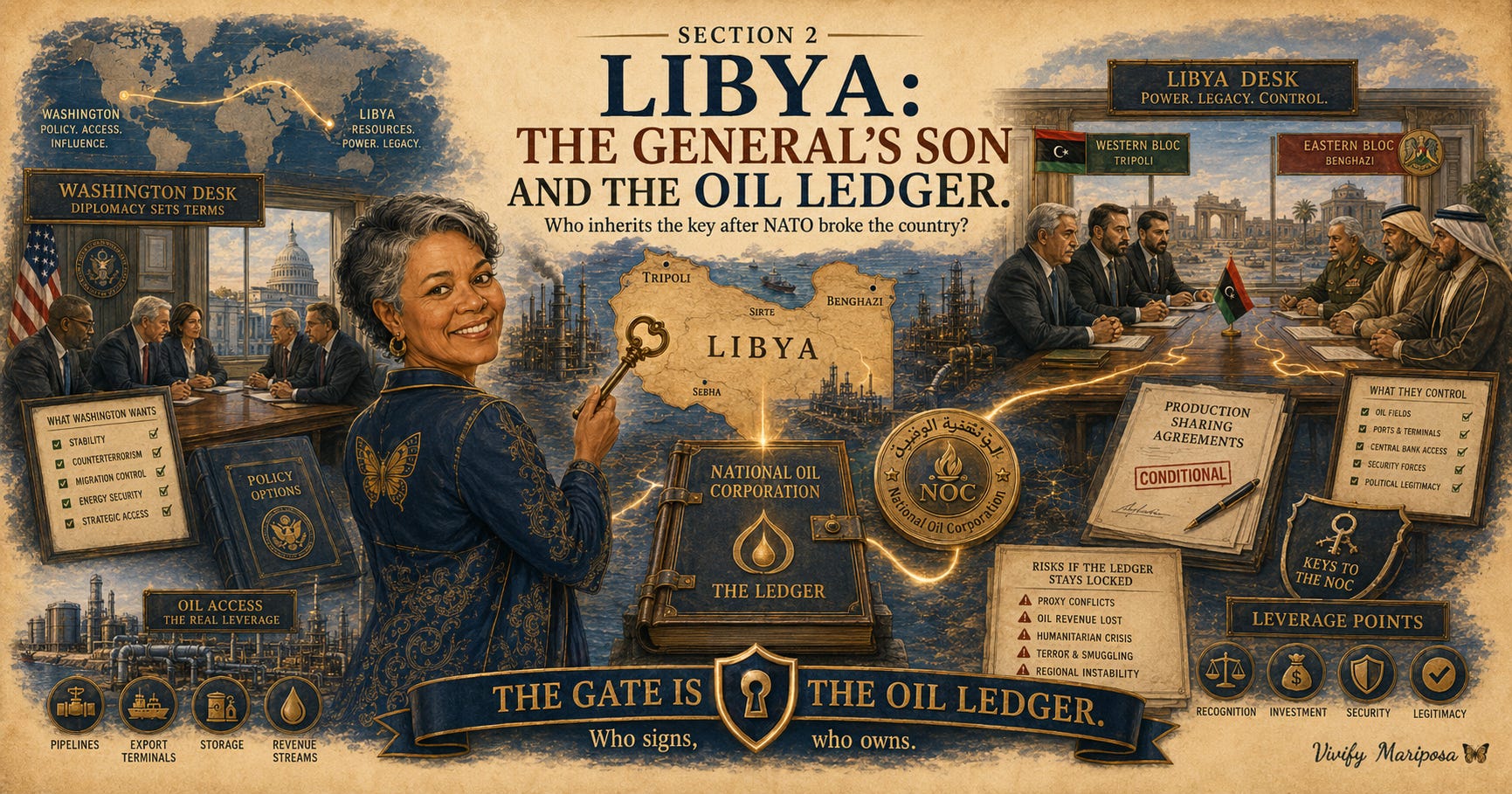
THE RECORD
The Empire That Never Died is the frame this belongs in. NATO broke Libya’s government in 2011 and called it liberation, then walked away from the country it broke. Fourteen years later, Washington is the broker in the room deciding which two families inherit the keys to the National Oil Corporation, while American companies wait for the ink to dry.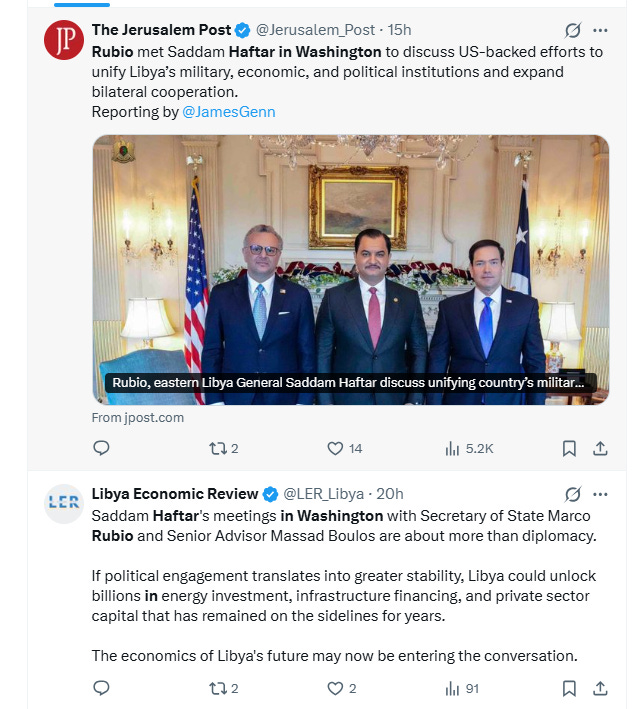
THE SEQUENCE
This is the third plain question in its purest form. The big country stopped looking at Libya in 2011. Now it is back in the room, and the small country is being handed not to its own institutions but to two family names, with an oil ledger sitting on the table between them. Watch who signs the final agreement in Washington and whose name is on the well leases six months after.kickingandscreaming
PREMIER
Narcissism is common among the "Trans" pathologyDon't forget Lil e's "Everyone Look At Me" Neighborhood.
Bruddah IZ
DA
Bruddah IZ
DA
kickingandscreaming
PREMIER
Yeah, and I miss these guys. Would love to know what they do for a living now (and then).
kickingandscreaming
PREMIER

Don't forget Lil e's "Everyone Look At Me" Neighborhood.
Espola's newest neighborhood
Hahahaha! The Left is all about the tragedy that’s gonna happen and never about the tragedies they promote / incite for political gain. Natural selection and extremely strong candidates for Darwin Awards could NOT be better represented by Prettu and Good. The Marxist brothers are so proud. 🤡🤡🤡🤡🤡
 socalsoccer.com
Bruddah IZ
DA
3. THE COBALT GATE: KINSHASA CLOSES ITS OWN DOOR.
THE CLIP
On June 30, the Democratic Republic of Congo’s mineral regulator, ARECOMS, enforced a hard deadline: any 2026 first-half cobalt export quota left unshipped is forfeited and rerouted into a government-controlled strategic reserve rather than reverting to the mining company that held it. Three companies, CMOC, Glencore, and Eurasian Resources Group, control over sixty percent of the permitted export allocations. Cobalt prices have moved from roughly twenty-one thousand dollars a tonne in early 2025 to over fifty-six thousand today. Reporting also ties Kinshasa’s export-control strategy to advice from Vectus Global, a firm connected to American businessman Erik Prince, working with the government on export controls and revenue collection since late 2024.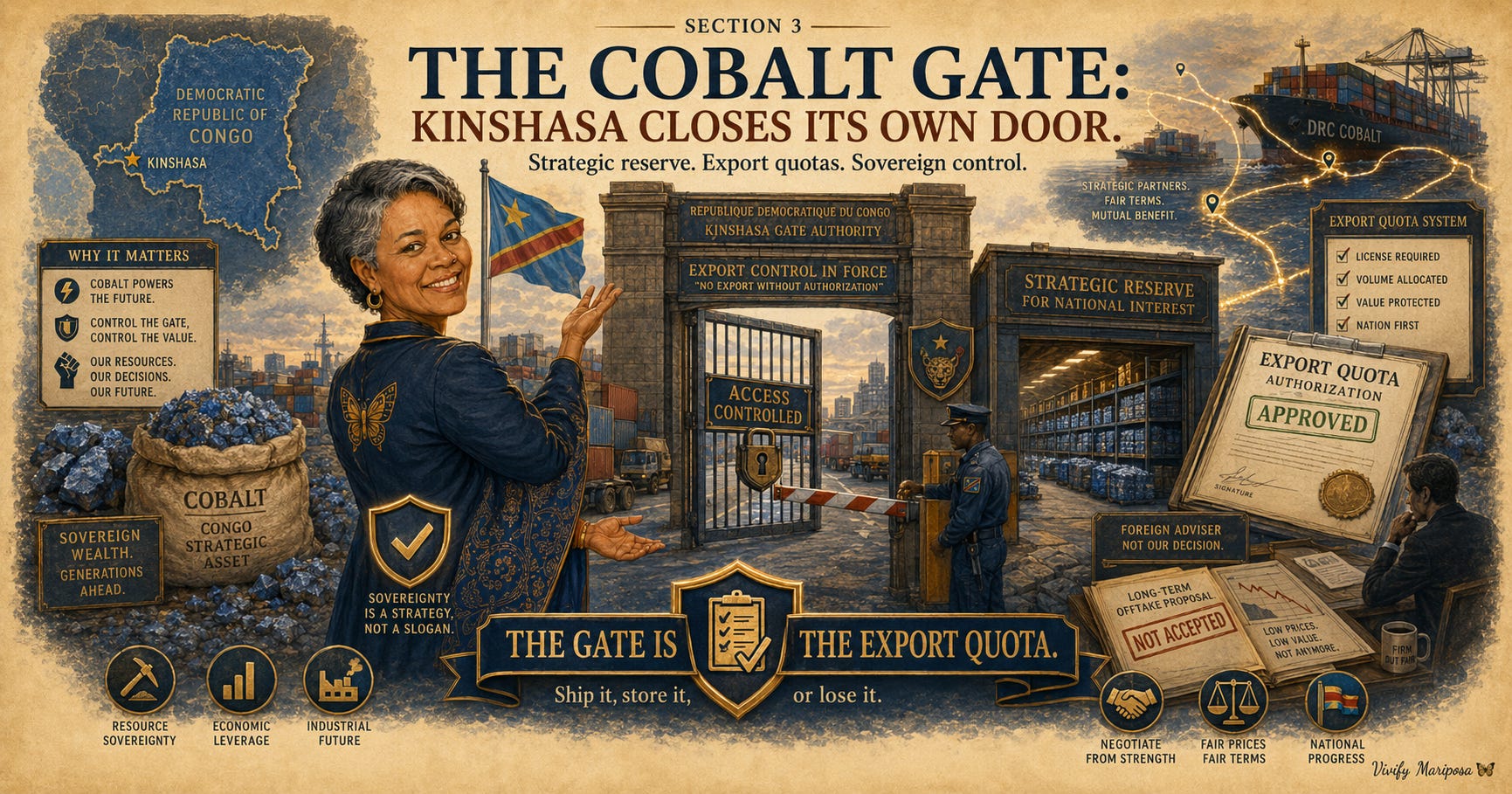
THE RECORD
Africa: The Machine Series and The Gates Are Being Taken Back are the frames here. The doctrine Bessent named at the Treasury last issue, mine it, ship it, refine it, or lose your sovereignty gradually to whoever does, is not only an American doctrine. This week an African government applied it to its own ground, closing the free-passage door on its own mineral gate the same way Washington closed it on the Hormuz insurance desk.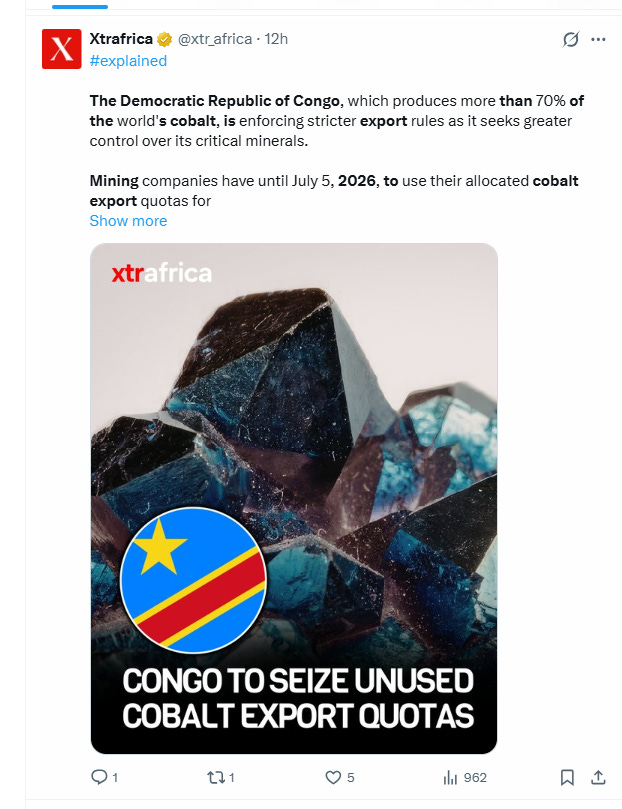
THE SEQUENCE
Notice what is unusual here before you flatten it into a simple villain story. This time the government reclaiming the gate is the country that actually holds the resource, not the country buying it. That is sovereignty in its textbook sense, a government deciding who profits from what leaves its own soil. What sits inside that story, quietly, is an American private security contractor advising the mechanism that enforces it. Hold both facts. The gate is being reclaimed and a foreign hand is inside the reclaiming.Yeah, and I miss these guys. Would love to know what they do for a living now (and then).
View attachment 39509
Wow, just wow Timmy!!! This is so obvious now.

Vang was convicted in 2006 of first-degree criminal sexual conduct. Between 2002 and 2006, he repeatedly sexually assaulted the girl.
At one point, he offered her $10 to keep quiet about the abuse, according to DHS.
He pleaded guilty to first-degree criminal sexual conduct in a plea deal that spared him from going to prison.
"Governor Tim Walz's decision to pardon an illegal alien convicted child rapist so he can remain in our country is disgusting," DHS Acting Assistant Secretary Lauren Bis said in a statement. "These are the criminal illegal aliens he and his Minnesota sanctuary politicians are protecting."
Walz, Minnesota Board of Pardons clears convicted illegal alien child sex offender facing deportation
Laos national convicted of sexually assaulting 10-year-old girl has slate wiped clean
Vang was convicted in 2006 of first-degree criminal sexual conduct. Between 2002 and 2006, he repeatedly sexually assaulted the girl.
At one point, he offered her $10 to keep quiet about the abuse, according to DHS.
He pleaded guilty to first-degree criminal sexual conduct in a plea deal that spared him from going to prison.
"Governor Tim Walz's decision to pardon an illegal alien convicted child rapist so he can remain in our country is disgusting," DHS Acting Assistant Secretary Lauren Bis said in a statement. "These are the criminal illegal aliens he and his Minnesota sanctuary politicians are protecting."

Desert Hound
DA
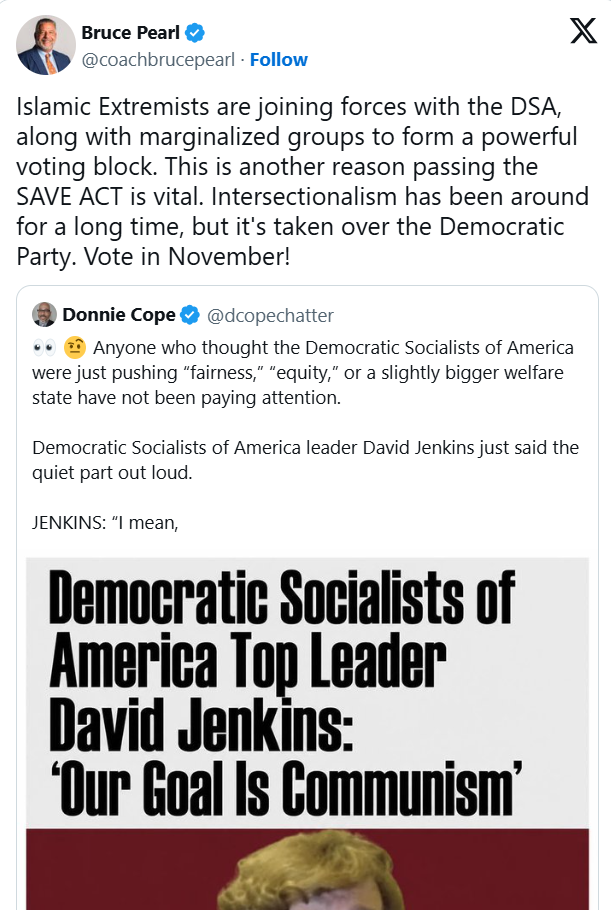
This is where the D party is going. You see all these wins and rather leftist Dems loosing to AOC/Mandami style Dems. Here is what one of the leaders of that group describes their goals as....

Hüsker Dü
DA
The funniest part of this photo isn’t the tactical vest, the megaphone, or the racist sign.
It’s the ankle monitor.
Because unlike a watch, a hat, or a pair of shoes, that’s not something you put on for the day. Somebody else put that on you and made it very clear you’re not to take it off.
Nothing says, “I’m here to explain what’s wrong with society” quite like carrying around government-issued tracking equipment.
Maybe let’s solve our own problems before grading entire races of people.
kickingandscreaming
PREMIER
^^^ I'm thinking this guy was all the SLPC could afford at this point.