Today in Fascism

The Lesson They Learned


Before the City of London became invisible, there was a family that was not.​


The Rothschild family financed the British government’s war against Napoleon. Supplied Wellington’s armies with gold when the Crown could not. In 1825, when the Bank of England ran so low on gold it was days from collapse, a private family bailed it out. The institution that was supposed to control the national currency needed a private family to keep it alive.

The Rothschild name was on every transaction. Every government loan. Every subsidy to every army. Every bond issued for every war. Their couriers moved faster than governments. Their information network beat every intelligence service in Europe.

And that visibility destroyed them.

A British MP stood in Parliament in 1828 and named Nathan Rothschild directly as the man who controlled European credit and could determine war or peace. The name was in pamphlets. In newspapers. In political speeches. In propaganda.

When you have a name, you have a target.


The Rothschild hegemony over European finance broke in the 1870s. Not because they ran out of money. Because the system learned to replicate their function without them. Central banks took over what private banking dynasties had done. The function survived. The family did not.

The City of London absorbed that lesson completely.

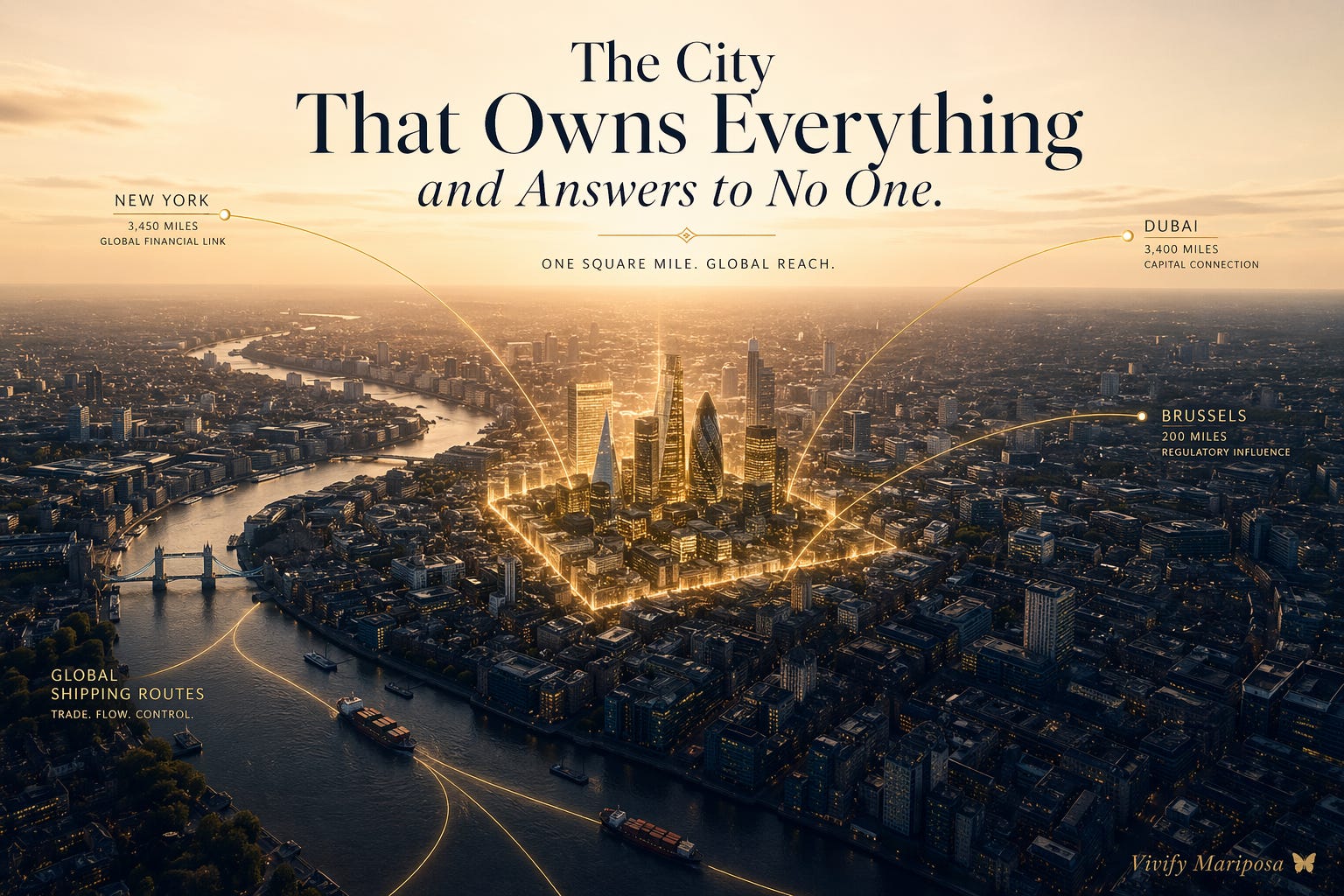
No family name. No founder. No face. A charter from 1067. No single person to blame. No face to put on a pamphlet. And 800 years of accumulated wealth in a private fund that no transparency law has ever touched.

The Rothschilds were the visible hand.

The City learned to have no hand at all.


The Architecture of Invisibility

The City of London Corporation runs on a structure that no democracy would design and no democracy has been able to dismantle.

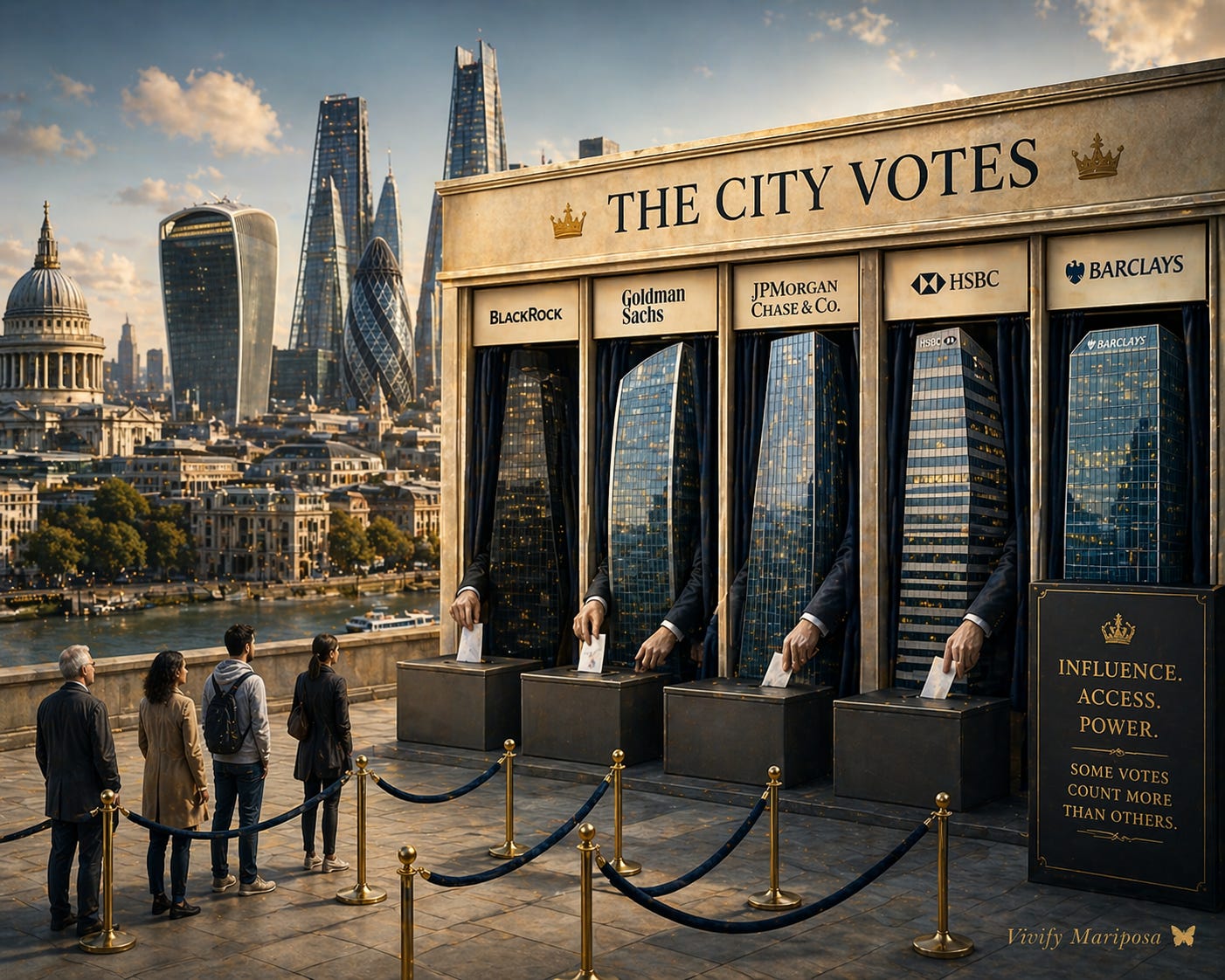
Corporations vote in its elections. Prior to 2002, businesses held 17,000 votes. A legal change expanded this to 32,000 votes and granted voting rights to international and multinational corporations. The people who live in the Square Mile are outvoted by the companies registered there. The Lord Mayor is required to contribute from their own personal finances to the costs of the mayoral year. Only the wealthiest can afford to run.

All candidates stand as independents. No political party. No platform. No accountability to voters.


The Corporation’s primary fund, the City’s Cash, is 800 years old. Not subject to transparency laws. In a single year it spent £3.9 million shaping legislation in Westminster, Whitehall and Brussels. Nobody voted on that. Nobody approved it. Nobody could even request the details.

When investigators asked for records, the Corporation responded: “The information that you have requested is outside the scope of the Freedom of Information Act. All costs for the Mayoralty are provided through non-public funds.”

The Rothschilds had to answer to pamphlets.

The City does not answer at all.
 

The Lesson They Learned​

Before the City of London became invisible, there was a family that was not.​


The Rothschild family financed the British government’s war against Napoleon. Supplied Wellington’s armies with gold when the Crown could not. In 1825, when the Bank of England ran so low on gold it was days from collapse, a private family bailed it out. The institution that was supposed to control the national currency needed a private family to keep it alive.

The Rothschild name was on every transaction. Every government loan. Every subsidy to every army. Every bond issued for every war. Their couriers moved faster than governments. Their information network beat every intelligence service in Europe.

And that visibility destroyed them.

A British MP stood in Parliament in 1828 and named Nathan Rothschild directly as the man who controlled European credit and could determine war or peace. The name was in pamphlets. In newspapers. In political speeches. In propaganda.

When you have a name, you have a target.


The Rothschild hegemony over European finance broke in the 1870s. Not because they ran out of money. Because the system learned to replicate their function without them. Central banks took over what private banking dynasties had done. The function survived. The family did not.

The City of London absorbed that lesson completely.

No family name. No founder. No face. A charter from 1067. No single person to blame. No face to put on a pamphlet. And 800 years of accumulated wealth in a private fund that no transparency law has ever touched.

The Rothschilds were the visible hand.

The City learned to have no hand at all.


The Architecture of Invisibility​

The City of London Corporation runs on a structure that no democracy would design and no democracy has been able to dismantle.

Corporations vote in its elections. Prior to 2002, businesses held 17,000 votes. A legal change expanded this to 32,000 votes and granted voting rights to international and multinational corporations. The people who live in the Square Mile are outvoted by the companies registered there. The Lord Mayor is required to contribute from their own personal finances to the costs of the mayoral year. Only the wealthiest can afford to run.

All candidates stand as independents. No political party. No platform. No accountability to voters.


The Corporation’s primary fund, the City’s Cash, is 800 years old. Not subject to transparency laws. In a single year it spent £3.9 million shaping legislation in Westminster, Whitehall and Brussels. Nobody voted on that. Nobody approved it. Nobody could even request the details.

When investigators asked for records, the Corporation responded: “The information that you have requested is outside the scope of the Freedom of Information Act. All costs for the Mayoralty are provided through non-public funds.”

The Rothschilds had to answer to pamphlets.

The City does not answer at all.
Screenshot_20260709_094030_Truth Social.jpg
 

The Lesson They Learned​

Before the City of London became invisible, there was a family that was not.​


The Rothschild family financed the British government’s war against Napoleon. Supplied Wellington’s armies with gold when the Crown could not. In 1825, when the Bank of England ran so low on gold it was days from collapse, a private family bailed it out. The institution that was supposed to control the national currency needed a private family to keep it alive.

The Rothschild name was on every transaction. Every government loan. Every subsidy to every army. Every bond issued for every war. Their couriers moved faster than governments. Their information network beat every intelligence service in Europe.

And that visibility destroyed them.

A British MP stood in Parliament in 1828 and named Nathan Rothschild directly as the man who controlled European credit and could determine war or peace. The name was in pamphlets. In newspapers. In political speeches. In propaganda.

When you have a name, you have a target.


The Rothschild hegemony over European finance broke in the 1870s. Not because they ran out of money. Because the system learned to replicate their function without them. Central banks took over what private banking dynasties had done. The function survived. The family did not.

The City of London absorbed that lesson completely.

No family name. No founder. No face. A charter from 1067. No single person to blame. No face to put on a pamphlet. And 800 years of accumulated wealth in a private fund that no transparency law has ever touched.

The Rothschilds were the visible hand.

The City learned to have no hand at all.


The Architecture of Invisibility​

The City of London Corporation runs on a structure that no democracy would design and no democracy has been able to dismantle.

Corporations vote in its elections. Prior to 2002, businesses held 17,000 votes. A legal change expanded this to 32,000 votes and granted voting rights to international and multinational corporations. The people who live in the Square Mile are outvoted by the companies registered there. The Lord Mayor is required to contribute from their own personal finances to the costs of the mayoral year. Only the wealthiest can afford to run.

All candidates stand as independents. No political party. No platform. No accountability to voters.


The Corporation’s primary fund, the City’s Cash, is 800 years old. Not subject to transparency laws. In a single year it spent £3.9 million shaping legislation in Westminster, Whitehall and Brussels. Nobody voted on that. Nobody approved it. Nobody could even request the details.

When investigators asked for records, the Corporation responded: “The information that you have requested is outside the scope of the Freedom of Information Act. All costs for the Mayoralty are provided through non-public funds.”

The Rothschilds had to answer to pamphlets.

The City does not answer at all.
Screenshot_20260705_135804_Truth Social.jpg
 

The Man No One Talks About

Since 1571 the City of London has kept a man inside Parliament.

His title is the Remembrancer. His job is to make sure that whatever elected representatives decide, the City’s rights and privileges survive intact. He monitors every piece of legislation. His department employs six lawyers to scrutinize prospective laws and give evidence to select committees. The Remembrancer’s budget in 2011 was £6 million.

Nicholas Shaxson, author of Treasure Islands, calls him “the world’s oldest institutional lobbyist.”


Clement Attlee, Labour Prime Minister from 1945 to 1951, wrote in 1937 before he took office: “Over and over again we have seen that there is in this country another power than that which has its seat at Westminster. The City of London, a convenient term for a collection of financial interests, is able to assert itself against the government of the country.”

Attlee became Prime Minister. Changed nothing. Left office in 1951. The Remembrancer is still there.

A French magistrate investigating the Elf-Aquitaine scandal named London as the tax haven she found most obstructive: “The City of London, that state within a state which has never transmitted even the smallest piece of usable evidence to a foreign magistrate.”

Not one piece. To any foreign magistrate. Ever.

The Rothschilds had Nathan. One man with a name.

The City has a Remembrancer. Nobody knows his name. Nobody is supposed to.


The Foreign Policy Nobody Voted For

The Lord Mayor of the City of London is not elected by the public. The position rotates through the wealthiest members of the Corporation’s network. He is meant to be apolitical.

In 2019 to 2020 he planned to visit at least 30 countries. That is more foreign visits than the British Foreign Secretary.

His meetings include heads of state. His travel is coordinated with the Foreign Office. Declassified Foreign Office documents show this arrangement has been in place since at least 1975. The Lord Mayor travels. The Foreign Office arranges the meetings. The records are shielded from transparency laws because the travel is paid from private funds.


A US diplomatic cable from 2009 published by WikiLeaks shows the incoming Lord Mayor privately briefing American officials against the Labour Prime Minister’s economic policies. The Lord Mayor is supposed to be apolitical. He was telling another country’s government what to do about his own country’s elected leader.

When Declassified UK filed a Freedom of Information request for the Lord Mayor’s travel schedule, the Corporation blocked it entirely.

The Rothschilds moved gold across Europe through a private courier network.

The City moves policy across the world through a private diplomatic network. And nobody files a Freedom of Information request about gold couriers.
 
Mitch McConnell is reportedly “officially brain dead”.

He was hospitalized on June 14th after being found unconscious.

Very little information on his condition has been released since- only his staff stating that “he is continuing to improve”.

Screenshot_20260709_125413_Truth Social.jpg
 

The Mini-IMF: How Two Presidents (OBAMA and CLINTON) Turned a Generation Into a Country to Be Drained​

The weaponization of higher education finance and the two presidents who put the loan shark behind the badge

Vivify Mariposa
Jun 15, 2026

The Loan Was Once a Tool

My readers asked me to follow the City of London out of its towers and into their own lives. I already showed you the body. The square mile inside London that is not London, that writes the law, prices the debt of whole nations, and rents its offshore pipes to the world. This is the same machine, turned on one person. On you. And it starts with a loan.

When I went to college I took a student loan and I paid it off in two years. No interest touched the balance until the day I graduated. The loan sat quiet while I studied. The moment I finished, I paid it like any honest debt, and it was gone. That was the deal. That was a tool.

You will not find that loan anymore.


What you will find is people online demonizing anyone who wants to be free of the debt. They want to be free, and the crowd calls them lazy, irresponsible, looking for a handout. The loudest line is always the same. My taxes will not pay for your debt.

They were already paying for it. They always have been. The government did not simply hand out these loans. It guaranteed them, funded them, serviced them, wrote the laws that protected them, and absorbed the loss every time one failed. The taxpayer was wired into this debt the day it was issued, standing behind every dollar, carrying the risk the banks were never made to carry. So canceling the debt does not walk the taxpayer into a bill they were never part of. It pulls back the curtain on a bill that was built into the structure from the start. The crowd screaming that they will not pay for someone else’s loan is standing on a bill that already has their name on it. They are not refusing to join the debt. They are refusing to look at the one they already signed.

So let me tell you the real one. Not the story they tell on the news. The story you find when you trace the money the way you trace a crime.

Let me clear one thing out of the way first, because they will reach for it. No one here is arguing that learning has no value. A degree can open a life. That was never the question. The question is why that value had to be turned into a lifetime financial claim on the person who earned it. Why the education and the debt were welded together so tightly that you cannot hold the first without surrendering decades to the second.

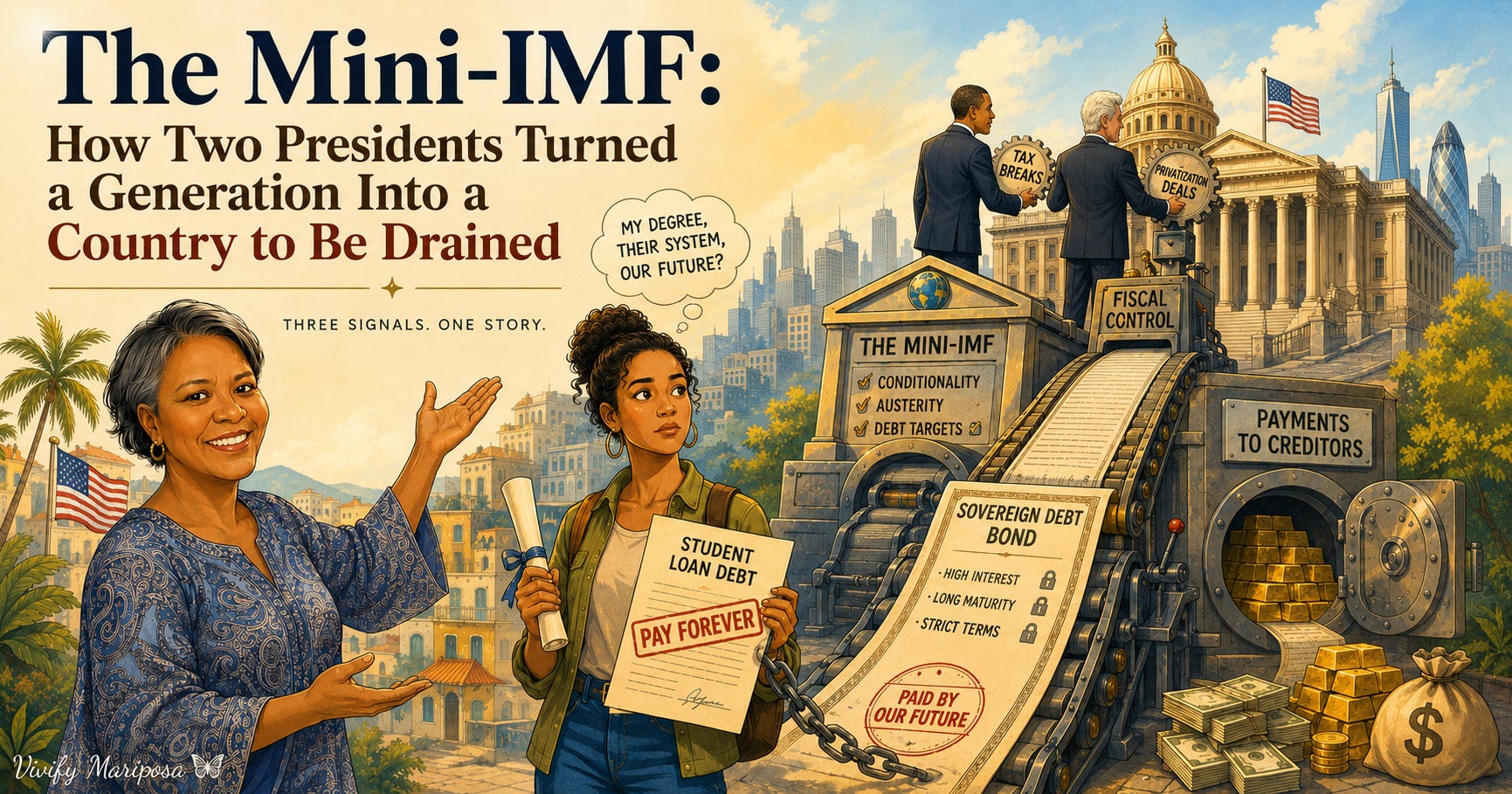
A student loan in America today is a debt you cannot discharge, cannot outlast, cannot fight in court, and cannot escape until the day you die. It is collected by force. It is sold to investors as a bond. It clears through a square mile in London that prices the debt of entire countries. It is the International Monetary Fund, shrunk down and aimed at a single eighteen-year-old. Pay or lose everything. That is the deal nations get. That is the deal the student gets now.

It is a new type of slavery. Not the kind with chains you can see. The kind written in contracts and enforced by the state.

If a private company had built this, it would be a racketeering case. So let me build the case the way an investigator would. The enterprise. The conduct. The money. And the one move that put all of it beyond the reach of any court.
 

The Enterprise

Start with what was built, because the structure is the confession.

A loan is supposed to carry risk on both sides. You borrow, and you might not pay. The lender lends, and might not get it back. That risk is what keeps lending honest. A bank that cannot lose money has no reason to care whether you can pay. It only cares that the law guarantees collection.

That is exactly what they built. A loan stripped of every risk to the lender and loaded with every risk onto the borrower. They did it in pieces, across decades, each piece buried inside a bigger bill the public was looking past. By the time it was finished, the most powerful collection machine in the country was pointed at the youngest, poorest, least informed people in it. Teenagers signing papers they were told they had no future without.


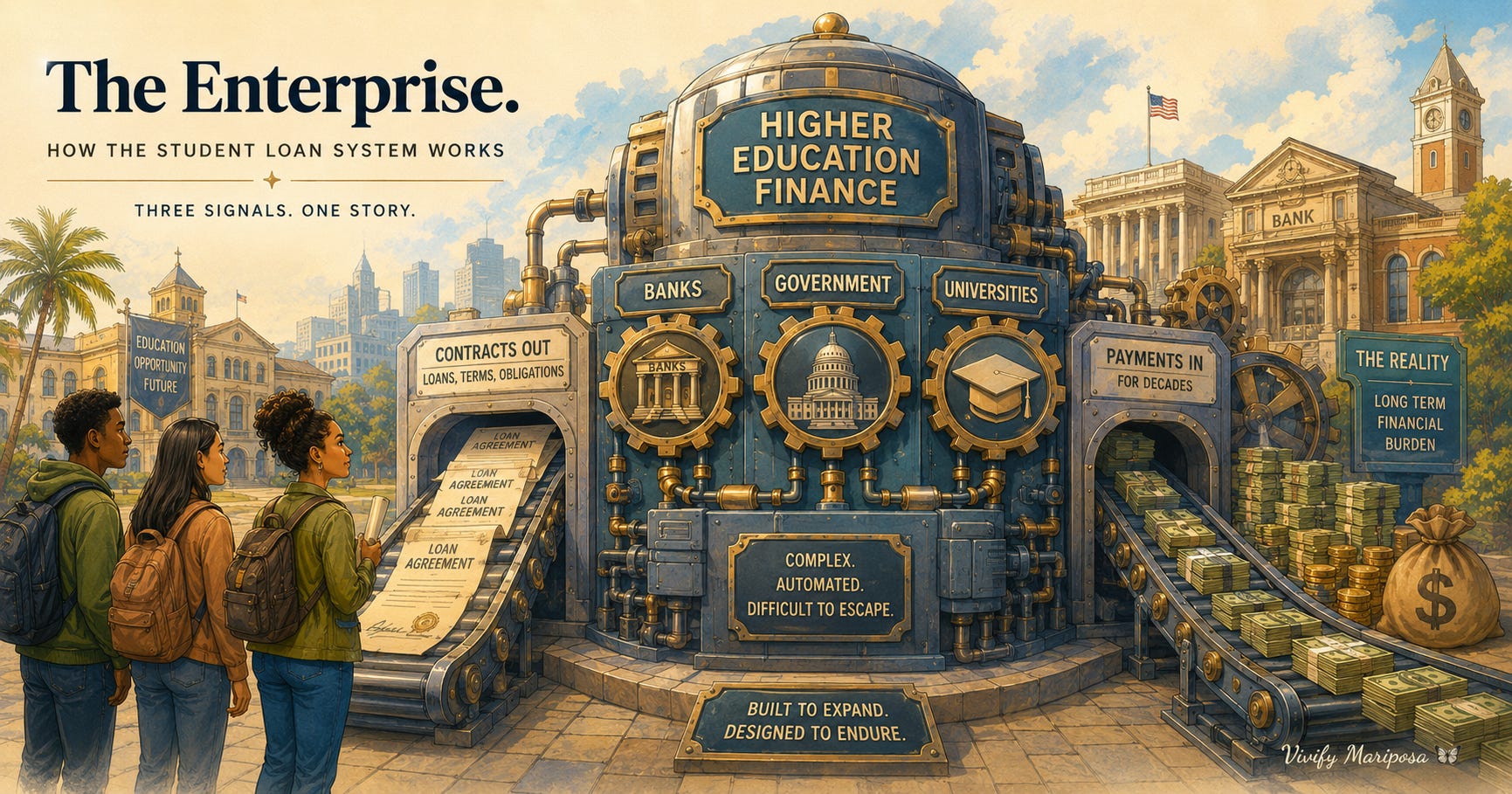
The federal government calls this higher education finance. Trace the mechanics and you find something with a different name in every other corner of the law. An enterprise that issues debt to people who cannot refuse it, structures that debt so it grows faster than they can pay, removes every legal escape, and collects by force for the rest of the borrower’s life. Strip the word education off the front of it and you are looking at the oldest racket there is.

The pieces were laid in order. Each one removed a protection that every other debtor in America still has.
 

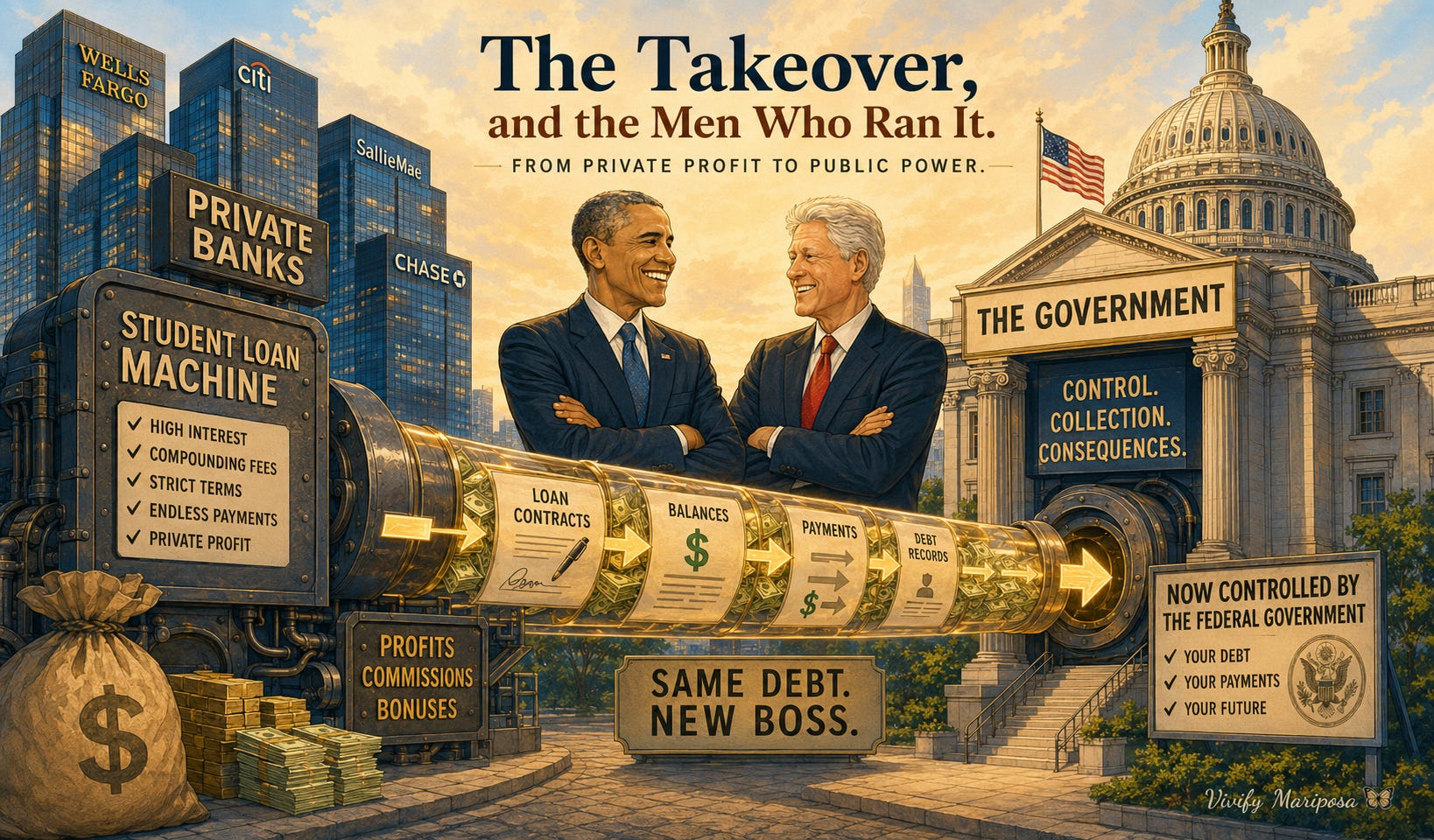
The Takeover, and the Men Who Ran It

Because in 2010 the enterprise did the one thing that makes the case vanish. But to understand that move you have to see who built the product first.

For decades the loans ran through private banks. The bank issued the loan. The government guaranteed it. If the student paid, the bank pocketed the interest. If the student defaulted, the taxpayer reimbursed the bank for almost the entire loss. The bank carried no risk and kept the profit. It was the safest, most guaranteed money on Wall Street, an investment that could not lose.

At the center of it sat Sallie Mae. It began as a public creation, chartered to serve students. Then it was privatized and set loose as a for-profit business trading on the backs of borrowers. It spent millions lobbying Congress to pass the very laws that stripped your bankruptcy rights, protecting its own revenue stream from any disruption. It later split off a collection arm called Navient, the company now accused in court of illegal collection practices and of defrauding the borrowers it was built to manage. The lender that was supposed to serve students became the thing students were warned about, and the man whose administration set that privatization in motion was Bill Clinton.


That is the first name in the case file. He took a public lender meant to serve students and helped turn student debt into a private product sold for profit.

Then came the second move, and the second name.

In 2010 the government cut the private banks out of the federal loan business and made itself the only lender. The official story was savings. Cut out the middleman, save the taxpayer money. The real move was a seizure. The profit center that used to flow to Wall Street now flowed straight to the Treasury. The government did not end the racket. It took the racket for itself.

And it bolted that takeover onto the health care law.

They could not pass Obamacare through the front door. They did not have the votes to break a filibuster. So they used a budget loophole, a process that needs only a bare majority and cannot be blocked, but that comes with a condition. To use it, the bill has to show budget savings. The student loan takeover, by killing the guaranteed payments to private banks, produced the savings on paper. So they fused the two together. The seizure of the student loan market became the financial engine that qualified the health care law for the loophole. The savings wrung out of a generation’s debt were routed into funding Obamacare.

One vote. Two operations. The public was told it was about health care.

That is the second name. Barack Obama nationalized the student loan market, tied it to his signature law, and pushed both through with a method built to keep the public out of the decision. And he knew. The savings were scored in advance by the government’s own number crunchers. The loophole was chosen on purpose precisely because it dodged an open vote. He signed it understanding that the student debt machine was the fuel that made the rest of it legal.
 

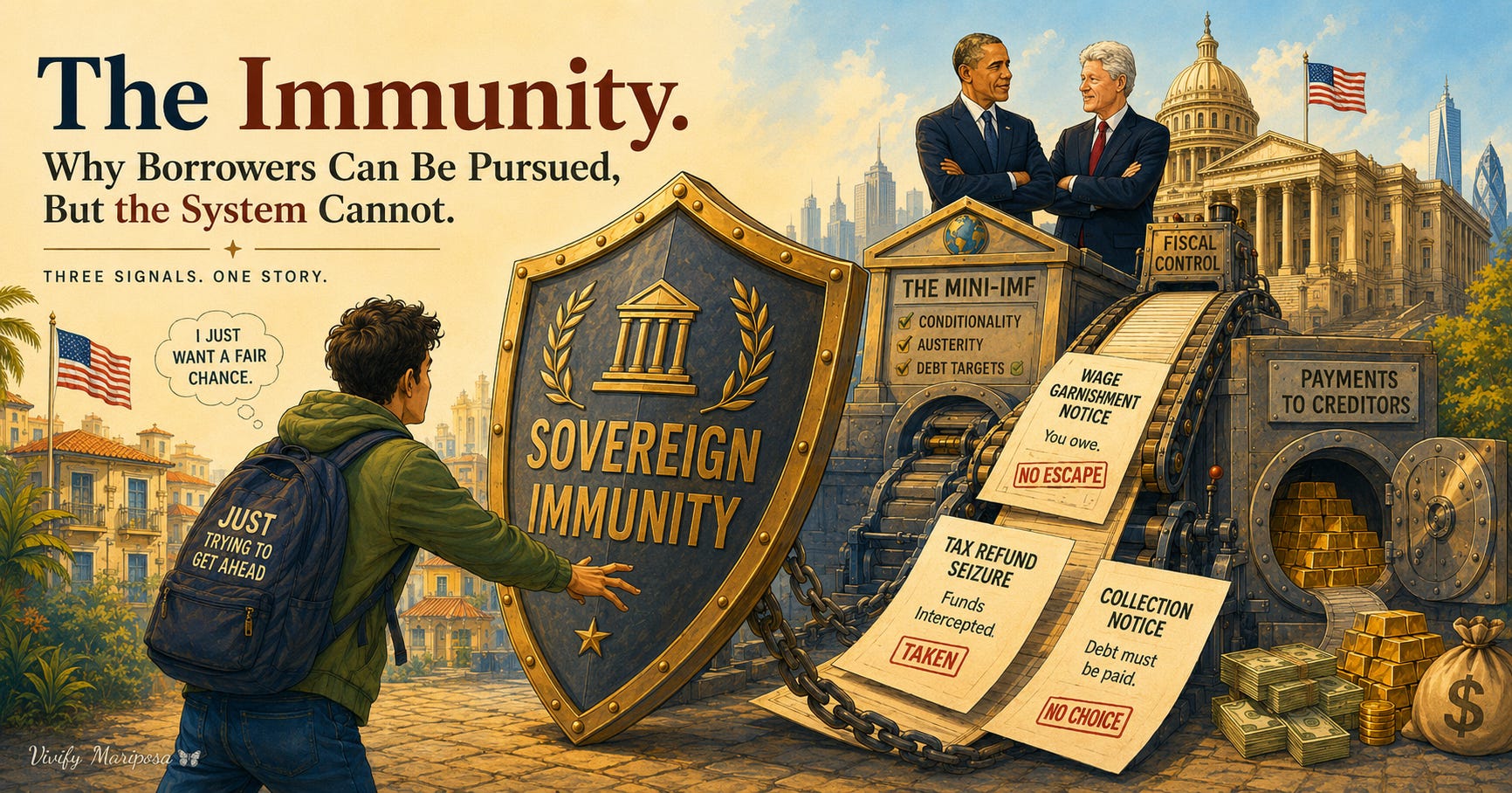
The Immunity

Here is the move that ends the prosecution before it starts.

When the government took over the loans in 2010, it did not just change who held the paper. It changed who you are allowed to challenge. A private bank that defrauds you can be sued. You can hire a lawyer, file in court, and drag it before a judge. The moment the debt became a direct obligation to the state, that door closed.


You cannot sue the United States unless the United States gives you permission. It is called sovereign immunity, and it is the oldest shield in the law. The same machine that uses extrajudicial power to seize your wages without a judge is itself protected from being judged. It can reach you. You cannot reach it.

And the debt did not just move behind that shield. It moved onto the national balance sheet. It became part of the federal books, more than a trillion and a half dollars of it. So now, when anyone proposes wiping it out or breaking the trap, the answer comes back dressed as fiscal responsibility. We cannot cancel it. It would explode the deficit. It would threaten the nation’s finances. The debt was wired directly into the survival of the state, so that fighting the lender now means fighting the country.


That is the genius of it, and the crime of it. A loan shark on a corner can be arrested. A loan shark that becomes the government cannot. The conduct did not change when the operation moved inside the sovereign. The wage garnishment without a judge did not become fair. The debt that never dies did not become just. The only thing that changed is that there is no longer anyone you are permitted to charge.

If Clinton and Obama had run this enterprise as a corporation, with these exact mechanics, they would answer for it in a federal courtroom under racketeering law. Extortion. Collection of unlawful debt. The elements are all there and they are not subtle. A chief executive who built a debt machine that grows faster than borrowers can pay, that cannot be escaped, that is collected by force, and that he personally fused to another product to make the numbers work, would be in a prison cell. These two are not in cells. One has a presidential library. The other is building his. The badge is the only difference between them and the man you would call a racketeer.
 
Back
Top