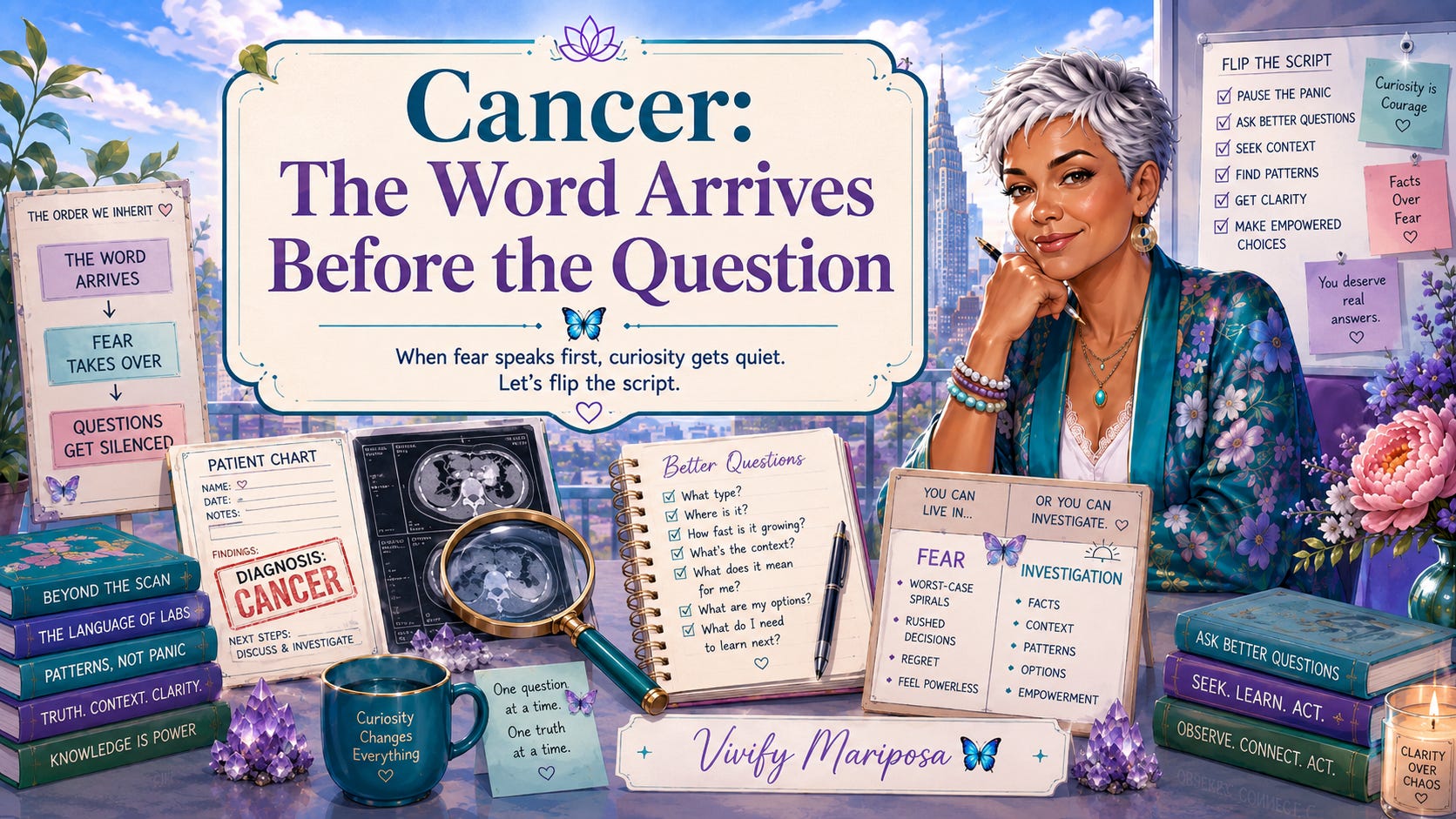
Cancer: The Word Arrives Before the Question
I already wrote about what the word cancer does to people in
Cancer, Obedience, and the Files Nobody Answered, so I am not going to repeat that investigation here. But something happened to me recently that made me see the same mechanism from another angle. I had a horrible reaction to infrared light. My left leg was badly burned, what I describe as a third-degree burn, and the same thing happened to my left breast. One healed faster than the other. If I show you my leg, everybody sees a burn. They ask what happened.
They can see the damaged tissue and the healing. But if I show you the breast, suddenly people stop seeing an injury and start seeing cancer. They tell me to see a doctor. Why? It is the same body. Why does the location change the logic? Why can the leg be injured, inflamed, burned and healing, but the moment something abnormal happens to a breast the first word people have been trained to reach for is cancer? Everything in the body that is abnormal is not cancer. The question "what happened?" gets replaced by "which label is this?"
Then I saw a CNBC headline about Moderna developing a cancer vaccine, and I had to laugh because the joke writes itself. Cancer is one of the words people have been trained to fear the most because the moment they hear it they immediately think death, and once fear enters the room critical thinking usually leaves. So now the answer is another vaccine? You are telling me that in order not to get cancer, or to treat cancer, I should inject another manufactured product into my body and apparently I am not supposed to ask what that product does inside the body years later because the word cancer came first and scared me enough to accept the solution.
Why not tell people to eat healthy? Why not teach them to listen to the body before the body is screaming? Look at populations that eat differently and live differently and have lower cancer rates. Look at the Amish. People want the easy way out and the system is more than happy to sell it to them: eat whatever you want, fill the body with processed garbage for years, sit all day, ignore what the body is telling you, then when something goes wrong wait for somebody to manufacture the rescue and call that science. Why is maintaining the body treated like a side note while the manufactured intervention becomes the exciting answer? Because one requires you to take responsibility for your own body and the other creates a customer. My question is always the same: why?
Then there is another stupidity I keep seeing everywhere: sensory sensitivity, another behavior people now want to put somewhere on the autism spectrum. A child hates noise and immediately somebody starts talking about sensory sensitivity, but why is nobody asking how that child lived from the moment they were born? If the adults around a baby never make noise, keep everything quiet, protect the child from normal sounds and never allow that child to experience the environment around them, then later the child cannot tolerate noise and suddenly the explanation becomes sensory sensitivity instead of lack of living and lack of exposure. Again, the label replaces the question. Nobody asks what happened before the behavior appeared.
They just name the behavior, connect it to another spectrum, and move on as though giving something a name explained where it came from.
I understand this because I experienced something similar with caffeine. As a child I was always drinking coffee, and I continued drinking it as an adult. After college, something changed. I probably oversaturated my body with caffeine and eventually my body said stop. The reactions became terrible. I would feel faint, my body would shake, and I would have neurological reactions from caffeine. So I stopped drinking it. But then something interesting happened: once I stopped completely, even a small amount of caffeine would create the reaction again. Anything containing caffeine became a problem. Eventually I looked at that and said, this is not normal. My body had consumed coffee for years without reacting that way, so why should I simply accept that suddenly caffeine had become something my body could never tolerate again? I introduced coffee again, little by little, and today I do not faint, I do not shake and I do not have that neurological response anymore. I listened to my body instead of accepting a permanent label for what my body was doing at one particular moment.
That experience changed how I look at the brain too. I learned that the brain takes time to repair itself. After a stroke, for example, somebody can lose abilities that were automatic before, including the ability to swallow properly or get oxygen the way the body normally does. Doctors do not always have the time to wait for the body to repair itself, and many people are given terrible predictions about how long they will live or what they will never do again. But think about the logic. If the problem is that the person cannot swallow food, food can still be given another way. If the person cannot get enough oxygen, oxygen can be provided. Those functions can be supported while the body and brain are doing whatever they are capable of doing. Yet people hear a doctor’s prediction and treat it like God has personally announced the expiration date.
Why? A doctor can tell you what they are seeing at that moment. They cannot tell you with certainty what your body will do tomorrow, six months from now or a year from now.
This is why I say something that makes people uncomfortable: if you follow medicine blindly, you are dead. If you ignore the fear and start listening to your own body, you may add days or years to your life. Surgery has a purpose. If something is broken and needs to be put back into place, I understand that. If something needs repair, repair it. But the moment somebody tells me the solution is simply to remove a part of my body, I do not look at that the same way. I want to know why. I want to know what happened to it. I want to know what the body is trying to do before somebody decides the body part itself is the problem.
Think about something as simple as a boil. When people have one outside the body, they are constantly warned not to start cutting and opening it themselves because they can make the situation worse. Yet when something abnormal appears inside the body, suddenly cutting, removing and opening become normal parts of the conversation. Why? Why does the logic change because I cannot see what is happening with my own eyes? Why does something inside me automatically become property of the medical system to name, remove, treat or frighten me about? I am still going to ask what caused it. I am still going to ask what changed. I am still going to ask whether the body is reacting, protecting itself, repairing itself or trying to tell me something before I accept that the answer is to remove something from it.
I was born to die. That is the one thing I know nobody can save me from, so why would I spend my life stressing over something I have absolutely no control over? When it is my time, it is my time. It will not matter how many healthy drinks I had, how many supplements I took, how many doctors I visited, how many vaccines somebody convinced me to inject or how many surgeries somebody performed. I am still going to die. And in the process of trying desperately not to die, people can accelerate the very thing they are terrified of. Stress will kill you faster than any doctor with all his vaccines, pills and surgery could save you if you spend your entire life terrified of dying. Fear changes how you sleep, how you eat, how you think and how you react to everything happening inside your body.
Yet people will allow a doctor with vaccines, pills and surgery to frighten them every day about death while never stopping to ask what that constant fear itself is doing to them.
And that is what medicine has learned to sell extremely well: dying slower. I will not call it modern medicine, because I see it as the medicine Rockefeller made sure became the system, a system that turned the human body into a permanent client and made millions for the legacy built around it. Keep people afraid of disease, teach them that every abnormality requires an expert, every symptom requires a name, every diagnosis requires treatment, every treatment requires another appointment, another prescription, another test, another intervention, and eventually the person no longer owns their body because somebody else has become the authority over everything happening inside it. That is a perfect customer. Not somebody who understands their body, questions what changed, learns how to maintain it and asks why. A perfect customer is somebody afraid enough to keep coming back.



 nordot.app