

You are using an out of date browser. It may not display this or other websites correctly.
You should upgrade or use an alternative browser.
You should upgrade or use an alternative browser.
Today in Fascism
- Thread starter Hüsker Dü
- Start date



kickingandscreaming
PREMIER
Looks like the Dems found a candidate that still doesn’t live in mom’s basement.
These are nasty people.
TINA PETERS: “JUST SAY YOU LIED.” SHE REFUSED.
On Going Rogue with Lara Logan, Gold Star mother and former Mesa County Clerk Tina Peters shares that she was given opportunities to make her legal troubles disappear—if she would simply say she had lied.
Peters says she refused.
“I don’t lie.”
She reflects on the price she says she paid for standing by the truth, from prison and personal loss to the unwavering belief that faithfulness is worth any cost. Peters explains why she believes living in fear is far worse than suffering for what you know is right, and why she hopes others will find the courage to stand for something greater than themselves. Amen To Tina. What a brave lady.
TINA PETERS: “JUST SAY YOU LIED.” SHE REFUSED.
On Going Rogue with Lara Logan, Gold Star mother and former Mesa County Clerk Tina Peters shares that she was given opportunities to make her legal troubles disappear—if she would simply say she had lied.
Peters says she refused.
“I don’t lie.”
She reflects on the price she says she paid for standing by the truth, from prison and personal loss to the unwavering belief that faithfulness is worth any cost. Peters explains why she believes living in fear is far worse than suffering for what you know is right, and why she hopes others will find the courage to stand for something greater than themselves. Amen To Tina. What a brave lady.
Can you blame them? They have a nice pair of kids, one of each.These control freaks and psychopaths are all over the world. They want the kids DNA, Mind and Soul!!!
Brazilian parents facing PRISON for homeschooling their own daughters (15 & 11).
Court ruling: “Intellectual neglect.” Their crime? Refusing to include state-mandated “gender and sex education” plus “tolerance and diversity” indoctrination in the family curriculum.
The government doesn’t just want to tax you. It wants to own your kids’ minds and will throw you in a cage if you resist.
This is what socialism (Communism) looks like, folks. Read the shit from Dad4, Du Du, EOTL & espola and you get a taste of what would have happen to our country if folks like crush were not willing to lose everything to prove a point that the unvaccinated are not the problem on earth.
Nanny state totalitarianism disguised as “education.” Your children are not property of any regime.
Reject the nanny state. Defend parental rights.
View attachment 39592
Girl who was allegedly sexually harassed by trans athlete in SCOTUS case speaks out after historic ruling
The Bridgeport High School student says her West Virginia school district ignored her locker room harassment report
EOTL (The espola Party) demanded that dudes be allowed to go into girls locker rooms. Insane that this is even a debate but like Joel said, "In the last days, good will be called evil and evil good. Folks, this is not good for any girl.
"When Adaleia first told us, she told us that [the trans athlete] was telling her and other girls ‘suck my dick,’" Cross's mother, Abby Cross alleged in December. "[The trans athlete] was saying to her, coming up and saying to her, ‘I’m going to stick my dick in your pussy and also in your ass.' At different times [the trans athlete] was saying these things to her." Her Parents

Hüsker Dü
DA
A few hundred men put on masks and marched through the capital on the Fourth of July, and the city called it a right. White cloth, sunglasses, beige caps, a uniform issued like a threat. They carried the American flag and the Confederate flag in the same hands without apparent contradiction. They chanted about taking the country back from the people who built it. The nation watched the footage and told itself it had finally seen the enemy. It had not. The mask was the least dangerous thing those men had on.
White supremacy has never needed the mask. Its most enduring work is done with the face bare, in a pressed suit, complimenting the meal before arguing the cook should be deported. The men in the street have simply not learned what the movement’s most effective advocates understood long ago. In America, you are believed in proportion to how quietly you say the unforgivable thing.
In the second season premiere of Huang’s World, which aired in the summer of 2017, weeks before the torches came out in Charlottesville and nearly a decade before the masks appeared in Washington, Eddie Huang sat across a table from Jared Taylor, the founder of American Renaissance and one of the most polished faces of modern white nationalism. Between them was Asian food. The choice was never explained. It did not need to be.
Taylor has spent decades sanding the language of hate down until it passes at a dinner party. He does not shout. He does not use the words his grandfather used. Huang asks how a man so devoted to facts could vote for a campaign built on none, and Taylor answers without a flicker.
“I voted for Donald Trump for one reason only. His policies, if implemented, would slow the dispossession of whites in the United States.”
He goes on in the same even register, talking about deporting every undocumented immigrant and thinking hard before admitting any Muslims, all of it intended to slow the rate at which whites become a minority. There is no venom in the delivery, nothing you could point to later as the moment it turned ugly. He could be reading the weather.
Huang asks why the prospect frightens him.
“Because I want my people to survive. Is that so strange?”
He explains that whites control nothing in the places where they are not the majority, that becoming a minority means losing the country for good. He poses it as though it were a fair question. To a certain kind of listener, it already sounds like one. Strip away the civility and the claim underneath is ancient. Not power exactly. Primacy. The right to decide who counts as the country and who lives here on sufferance.
Huang does not interrupt him. Extremism expects a fight. Huang lets it keep talking.
Nothing dramatic happens, and that is the horror of it. There is no catharsis, no moment where the ideology buckles under its own contradictions. The conversation remains civil while the food sits between them like a charge waiting to be read aloud. Taylor eats. He compliments the meal. He does not notice, or will not, that he is consuming a culture he has spent a career insisting does not belong.
This is the whole of it. White supremacy has never objected to culture. It objects to people. It will eat the food, wear the clothes, borrow the music, and profit from the labor of every group it has ranked beneath it. The problem was never proximity. It was equality. The man at the table is not asking the cook to leave the kitchen. He is asking her to stay in it forever.
Huang does not try to argue Taylor into shame. He asks questions and lets Taylor draw the line himself, the clean line between consumption and belonging.
Take the culture. Bury the people.
The country was built on that line and has never stopped pouring the foundation. Labor gets used. The aesthetics get adopted. The food gets enjoyed. The people remain peripheral, conditional, grateful for the scraps of recognition that fall from the table they set. Huang, sitting there, breaks the spell. He is not asking permission. He is not performing gratitude. He is simply present, whole, and impossible to reduce to a product.
Think about who Taylor means when he says my people. Among those excluded are the descendants of the Choctaw, who, scarcely fifteen years after the government drove them from their own land and left their dead along the road, took up a collection for strangers starving across the Atlantic and sent every dollar of it to Ireland. The men Taylor comes from could not have managed that on their finest day. The people he wants kept in the kitchen already proved they possess the thing his whole philosophy insists they lack. He has to look straight past it. The argument survives only if he refuses to see the humanity that keeps interrupting it.
That is the labor his composure is doing. He does not resemble the monster the culture taught you to picture. He looks like a neighbor. A colleague. The man one table over at the restaurant, ordering in a low voice, generous with the waiter. He learned that respectability is the most effective disguise exclusion ever wore, and that some of the cruelest decisions in this country’s history were made in quiet rooms by men in good suits. The audience that hears him and nods was not born nodding. It was taught, slowly and expensively, to mistake restraint for reason and abstraction for honesty.
The food never becomes a metaphor for unity. It becomes evidence.
Taylor never reconsiders. There is no redemption arc because the ideology does not require one. It survives perfectly well inside good manners. It knows how to pass the plate while arguing that the woman who prepared the meal has no place in the country where it is served.
We live in a decade that dresses exclusion as procedure. It calls itself a policy debate, a cultural preference, an administrative concern. It is defended by people who would be genuinely offended to hear themselves called hateful. Huang drags the argument out of the abstract and places it across the table from the body it intends to remove.
The men in Washington skipped that step. They wanted the spectacle without the consequence, the threat without accountability. And the country, watching, felt relief, because a masked column carrying Confederate flags through the nation’s capital on Independence Day is a sentence a child can read. We know that monster. We prefer knowing where he is. The mask flatters us. It promises that hatred still has the decency to look like hatred, that it marches in formation, that it announces itself before it arrives.
It does not.
I wrote earlier this year about Reconstruction, about the men who ended it and thought of themselves not as architects but as restorers. Taylor is their grandson in argument, if not in blood. The grammar has been updated. The thesis has not.
The country he wants is the one those men nearly kept, and the polished voice he uses echoes the lawyers who defended segregation from courtrooms and the legislators who emptied polling places with statutes instead of rifles. This time the state did not stand against the marchers. It escorted them. It logged their route, called it speech, and announced with something close to pride that no one had been harmed, as though harm had ever been measured only by what happened that afternoon.
Around midday they boarded commuter trains, rode out to the Maryland suburbs, peeled the cloth from their faces, and disappeared into ordinary life.
Future historians will not spend much time on the masks. They rarely do. They will spend their time on the people who mistook them for the important part.
White supremacy has never needed the mask. Its most enduring work is done with the face bare, in a pressed suit, complimenting the meal before arguing the cook should be deported. The men in the street have simply not learned what the movement’s most effective advocates understood long ago. In America, you are believed in proportion to how quietly you say the unforgivable thing.
In the second season premiere of Huang’s World, which aired in the summer of 2017, weeks before the torches came out in Charlottesville and nearly a decade before the masks appeared in Washington, Eddie Huang sat across a table from Jared Taylor, the founder of American Renaissance and one of the most polished faces of modern white nationalism. Between them was Asian food. The choice was never explained. It did not need to be.
Taylor has spent decades sanding the language of hate down until it passes at a dinner party. He does not shout. He does not use the words his grandfather used. Huang asks how a man so devoted to facts could vote for a campaign built on none, and Taylor answers without a flicker.
“I voted for Donald Trump for one reason only. His policies, if implemented, would slow the dispossession of whites in the United States.”
He goes on in the same even register, talking about deporting every undocumented immigrant and thinking hard before admitting any Muslims, all of it intended to slow the rate at which whites become a minority. There is no venom in the delivery, nothing you could point to later as the moment it turned ugly. He could be reading the weather.
Huang asks why the prospect frightens him.
“Because I want my people to survive. Is that so strange?”
He explains that whites control nothing in the places where they are not the majority, that becoming a minority means losing the country for good. He poses it as though it were a fair question. To a certain kind of listener, it already sounds like one. Strip away the civility and the claim underneath is ancient. Not power exactly. Primacy. The right to decide who counts as the country and who lives here on sufferance.
Huang does not interrupt him. Extremism expects a fight. Huang lets it keep talking.
Nothing dramatic happens, and that is the horror of it. There is no catharsis, no moment where the ideology buckles under its own contradictions. The conversation remains civil while the food sits between them like a charge waiting to be read aloud. Taylor eats. He compliments the meal. He does not notice, or will not, that he is consuming a culture he has spent a career insisting does not belong.
This is the whole of it. White supremacy has never objected to culture. It objects to people. It will eat the food, wear the clothes, borrow the music, and profit from the labor of every group it has ranked beneath it. The problem was never proximity. It was equality. The man at the table is not asking the cook to leave the kitchen. He is asking her to stay in it forever.
Huang does not try to argue Taylor into shame. He asks questions and lets Taylor draw the line himself, the clean line between consumption and belonging.
Take the culture. Bury the people.
The country was built on that line and has never stopped pouring the foundation. Labor gets used. The aesthetics get adopted. The food gets enjoyed. The people remain peripheral, conditional, grateful for the scraps of recognition that fall from the table they set. Huang, sitting there, breaks the spell. He is not asking permission. He is not performing gratitude. He is simply present, whole, and impossible to reduce to a product.
Think about who Taylor means when he says my people. Among those excluded are the descendants of the Choctaw, who, scarcely fifteen years after the government drove them from their own land and left their dead along the road, took up a collection for strangers starving across the Atlantic and sent every dollar of it to Ireland. The men Taylor comes from could not have managed that on their finest day. The people he wants kept in the kitchen already proved they possess the thing his whole philosophy insists they lack. He has to look straight past it. The argument survives only if he refuses to see the humanity that keeps interrupting it.
That is the labor his composure is doing. He does not resemble the monster the culture taught you to picture. He looks like a neighbor. A colleague. The man one table over at the restaurant, ordering in a low voice, generous with the waiter. He learned that respectability is the most effective disguise exclusion ever wore, and that some of the cruelest decisions in this country’s history were made in quiet rooms by men in good suits. The audience that hears him and nods was not born nodding. It was taught, slowly and expensively, to mistake restraint for reason and abstraction for honesty.
The food never becomes a metaphor for unity. It becomes evidence.
Taylor never reconsiders. There is no redemption arc because the ideology does not require one. It survives perfectly well inside good manners. It knows how to pass the plate while arguing that the woman who prepared the meal has no place in the country where it is served.
We live in a decade that dresses exclusion as procedure. It calls itself a policy debate, a cultural preference, an administrative concern. It is defended by people who would be genuinely offended to hear themselves called hateful. Huang drags the argument out of the abstract and places it across the table from the body it intends to remove.
The men in Washington skipped that step. They wanted the spectacle without the consequence, the threat without accountability. And the country, watching, felt relief, because a masked column carrying Confederate flags through the nation’s capital on Independence Day is a sentence a child can read. We know that monster. We prefer knowing where he is. The mask flatters us. It promises that hatred still has the decency to look like hatred, that it marches in formation, that it announces itself before it arrives.
It does not.
I wrote earlier this year about Reconstruction, about the men who ended it and thought of themselves not as architects but as restorers. Taylor is their grandson in argument, if not in blood. The grammar has been updated. The thesis has not.
The country he wants is the one those men nearly kept, and the polished voice he uses echoes the lawyers who defended segregation from courtrooms and the legislators who emptied polling places with statutes instead of rifles. This time the state did not stand against the marchers. It escorted them. It logged their route, called it speech, and announced with something close to pride that no one had been harmed, as though harm had ever been measured only by what happened that afternoon.
Around midday they boarded commuter trains, rode out to the Maryland suburbs, peeled the cloth from their faces, and disappeared into ordinary life.
Future historians will not spend much time on the masks. They rarely do. They will spend their time on the people who mistook them for the important part.

Bruddah IZ
DA
What he is really saying is that the Globalist are trying to assassinate him because he is cutting off the Trust Fund Globalist Finances.Iran and The espola Party (The Left) want Trump killed. They want crush dead. They want the rest of you sick and obedient.
View attachment 39609
Bruddah IZ
DA
A few hundred men put on masks and marched through the capital on the Fourth of July, and the city called it a right. White cloth, sunglasses, beige caps, a uniform issued like a threat. They carried the American flag and the Confederate flag in the same hands without apparent contradiction. They chanted about taking the country back from the people who built it. The nation watched the footage and told itself it had finally seen the enemy. It had not. The mask was the least dangerous thing those men had on.
White supremacy has never needed the mask. Its most enduring work is done with the face bare, in a pressed suit, complimenting the meal before arguing the cook should be deported. The men in the street have simply not learned what the movement’s most effective advocates understood long ago. In America, you are believed in proportion to how quietly you say the unforgivable thing.
In the second season premiere of Huang’s World, which aired in the summer of 2017, weeks before the torches came out in Charlottesville and nearly a decade before the masks appeared in Washington, Eddie Huang sat across a table from Jared Taylor, the founder of American Renaissance and one of the most polished faces of modern white nationalism. Between them was Asian food. The choice was never explained. It did not need to be.
Taylor has spent decades sanding the language of hate down until it passes at a dinner party. He does not shout. He does not use the words his grandfather used. Huang asks how a man so devoted to facts could vote for a campaign built on none, and Taylor answers without a flicker.
“I voted for Donald Trump for one reason only. His policies, if implemented, would slow the dispossession of whites in the United States.”
He goes on in the same even register, talking about deporting every undocumented immigrant and thinking hard before admitting any Muslims, all of it intended to slow the rate at which whites become a minority. There is no venom in the delivery, nothing you could point to later as the moment it turned ugly. He could be reading the weather.
Huang asks why the prospect frightens him.
“Because I want my people to survive. Is that so strange?”
He explains that whites control nothing in the places where they are not the majority, that becoming a minority means losing the country for good. He poses it as though it were a fair question. To a certain kind of listener, it already sounds like one. Strip away the civility and the claim underneath is ancient. Not power exactly. Primacy. The right to decide who counts as the country and who lives here on sufferance.
Huang does not interrupt him. Extremism expects a fight. Huang lets it keep talking.
Nothing dramatic happens, and that is the horror of it. There is no catharsis, no moment where the ideology buckles under its own contradictions. The conversation remains civil while the food sits between them like a charge waiting to be read aloud. Taylor eats. He compliments the meal. He does not notice, or will not, that he is consuming a culture he has spent a career insisting does not belong.
This is the whole of it. White supremacy has never objected to culture. It objects to people. It will eat the food, wear the clothes, borrow the music, and profit from the labor of every group it has ranked beneath it. The problem was never proximity. It was equality. The man at the table is not asking the cook to leave the kitchen. He is asking her to stay in it forever.
Huang does not try to argue Taylor into shame. He asks questions and lets Taylor draw the line himself, the clean line between consumption and belonging.
Take the culture. Bury the people.
The country was built on that line and has never stopped pouring the foundation. Labor gets used. The aesthetics get adopted. The food gets enjoyed. The people remain peripheral, conditional, grateful for the scraps of recognition that fall from the table they set. Huang, sitting there, breaks the spell. He is not asking permission. He is not performing gratitude. He is simply present, whole, and impossible to reduce to a product.
Think about who Taylor means when he says my people. Among those excluded are the descendants of the Choctaw, who, scarcely fifteen years after the government drove them from their own land and left their dead along the road, took up a collection for strangers starving across the Atlantic and sent every dollar of it to Ireland. The men Taylor comes from could not have managed that on their finest day. The people he wants kept in the kitchen already proved they possess the thing his whole philosophy insists they lack. He has to look straight past it. The argument survives only if he refuses to see the humanity that keeps interrupting it.
That is the labor his composure is doing. He does not resemble the monster the culture taught you to picture. He looks like a neighbor. A colleague. The man one table over at the restaurant, ordering in a low voice, generous with the waiter. He learned that respectability is the most effective disguise exclusion ever wore, and that some of the cruelest decisions in this country’s history were made in quiet rooms by men in good suits. The audience that hears him and nods was not born nodding. It was taught, slowly and expensively, to mistake restraint for reason and abstraction for honesty.
The food never becomes a metaphor for unity. It becomes evidence.
Taylor never reconsiders. There is no redemption arc because the ideology does not require one. It survives perfectly well inside good manners. It knows how to pass the plate while arguing that the woman who prepared the meal has no place in the country where it is served.
We live in a decade that dresses exclusion as procedure. It calls itself a policy debate, a cultural preference, an administrative concern. It is defended by people who would be genuinely offended to hear themselves called hateful. Huang drags the argument out of the abstract and places it across the table from the body it intends to remove.
The men in Washington skipped that step. They wanted the spectacle without the consequence, the threat without accountability. And the country, watching, felt relief, because a masked column carrying Confederate flags through the nation’s capital on Independence Day is a sentence a child can read. We know that monster. We prefer knowing where he is. The mask flatters us. It promises that hatred still has the decency to look like hatred, that it marches in formation, that it announces itself before it arrives.
It does not.
I wrote earlier this year about Reconstruction, about the men who ended it and thought of themselves not as architects but as restorers. Taylor is their grandson in argument, if not in blood. The grammar has been updated. The thesis has not.
The country he wants is the one those men nearly kept, and the polished voice he uses echoes the lawyers who defended segregation from courtrooms and the legislators who emptied polling places with statutes instead of rifles. This time the state did not stand against the marchers. It escorted them. It logged their route, called it speech, and announced with something close to pride that no one had been harmed, as though harm had ever been measured only by what happened that afternoon.
Around midday they boarded commuter trains, rode out to the Maryland suburbs, peeled the cloth from their faces, and disappeared into ordinary life.
Future historians will not spend much time on the masks. They rarely do. They will spend their time on the people who mistook them for the important part.


Bruddah IZ
DA
The City That Owns Everything and Answers to No One
Vivify MariposaApr 21, 2026
There is a city inside London that is not London.
One square mile. Its own police force. Its own courts. Its own laws. Its own flag. Its own government that predates the United Kingdom by several hundred years. The Mayor of London has no authority there. Parliament has no authority there. The Prime Minister has no authority there.
It has a charter from 1067.
Nobody alive remembers who founded it.
That is not an accident.
The City of London Corporation owns one of the surviving copies of the Magna Carta. The 1297 copy. With Edward I’s seal. The document that stated the City of London shall have all its ancient liberties by land and by water. The City is the only entity in the Magna Carta named as specifically protected. In 1215, King John was losing a rebellion. Hoping to win the Londoners to his side, he granted them the right to choose their own mayor annually. Weeks later, the same rebellion forced him to sign Magna Carta. The City used the chaos to extract permanent protections for itself. The document that became the foundation of individual liberty in the English-speaking world contains a clause written specifically to protect the City of London from ever being touched.
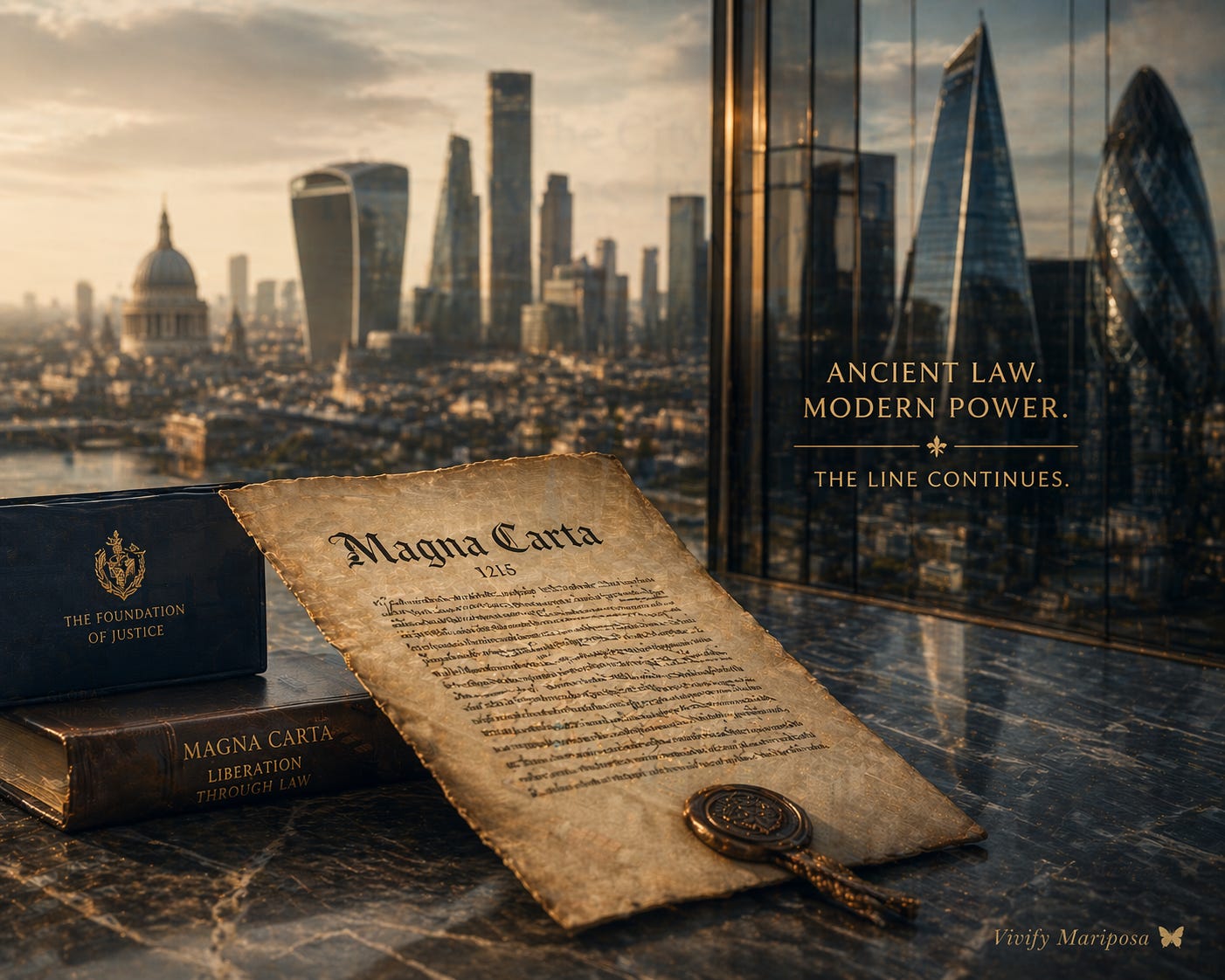
The Magna Carta influenced the framers of the American Declaration of Independence. The City of London owns the Magna Carta. It has owned the document of freedom since 1297. It wrote its own protections into the founding text of Western liberty and has been enforcing those protections ever since.
The liberties in the Magna Carta are the City’s liberties. They were never designed to be anyone else’s.
Bruddah IZ
DA
You keep raising YOUR hand.
Hüsker Dü
DA
Donald Trump hates America.
He’s been talking about communists again.
Not communism. Communists.
He’s not just using the word as a description of an economic ideology. He’s using it as a mechanism of dehumanization and permission.
Communists. Vermin. Enemies within. Radical left lunatics. Scum. Traitors.
The words change. The purpose doesn’t.
Convince millions of Americans that other Americans are not legitimate political opponents. Convince them they are dangerous. Evil. An existential threat. Something contaminating the country that must be expunged.
Donald Trump is not trying to defeat half of America politically. He is teaching his followers to hate them.
And we already know where that can lead.
We watched a mob attack the Capitol after months of lies, escalating rhetoric, and constant demonization.
But the rhetoric didn’t stop.
It escalated.
Then there’s the propaganda infrastructure.
Fox News. Newsmax. Right-wing influencers who spew Russian talking points. Podcasts. Social platforms. The entire Trump-aligned information ecosystem.
Trump says it.
The propaganda machine repeats it.
Millions of people hear it.
Again. And again. And again.
Until Democrat no longer means your neighbor who disagrees with you.
It means enemy.
Immigrants become invaders. Protesters become terrorists. Journalists become enemies of the people. Anyone who refuses loyalty to Donald Trump becomes a communist, traitor, criminal, or threat.
This is how dehumanization works.
You create an enemy. You make people afraid of them. You make people hate them. You repeat the words until millions stop seeing other human beings and begin seeing a threat that must be eliminated.
And eventually, you create permission for whatever happens next.
We don’t have a president who believes he represents all Americans. We have a president who has decided that millions of Americans are his enemies.
It’s the language of a man teaching one half of America to hate the other.
A man who attacks the Constitution, destroys institutions, and turns Americans against one another while demanding their loyalty does not love this country.
Donald Trump hates America.
He’s been talking about communists again.
Not communism. Communists.
He’s not just using the word as a description of an economic ideology. He’s using it as a mechanism of dehumanization and permission.
Communists. Vermin. Enemies within. Radical left lunatics. Scum. Traitors.
The words change. The purpose doesn’t.
Convince millions of Americans that other Americans are not legitimate political opponents. Convince them they are dangerous. Evil. An existential threat. Something contaminating the country that must be expunged.
Donald Trump is not trying to defeat half of America politically. He is teaching his followers to hate them.
And we already know where that can lead.
We watched a mob attack the Capitol after months of lies, escalating rhetoric, and constant demonization.
But the rhetoric didn’t stop.
It escalated.
Then there’s the propaganda infrastructure.
Fox News. Newsmax. Right-wing influencers who spew Russian talking points. Podcasts. Social platforms. The entire Trump-aligned information ecosystem.
Trump says it.
The propaganda machine repeats it.
Millions of people hear it.
Again. And again. And again.
Until Democrat no longer means your neighbor who disagrees with you.
It means enemy.
Immigrants become invaders. Protesters become terrorists. Journalists become enemies of the people. Anyone who refuses loyalty to Donald Trump becomes a communist, traitor, criminal, or threat.
This is how dehumanization works.
You create an enemy. You make people afraid of them. You make people hate them. You repeat the words until millions stop seeing other human beings and begin seeing a threat that must be eliminated.
And eventually, you create permission for whatever happens next.
We don’t have a president who believes he represents all Americans. We have a president who has decided that millions of Americans are his enemies.
It’s the language of a man teaching one half of America to hate the other.
A man who attacks the Constitution, destroys institutions, and turns Americans against one another while demanding their loyalty does not love this country.
Donald Trump hates America.