Exactly. Pratt up by 10 points, keep counting. Raman goes up by a couple points, declare her the victor over Pratt.I think this falls under the "stop counting when I say so" theory of statistics.

You are using an out of date browser. It may not display this or other websites correctly.
You should upgrade or use an alternative browser.
You should upgrade or use an alternative browser.
Today in Fascism
- Thread starter Hüsker Dü
- Start date


"Spencer Pratt had a massive lead. A candidate conceded and apologized to her family. Then mail-in ballots came in — ALL going to one specific candidate who had been in third place — with a net swing of 43,000 votes.
43,000 is the exact number of homeless people in LA. Nowhere in US history has a third-place finisher who already conceded made a miraculous comeback from mail-in ballots AFTER election day.
It's statistically impossible." Dave
43,000 is the exact number of homeless people in LA. Nowhere in US history has a third-place finisher who already conceded made a miraculous comeback from mail-in ballots AFTER election day.
It's statistically impossible." Dave
In her defense she did travel all the way to Wisconsin.
Chelsea dad g09
SILVER
Maybe you should've taken "persuasive cartography" in college.I wish that I could have just urged my college professors to do their own math.
I think this falls under the "stop counting when I say so" theory of statistics.
Have they stopped counting yet?Exactly. Pratt up by 10 points, keep counting. Raman goes up by a couple points, declare her the victor over Pratt.
kickingandscreaming
PREMIER
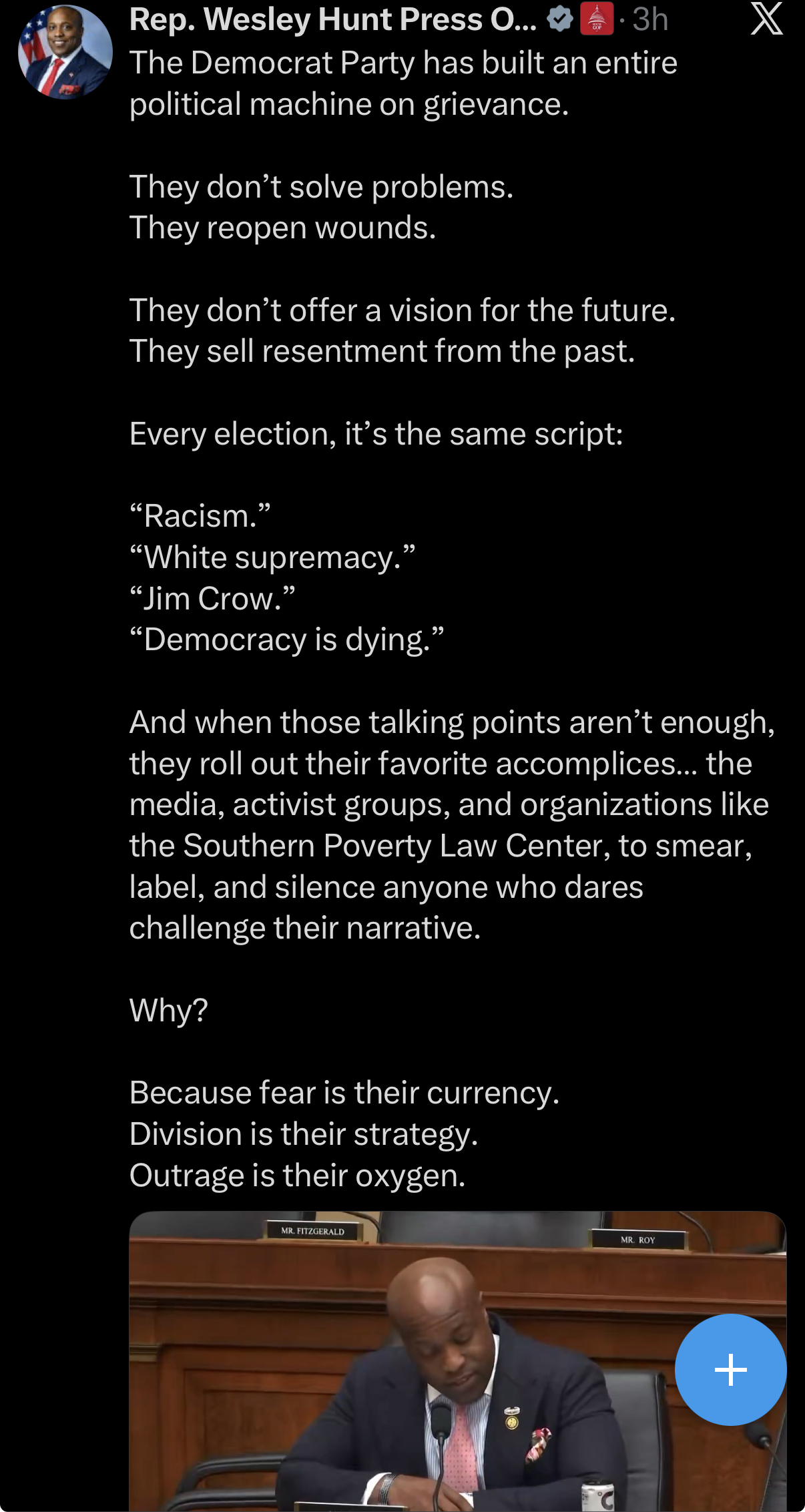
Wesley lays it out succinctly.

 x.com
x.com
Congressman Wesley Hunt (@RepWPH) on X
The Democrat Party has built an entire political machine on grievance. They don’t solve problems. They reopen wounds. They don’t offer a vision for the future. They sell resentment from the past. Every election, it’s the same script: “Racism.” “White supremacy.” “Jim Crow.” “Democracy is dyin…
Why? Because they can't win on policy.Wesley lays it out succinctly.
View attachment 38969
Congressman Wesley Hunt (@RepWPH) on X
The Democrat Party has built an entire political machine on grievance. They don’t solve problems. They reopen wounds. They don’t offer a vision for the future. They sell resentment from the past. Every election, it’s the same script: “Racism.” “White supremacy.” “Jim Crow.” “Democracy is dyin…

Bruddah IZ
DA
Speaking of Gymnastics. You voted for Biden and Harris.You MAGAs are sooo desperate to believe Trump so ya all do gymnastics in an attempt to make his lies valid. It’s laughingly obvious from outside your idiot bubble.
Bruddah IZ
DA
Economic Sovereignty.....
I watched most of the interview before getting bored and turning the channel. It was oddly cordial for the first couple of segments, then I could tell that Trump was getting irritated (and rightly so) that she kept stopping the interview and making him wait for the rain to stop. He just wanted to push through. I didn't realize he stormed out of the interview until the next day. No surprise it devolved into thin-skinned Trump batttling a looney lefty attempting gotcha journalism. Another example of the gross arrogance on the part of the MSM, she made it all about herself by interrupting his time and then had the audacity to cry about her coming all the way out to Wisconsin like POTUS owed her a favor. The other recent example is Pelley comparing getting fired to having a spouse murdered, like getting fired for insubordination is some crime against humanity. What a self-important asshole. Kudos to his remaining CBS colleagues for hanging him out to dry.

Hüsker Dü
DA
That hospital ship Trump personally himself promised was headed to Greenland ("It's on the way!), anybody got a status update on that?
Funny, right? Ha ha. Of course Trump's promised hospital ship was just bullshit. There was never a ship, never a need, never a reality. It was just something he said in the spur of the moment, his damaged brain stringing together random bits to produce some off-the-cuff nonsense that he forgot within minutes.
It's on the way!
BUT THAT'S THE THING, isn't it?
That's the joker in the deck. That's Trump promises to America's business, to America's farmers, to America's taxpayers, to the American military, to America's allies. That's every promise Trump ever made to the American people. Empty. Nothing. Bullshit. Forgotten within minutes.
MAGAs like to tell you Trump means what he says and says what he means, but in reality most of the time Trump doesn't even remember WHAT he said and gets mad if you remind him. Infrastructure? Healthcare? Prosperity? Tax cuts will pay for themselves? Jobs? BLACK jobs (whatever those are)? No new wars? Farm markets? Cheap energy? Tariff Rebate checks? Tax rebate checks? It's on the way!
Sure it is.
And when Trump's promises don't materialize, well, it's all Joe Biden's fault. Somehow.
When he's questioned on it, when the Press actually finds the courage to do their goddamn job and put the question to him, he comes unglued. Nothing enrages Trump faster than a question about one of his empty promises.
Nothing will bring down the wrath of Trump's federal government on your employer faster than putting the question to Trump.
The only thing that's on the way, is more of the same. - Jim Wright
Funny, right? Ha ha. Of course Trump's promised hospital ship was just bullshit. There was never a ship, never a need, never a reality. It was just something he said in the spur of the moment, his damaged brain stringing together random bits to produce some off-the-cuff nonsense that he forgot within minutes.
It's on the way!
BUT THAT'S THE THING, isn't it?
That's the joker in the deck. That's Trump promises to America's business, to America's farmers, to America's taxpayers, to the American military, to America's allies. That's every promise Trump ever made to the American people. Empty. Nothing. Bullshit. Forgotten within minutes.
MAGAs like to tell you Trump means what he says and says what he means, but in reality most of the time Trump doesn't even remember WHAT he said and gets mad if you remind him. Infrastructure? Healthcare? Prosperity? Tax cuts will pay for themselves? Jobs? BLACK jobs (whatever those are)? No new wars? Farm markets? Cheap energy? Tariff Rebate checks? Tax rebate checks? It's on the way!
Sure it is.
And when Trump's promises don't materialize, well, it's all Joe Biden's fault. Somehow.
When he's questioned on it, when the Press actually finds the courage to do their goddamn job and put the question to him, he comes unglued. Nothing enrages Trump faster than a question about one of his empty promises.
Nothing will bring down the wrath of Trump's federal government on your employer faster than putting the question to Trump.
The only thing that's on the way, is more of the same. - Jim Wright
Bruddah IZ
DA
The Drug Was Always the Weapon
Opium took China. Fentanyl is taking America. Same machine, same gates. This is how it began.
Vivify MariposaJun 06, 2026
The Conversation That Opened the Door
Last week I was talking with Tom and Rich about Guatemala.Guatemala had just given the United States permission to strike the drug cartels operating inside its borders. On the surface it looked like one more headline about the war on drugs. It was not. It was another blow against the City of London and the money that moves through its drug flows. That is what we were really talking about. How this administration keeps making moves in places nobody expects, taking the drug routes of this hemisphere out of the hands that have held them. This is not about a man chasing drug money. This is about control of the gates. He is pulling the hemisphere away from the City of London, which has run it the only way it knows how, through corruption, through the cartels, through divide and conquer.
And somewhere in that conversation I said it out loud. This is the same playbook they ran on China in the Opium War. Exactly the same. Look at it and there is no difference.
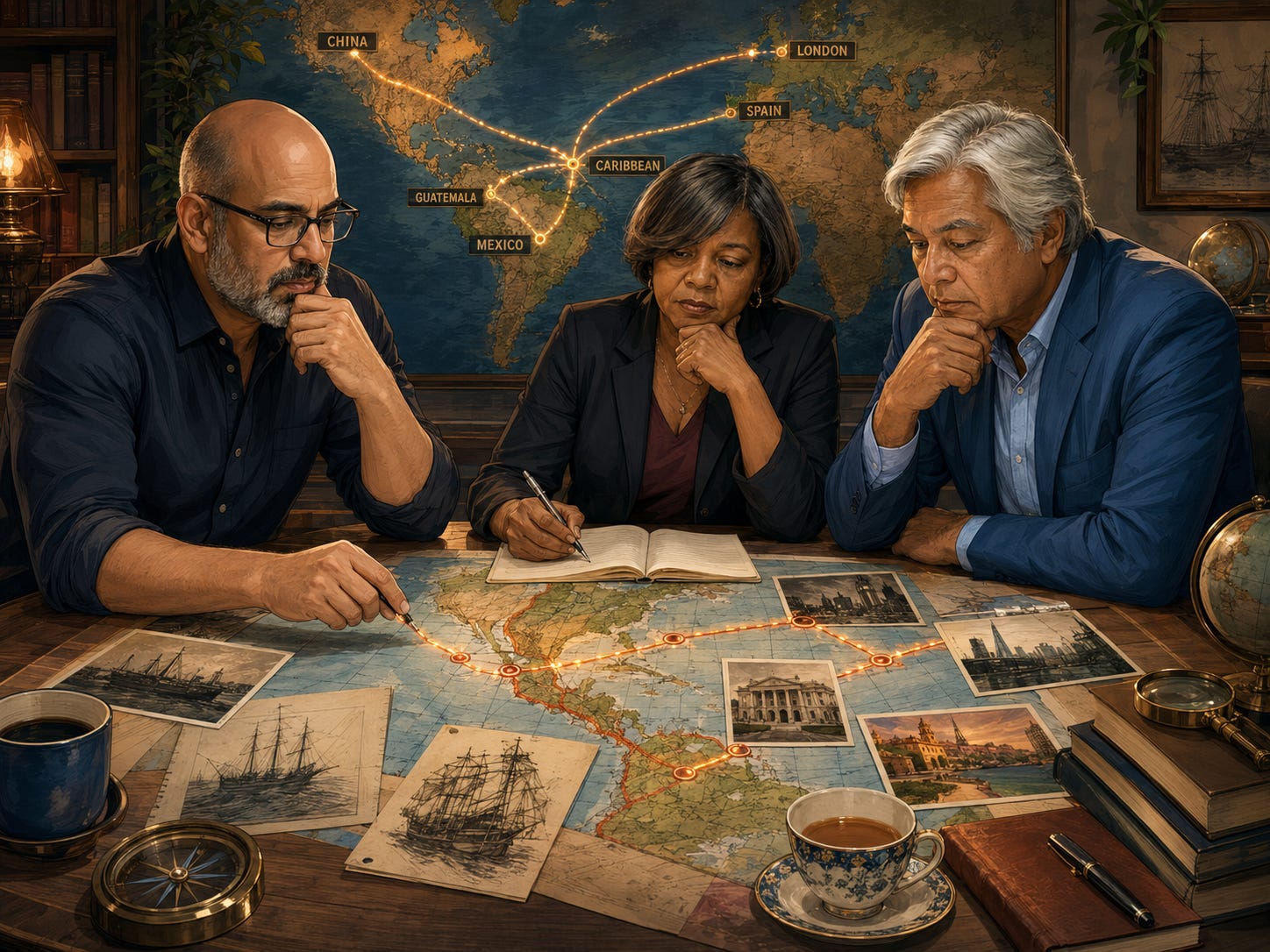
I said it as a comparison. Then I could not stop thinking about it, because it was not a comparison. It was the same thing wearing a different year.
So I went back. I did not start with a theory. I started with one country and one drug, and I followed it, and every step I took handed me the next one whether I wanted it or not. The silver handed me the drug. The drug handed me the ports. The ports handed me a bank. The bank handed me London. London handed me a square mile with no name on it. The square mile handed me a string of islands. The islands handed me Spain, and Mexico, and the whole Caribbean, and then half the hemisphere. Not as a list. As a trail.
And when I got to the end of that trail and looked up at the calendar, it said 2026, and the same gates were being touched again. Except this time something was different. This time they were not being held. They were being taken. Guatemala was only the move that made me look.
Before I walk you through it, let me tell you what it is, so you are not standing there waiting for the wrong thing to show up.
It is a war. It is the third world war, and it is already here, and it has been here for a while. You cannot see it because you are watching for the last one. You are waiting for tanks across a border. Missiles in the night sky. Soldiers in a line. A man on the radio reading a declaration. That is the war you were taught to look for, so that is the only war your eyes will accept.
This one does not look like that. This one looks like a trade route. A bank. A drug. A loan with conditions attached. An insurance contract that quietly does not get renewed. A former president walking into a courtroom. A country giving permission for the strike. A port that suddenly gets very busy. It is fought one degree at a time, on every front at once, and almost nobody fights back, because almost nobody can see that the fight is on.
The first time they ran it at full strength was on China, two hundred years ago. That is where the trail starts. Walk it with me.
Bruddah IZ
DA
The Silver Went One Way
Britain had a money problem in the early 1800s, and the problem was the thing that paid for everything.Britain wanted China’s tea. The whole country drank it. It wanted the silk and the porcelain too. And China, for its part, wanted almost nothing Britain made. China sold, and Britain bought, and the payment came in one form. Silver. Real silver, by the ton, leaving British hands and going into Chinese ones and not coming back.
That is a trade running one direction, and a trade running one direction is a wound. An empire that lived on commerce was watching its own treasure drain east, year after year, with nothing flowing back to balance it. The math did not work. And an empire that cannot make the math work does not accept the loss. It goes looking for something the other side cannot say no to.
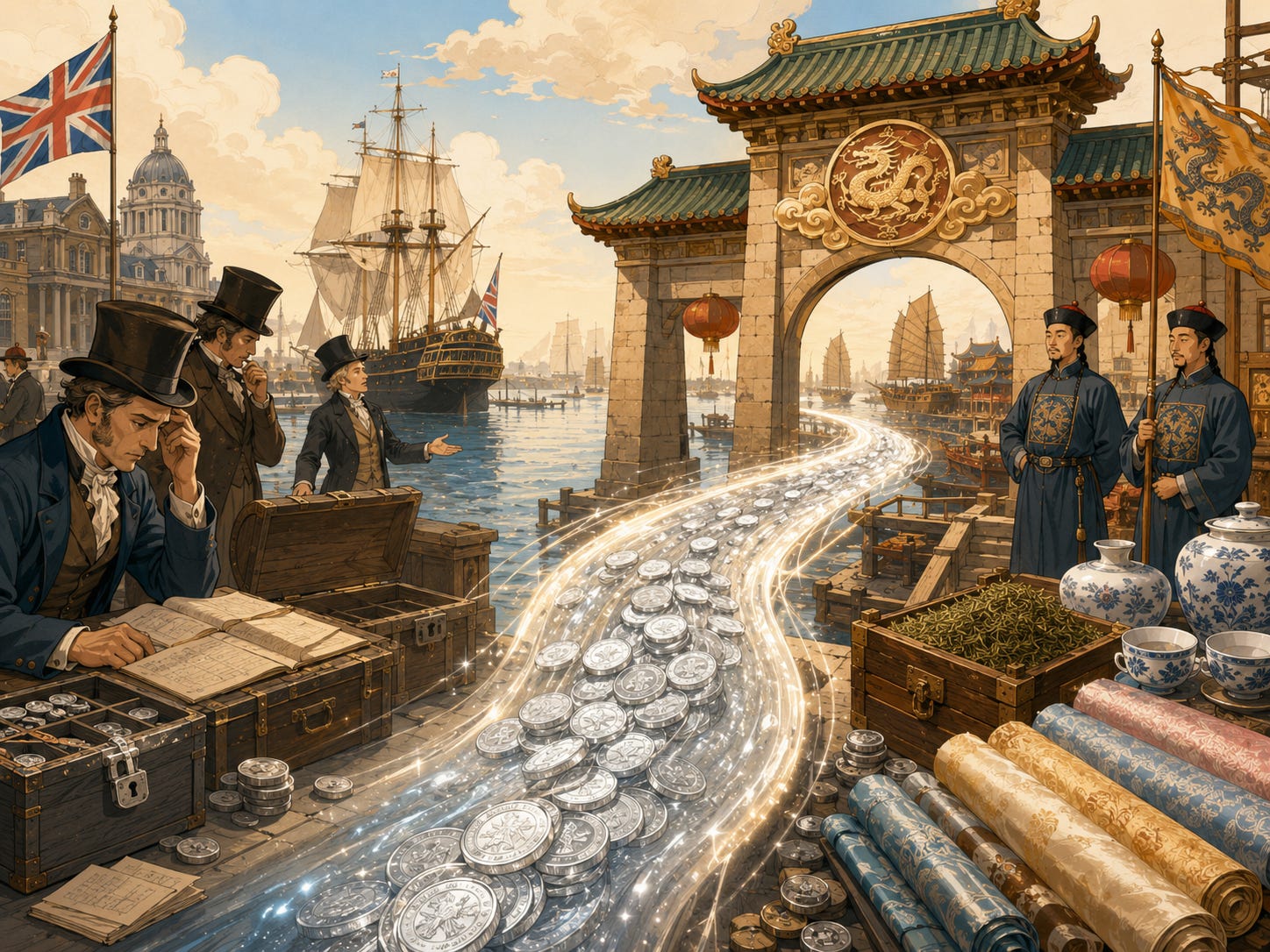
It went looking for a product China would buy whether China wanted to or not. A product that would create its own demand. A product that, once it was in, would not stop pulling silver back across the water for as long as the people on the other end kept needing it.
It found one. It grew in its own colony, and it turned out to be the most effective trade weapon ever devised, because the customer could not quit.
Bruddah IZ
DA
The Drug Turned the River Around
The poppy grew in British India.The East India Company grew it. The Company processed it, pressed it into chests, and sold those chests at auction in Calcutta. And here is the first move that matters, the one that repeats in every chapter of this story all the way to today. The Company kept its own name off the crime. It did not smuggle the opium into China itself. It sold the chests to private firms, traders with names like Jardine Matheson and Dent, and those firms carried the opium into China through the southern coast, paid the local officials to look the other way, and sold it for the silver that Britain had been losing.
The Company’s hands stayed clean. The private firms took the risk. The silver came home. And every link in that chain could say, truthfully, that it had only done its small legal part.
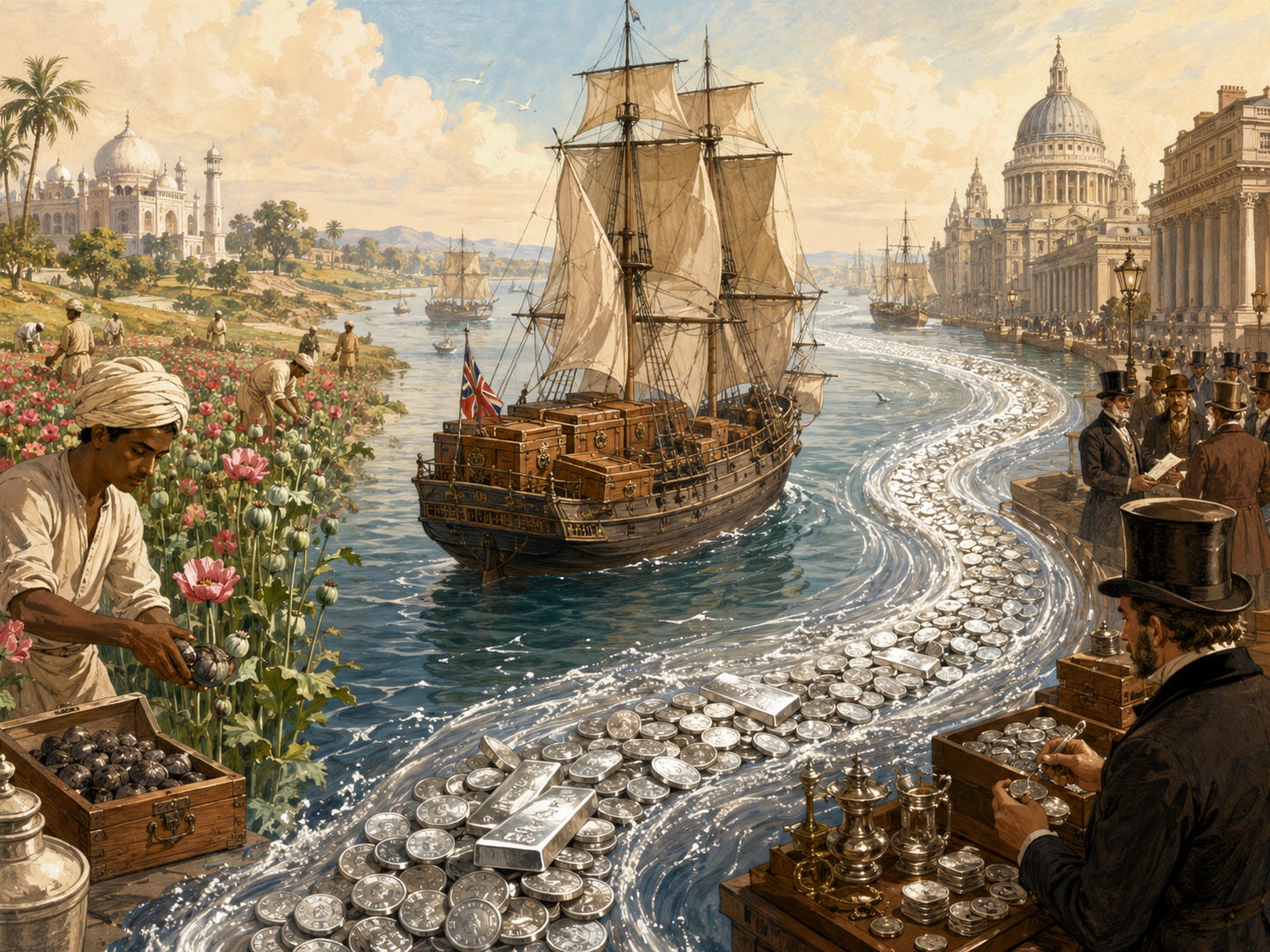
The river of silver turned around. It stopped draining east and started flowing back to London. And it came back soaked in something that was eating the people on the other end of the trade.
This is the first thing I understood, sitting with that history, and it changed how I read everything after it. The drug was not a weakness the Chinese fell into. The drug was a tool. It was aimed. It was chosen and grown and shipped on purpose to solve a British accounting problem, and it solved it perfectly. The opium was a weapon before it was ever an addiction.
The addiction came next, the way it always comes. Slowly, and then all at once. The chests that came in by the thousands became tens of thousands. The smoke spread through the ports, then inland, then through every class of person. Workers stopped working. Soldiers stopped fighting. Whole stretches of a functioning society went soft and slow and hungry for the next pipe. A country does not collapse in a day from this. It softens, one person at a time, until one morning the country that used to be there is gone and something hollow is standing in its place.
And the officials who were supposed to stop it were already paid. That is the second move, and it also repeats forever. You do not have to defeat a country’s defenses if you can buy the men standing in front of them. The customs officers took the money. The local magistrates took the money. The trade kept flowing because the people whose whole job was to stop it had a private reason not to.
The emperor in Beijing could see it happening. He could see the silver leaving and the people falling and the orders being ignored. So the Chinese state decided to do the one thing a state is supposed to do. It decided to defend itself.
But the drug went in, and the silver came out, and all of it had to move through one kind of place. And that place is where China made its stand.
Bruddah IZ
DA
The Ports Were the First Gate
Every chest of opium had to come ashore somewhere.A harbor. A river mouth. A wharf at Canton. The opium did not teleport into China. It arrived at a physical place, was unloaded at a physical place, and moved inland from a physical place. And whoever controlled that place controlled the flow, and whoever controlled the flow took the cut.
That is the thing I kept seeing all the way down the trail, in every country and in every century. The gate is the prize. Not the drug. The drug is the weapon. The gate is what you are actually fighting for, because the gate is where you stand to take your share of everything that passes. The gate is the prize. It always was.
China decided to shut its gate. In 1839 it sent a man named Lin Zexu to Canton with full authority to end the trade. He did not negotiate it. He seized the opium. He took roughly twenty thousand chests of it out of the foreign warehouses and the ships, more than a thousand tons, and he destroyed all of it. He had it broken up and flushed into the sea.
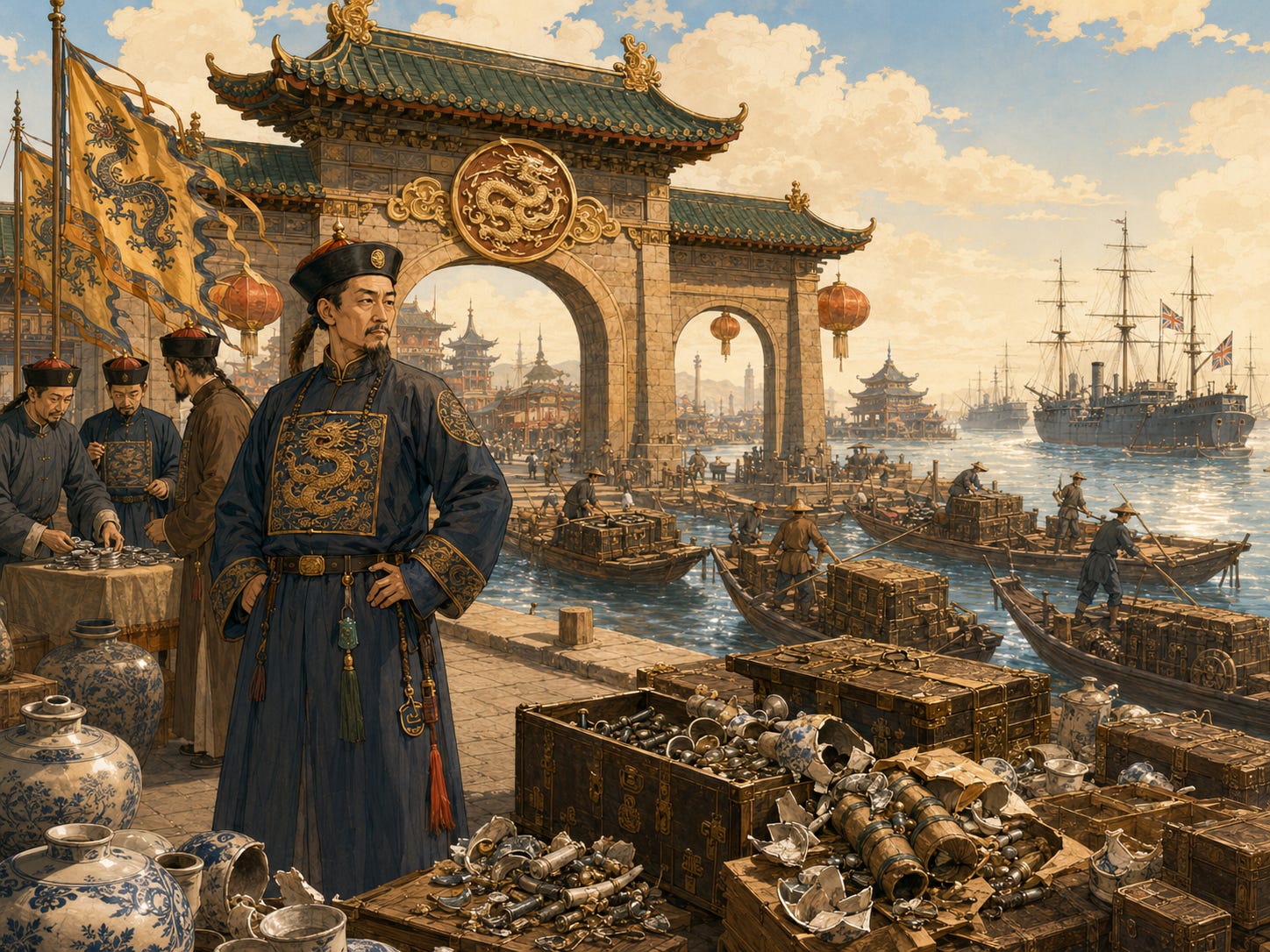
He also did something else. He wrote a letter to the Queen of England. He asked her, plainly, how a country that banned opium for its own people could grow it and sell it to his. He asked her to act on her own stated morality. He was an official of the Chinese state, enforcing Chinese law, on Chinese soil, against a poison that was killing Chinese people, and he asked the source of the poison to simply stop.
For that, China was punished.
Britain sent warships. It called the war a defense of free trade and a defense of the rule of law. Read that slowly, because it is the oldest trick in the entire story. The country trying to stop the poison was named the aggressor. The empire pushing the poison cast itself as the wronged party whose lawful commerce had been violated. The dealer went to war because the customer tried to quit, and the dealer called it justice.
China lost, and it was never going to win, because the gap in the weapons was total. The treaty that ended the first war took Hong Kong outright and handed it to Britain. It forced open the ports Britain wanted, five of them, so the trade could never be shut again. It charged China an enormous indemnity in silver, and that bill included a specific charge for the very opium that Lin Zexu had destroyed. Sit with that. China was made to pay Britain back for the drugs that China had seized from British traders who were breaking Chinese law. The victim reimbursed the dealer for the inventory the victim had thrown away.
It did not end there. A second war came less than twenty years later, and that one finished the job. It legalized the opium outright. The crime stopped being a crime and became the official, taxed, protected policy of the trade. And for nearly half a century after that, the customs house itself, the gate where China taxed and counted its own trade, the beating heart of its own sovereignty over its own commerce, was run by a foreigner.
The ports were taken. The gate was taken. The country was opened and could not close again.
So I followed the money that came through that gate, because the silver had to go somewhere, and where it went told me who the war had really been for.
Bruddah IZ
DA
The Money Came Home Clean
It did not stay in China. It never stays where the poison lands.The opium fortunes sailed back to London, and they changed clothes on the way. They became shipping lines. Insurance houses. Grand townhouses in the best parts of the city. Respectable old family names that ended up on banks and charities and seats in Parliament. The men who made their money on the smoke came home and became pillars.
In 1865 the trade seeded a bank, founded in Hong Kong, built specifically to finance this commerce between Britain and the China coast. That bank still exists. It is one of the largest in the world. It still carries the names of the two cities it was created to serve.
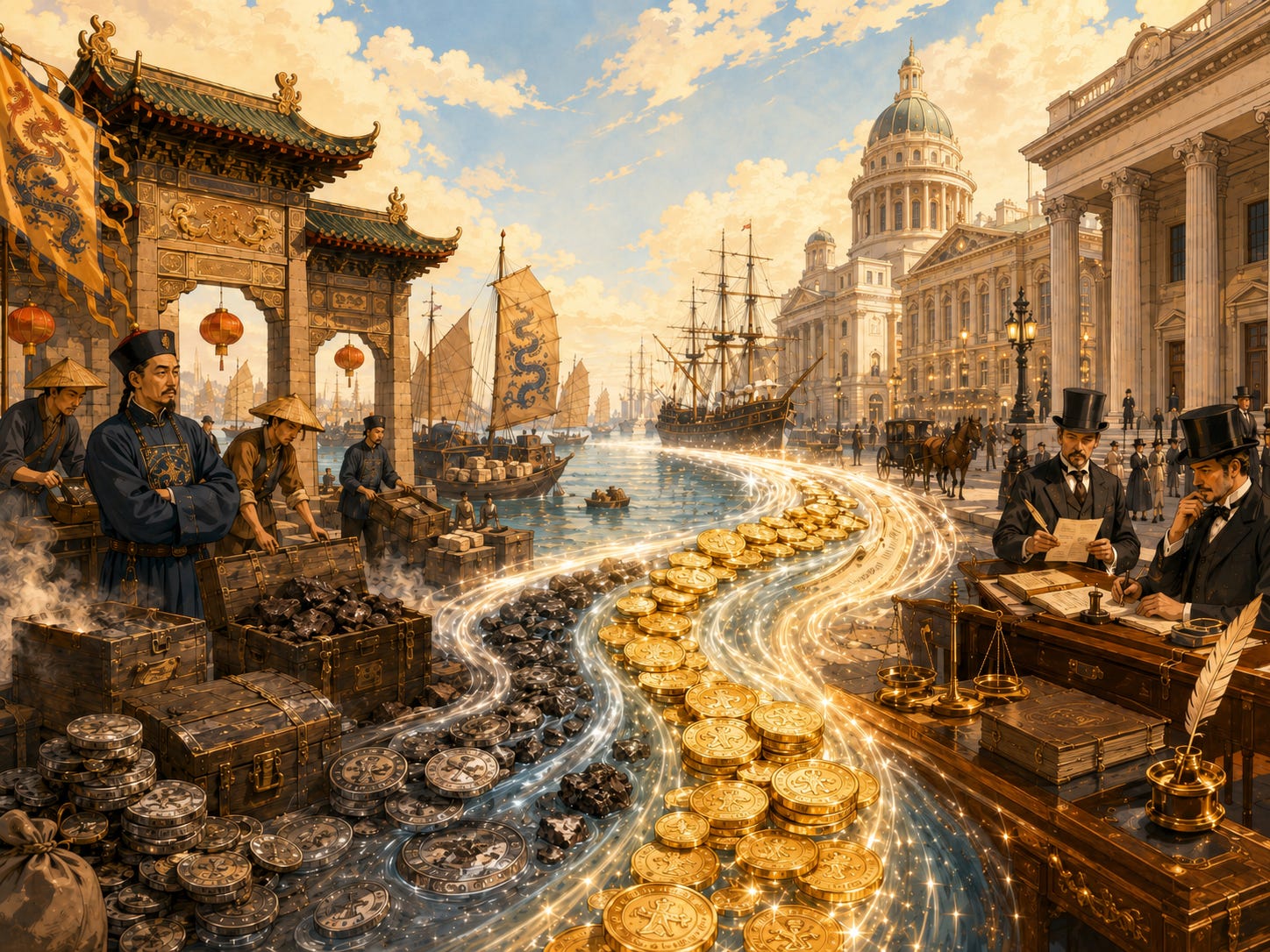
The dirtiest money in Asia walked into London as the cleanest capital in Europe.
That is the move that matters more than any other in this whole story, because it is the move that never stopped and it is the move the entire machine is built around. You poison a place far away. You pull the wealth out of it while it is too sick to resist. And you wash that wealth the moment it lands somewhere respectable, so that by the time anyone could ask where it came from, it is already a building, a trust, a family fortune, a donation with a name on a wall.
The body falls in one country. The money gets a new suit in another.
And nobody at the clean end ever asks where the suit came from. The lawyer who builds the structure does not ask. The banker who opens the account does not ask. The estate agent who sells the townhouse does not ask. The school that takes the children’s fees does not ask. Not asking is not an accident or an oversight. Not asking is the product. That is the actual service the clean end of the machine sells to the dirty end. Distance, silence, and a new name.
So I asked the only question that was left. If the poison goes out from one place and the clean money comes home to another, where is home? Where does the trail actually end?
It kept pointing at the same square mile.
Bruddah IZ
DA
The Square Mile With No Face
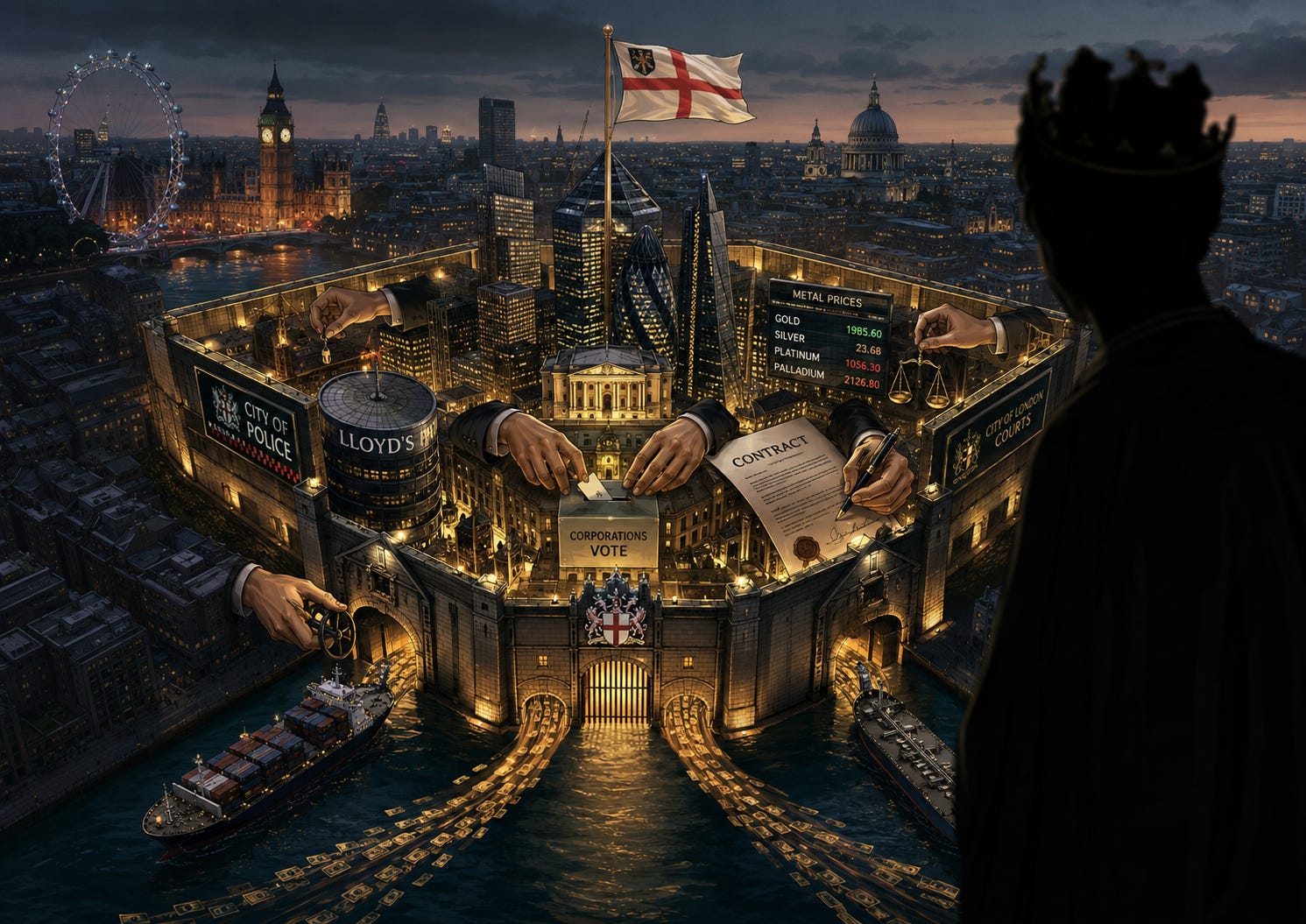
There is a city inside London that is not London.One square mile. It has its own police force. Its own courts. Its own flag. Its own government, and that government is not chosen the way you think a government is chosen, because the companies registered there cast the votes, and the few thousand people who actually live there are outnumbered at the ballot by the corporations around them. It runs on a charter older than the British Parliament. When the reigning monarch comes to its boundary, the monarch stops and asks permission to enter. There is no founder’s name on it. No single face hangs over it. There is nobody to put on a pamphlet, nobody to march against, nobody to blame.
It has kept a man inside the British Parliament since 1571. He has a title and a seat in the chamber, and his entire job is to sit there and watch every law as it moves, and to make sure that whatever the elected representatives of the country decide to do, the square mile comes through it untouched. Four and a half centuries of one institution with a permanent set of eyes inside the lawmaking of the nation that supposedly contains it.
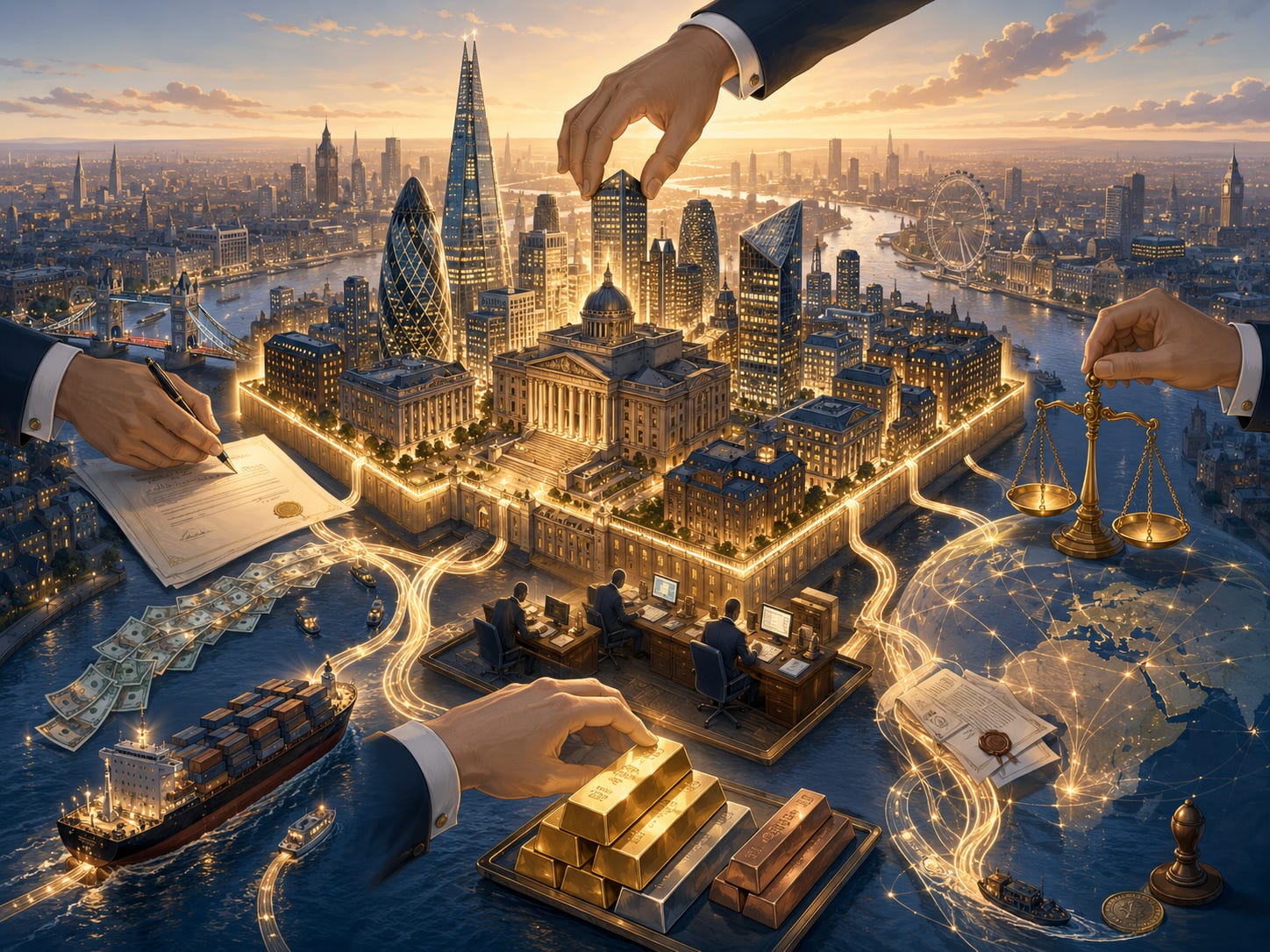
Its own private fund is centuries old, and no transparency law has ever opened it. When investigators have asked to see how its money is spent shaping legislation, the answer has been that the question falls outside the law, because the money is private. A French magistrate who spent years trying to trace dirty money through it called it a state within a state that had never handed her a single usable piece of evidence. Not one. Ever.
It does not own countries. It owns the gates that every country has to pass through. And that is a far better thing to own, because owning the gate means you never have to send an army again. You let the world come to you.
It prices the sea. Lloyd’s of London has set the risk on the world’s shipping since 1688. A cargo does not cross an ocean until the risk of that crossing has been priced in that mile. More than three centuries of every hull and every tanker and every container ship paying its toll to the same place before it is allowed to sail.
It prices the metal. The exchange inside that mile sets the global price of copper and cobalt and nickel and aluminum, so the country that digs the copper out of Chilean ground does not get to name what its own copper is worth. London names it. It prices the gold. The bullion market in that mile sets what gold and silver are worth for the entire planet, so the countries that pull the gold out of the ground in Africa and the Americas do not name its price either. They do the digging. London does the pricing. They take the labor and the danger. London takes the margin and the certainty.
It writes the law. English law governs more of the world’s contracts than any other law on earth, and when those deals break, they are settled in London courts, under London rules, by London judges.
And when a country has nothing that can be poisoned, when there is no drug to push through it, the mile reaches for a quieter tool that does the same work. It offers a loan. The loan arrives when the country is already on its knees, and it comes with conditions. Open your markets. Sell your public assets. Cut what you spend on your own people. The country signs, because it believes it has no choice, and the conditions do to that country exactly what the opium did to China. They hollow it out from the inside. The currency falls. Foreign capital walks in and buys what was just put up for sale at the bottom. The debt does not shrink, because the debt was never designed to shrink. Argentina has worn that leash for decades and collapsed under it again and again, its bonds written under foreign law so that the lender always comes out ahead no matter how the country ends up. The loan was never the rescue. The loan was the leash.
The same mile sat at the center of the largest financial scandals of our own time. For years the banks inside it rigged the benchmark interest rate that priced hundreds of trillions of dollars in loans and mortgages and contracts around the world, setting the number wherever their own trading books needed it to be, and when it finally came out the fines ran into many billions and almost no one went to prison.
This is the machine that boiled China. After the opium wars it never had to be that loud again, because it had learned the more elegant version of the same thing. You let the country do the mining and the growing and the shipping and the dying. You sit at the gate. You price the risk, you clear the money, you hide the owner, and you write the law that governs all of it. You take the cut on everything that moves, and you leave no fingerprints, because there is no hand to leave them.
That is how you keep a fire burning under every country on earth at the same time and never fire a shot.
But the money that comes home still has to disappear somewhere, because even clean money does not like to be looked at. So I followed it out of the mile, and it ran straight to a handful of islands.
Bruddah IZ
DA
The Islands That Hide the Owner
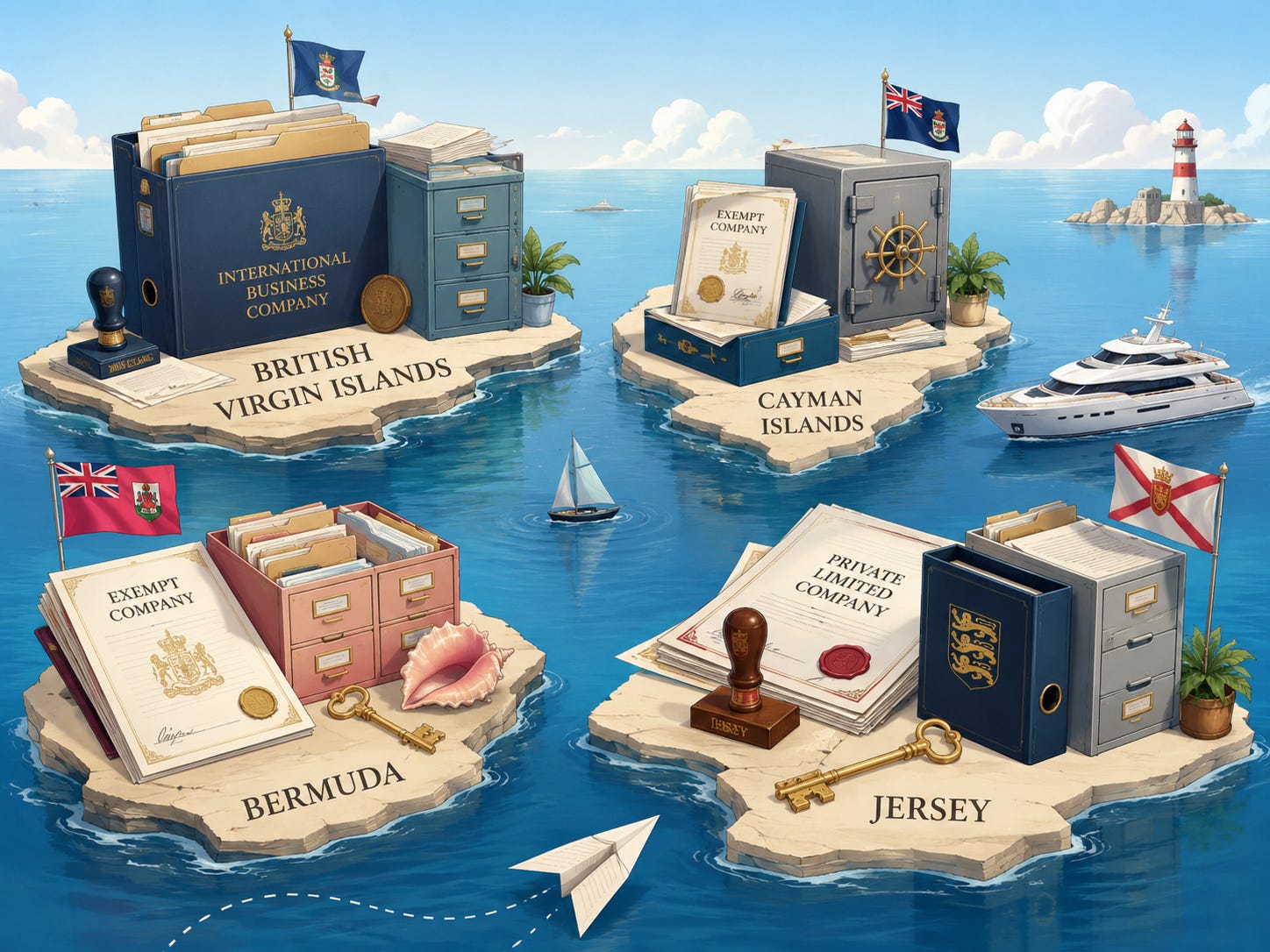
The mile flies a flag over the best hiding places on earth.The British Virgin Islands register hundreds of thousands of companies in a territory with fewer than forty thousand residents. The Cayman Islands hold tens of thousands of investment funds. Bermuda runs the insurance and reinsurance. Jersey, Guernsey, the Isle of Man, Gibraltar, each a small rock with a flag, each one outside the tax law of the country whose flag it flies. Together they form the largest secrecy network in the world, and the worst of them all answer to the British Crown.
The companies built there make nothing. They sell nothing. They exist to hold a thing and to hide who holds it. More than half the companies exposed in the Panama Papers were built in the British Virgin Islands. Each one is a paper wall between a man and his money, and every one of those walls clears home to London. By the estimates of the people who study it, the British network of islands costs the rest of the world more than a hundred and sixty billion dollars a year in lost tax, and London itself launders something like ninety billion in illicit money every year, and the law that was written to force the rich to explain their wealth is almost never used, because when the government loses one of those cases it has to pay the other side’s legal bills.
These places are not a loophole in the system. They are the system. They are the back room of the same square mile.
And every so often the machine shows its face by accident. The leader of the British Virgin Islands, the premier himself, was caught in a sting agreeing to move tons of cocaine through his own islands’ ports to Miami, with the head of the ports authority helping him do it. He was convicted in a United States court and sentenced to more than a decade in prison. Stop on that one. A British territory whose entire economy is built on hiding other people’s money also had a sitting head of government willing to run the cocaine itself through the same ports that hide the cash. The drug and the laundry were never separate businesses. They were the same business, run through the same gate, by the same kind of man.
So now I had the whole shape of the old machine in front of me. The drug at one end. The gate it comes through. The wealth pulled out and sent home clean. The mile that prices it and clears it and writes its law. The islands that swallow the owner whole. And the moment I could see that shape, I could not stop seeing it. But I had walked straight past the simplest question of all. The drug makes cash, dirty cash, by the truckload. How does that cash come out the other end clean enough to buy a building in Europe? So I followed one dollar of it through the laundry.
Bruddah IZ
DA
The Island Was Small. The Money Was Not.
Here is the question I had skated past. A speck of land in the Caribbean, a few thousand people, one main road. Why does a place like that hold more banks and funds than a real city?It does not hold them for the people who live there. Those people buy groceries and pay rent like anyone else, and that does not take a global financial center. The banks are not there for the island. They are there for money that came from somewhere else and needs a place to stop being what it is.
Watch one dollar of it move.
The cash leaves the street. Somewhere a load got sold, and now there is money that should not exist, money with a body behind it.
It becomes a company. Not a real one. A name on a page that owns a bank account.
That company belongs to another company. And that one belongs to a third. By now there is no person’s name attached to anything.
The company at the top sits in the British Virgin Islands, the paper wall, the place whose only product is making the owner disappear.
The account sits in the Cayman Islands, where the bank and the fund and the trust and all the quiet plumbing live, because Cayman is the pipe the money actually runs through.
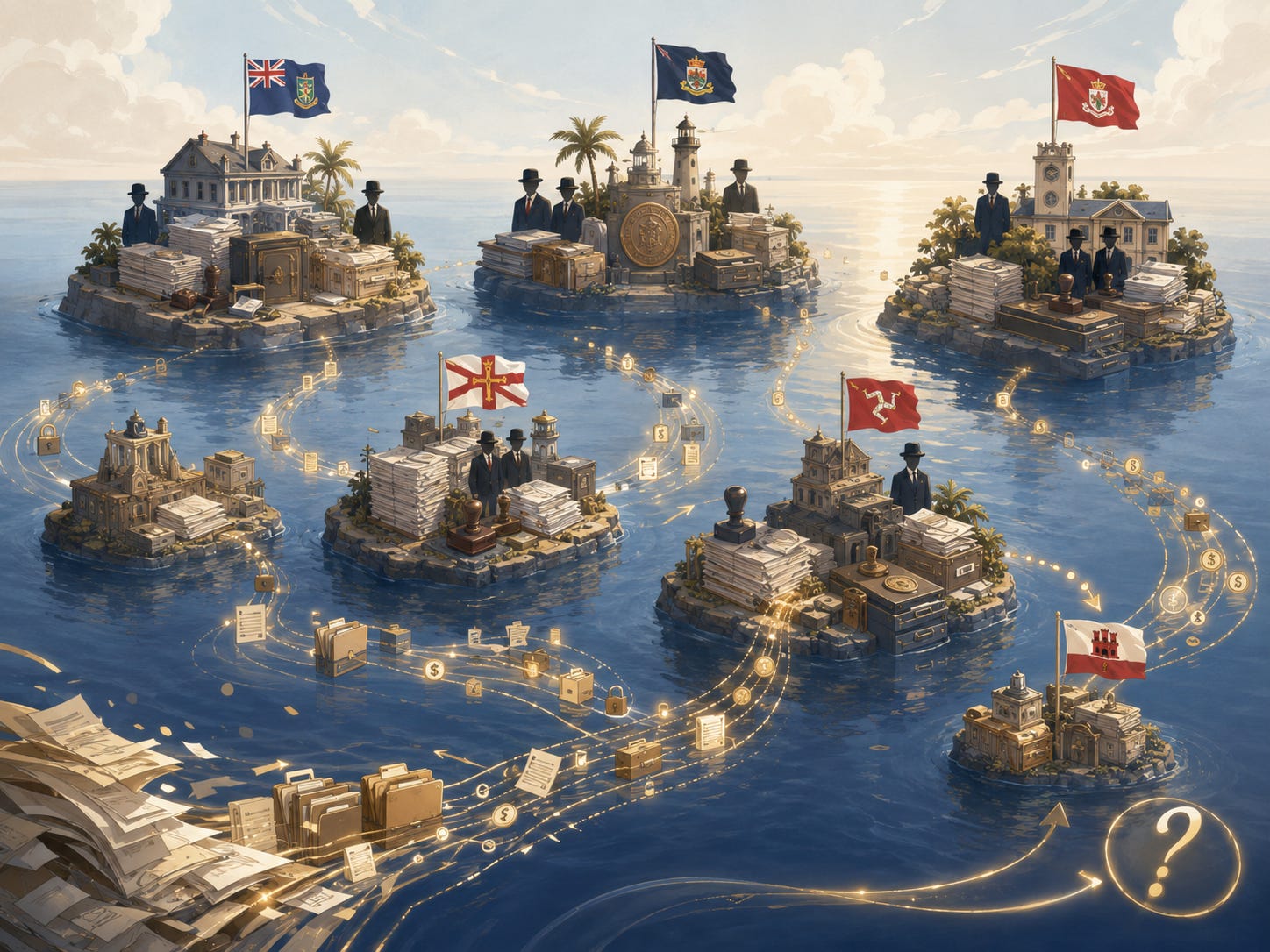
The paper runs through Panama, which exists to print more of it, more layers, more distance between the dollar and the body.
The property sits in Madrid, a building, a fortune, a clean European address, because Spain is where the money is allowed to land and look respectable.
The contract over all of it is written under English law, and if anyone ever fights about it, they fight in a London court, because London sells the one thing the chain needs at the very end. Respectability. The stamp that says this is normal.
And the owner is nowhere.
That is laundering. It is not a suitcase of bills crossing a border. It is a chain. Each link is legal on its own. Each lawyer did his small clean part. Each island took its fee. And by the time the money reaches Europe, there is no blood on it that anyone can point to, because the blood is eight companies and two oceans back, on a street in a country nobody at the clean end has ever had to see.
The cartel does not need to own a single bank. It only needs the money to pass through enough hands that no one can be made to answer for any of them.
The island is small. The money is not.
Bruddah IZ
DA
The Machine Left China
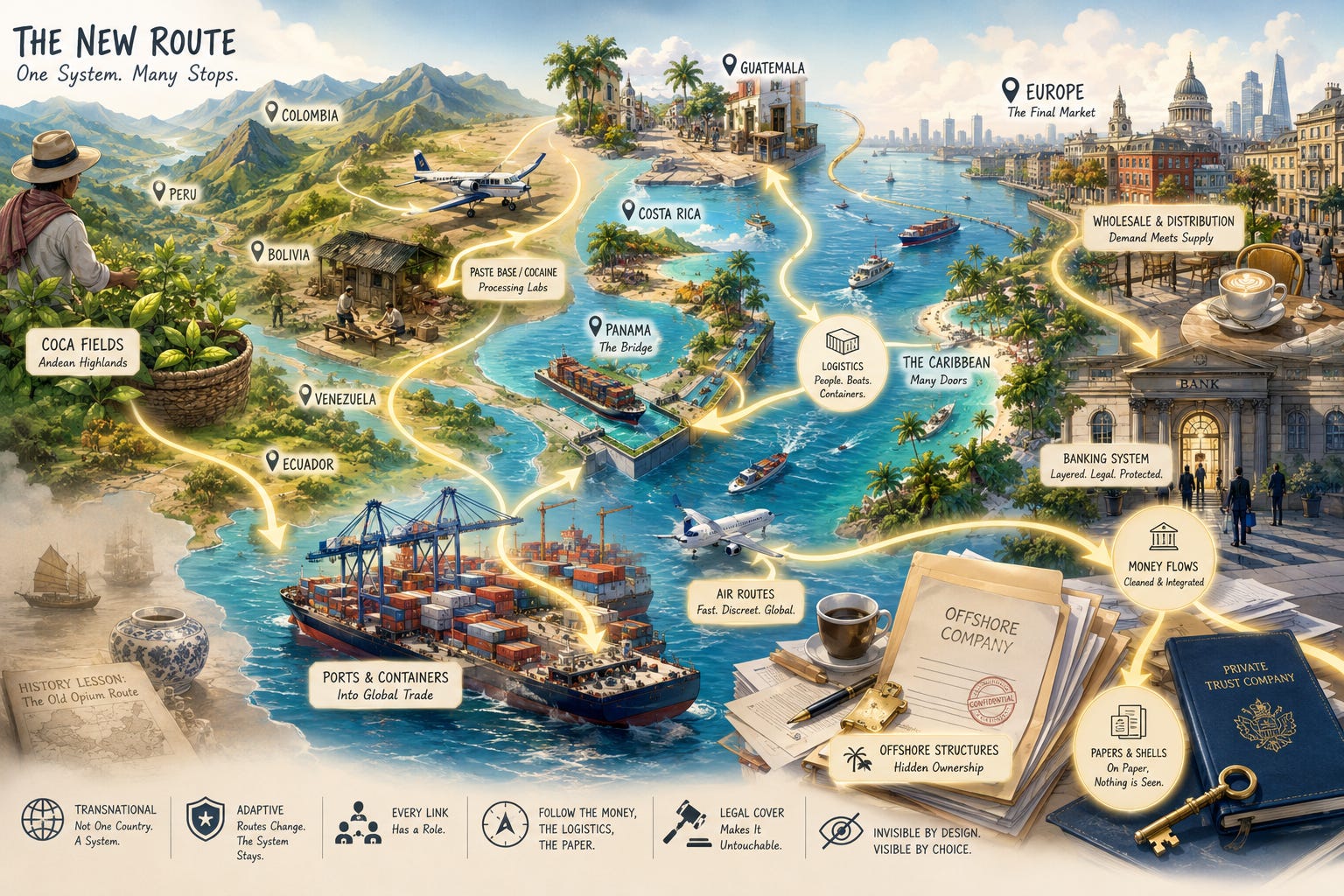
The machine left China. The drug changed names. The ports changed names. The banks changed names. But the route stayed the same.The poppy became the coca leaf. It grows on the high slopes of the Andes, in Colombia, in Peru, in Bolivia, and the first thing that grows next to it is protection. In Colombia the FARC and the ELN taxed the crop and guarded the labs, and in the Catatumbo and around Tumaco the state today is a flag on a building and nothing more. The fronts that once fought for an idea now fight for the laboratories, and the young get pulled in because the legal crop cannot pay the same day the lab can. A commander of one of those fronts was sentenced in a United States court to twenty-one years for moving more than seventy-five thousand kilos of cocaine. In Peru the remnants of the Shining Path stopped fighting for the revolution and started guarding the fields in the VRAEM valleys for a cut. In Bolivia the growers’ federations hold the land and lock the central police out by design, the American drug agents were put out of the country, and the remote municipalities turned into quiet rooms where the base is cooked and the transit flights leave for the Atlantic with no one official watching.
Then the product moves. Watch it move, because the movement is the whole story.
It moves through Venezuela, where the state itself became the corridor. The military guards the load. The men at the top of the government run it. The oil company washes the money. The ports open on command. State power stopped being a wall against the trade and became the trade’s bodyguard.
It moves through Suriname, where the country’s own security and its airport became part of the route.
It moves through Ecuador, where Guayaquil now reads like a city under siege, the docks fought over street by street, the cocaine packed into crates of fruit bound for Europe. In one load alone they pulled thirteen tons of it out of bananas that had sailed from that port.
It moves through Brazil, where the cocaine pours out of the port of Santos toward Europe, where the prison syndicate that runs it buys the public contracts and the transport it travels on, and the violence rides the same rails into Rio and São Paulo.
It moves through Guatemala, where the families that move the load own the mayors and the officials, and the whole country becomes the hallway north.
It moves through Costa Rica, the one that was supposed to be peaceful, where Limón and Moín became the gates and the trafficking money soaked into the courts and the police until a former security minister was flown to a United States court for protecting it.
It moves through Honduras, where a president went to a prison in New York for the trade and was given forty-five years, and that one matters, because that president was a conservative and an ally. The machine does not care about your ideology. It cares about your ports.
It moves through Nicaragua, where one family took the state, the gold, the police, and the silence, and ran the money through the same hands that jailed anyone who named it.
It moves through El Salvador, where the line between the gang and the government blurred until no one could say where the criminal ended and the state began.
It moves through Cuba, the oldest shelter on the route, the one that trained and protected the movements that grew into these armies, and paid for it with a permanent place on the list of terror sponsors.
It moves through Panama, where the canal and the banks and the law firms and the free zone turn the movement of the drug into the ownership of the money, and a shell company makes the owner vanish.
And it moves through the Dominican Republic, and Puerto Rico, and the U.S. Virgin Islands, the last stretch of water before the prize, the Caribbean corridor that carries it toward the United States. And do not assume that water was ever clean. In February 2026 the United States shut its own drug agency’s office in Santo Domingo and arrested the supervisor who had run it for six years, charged with taking cash to push visas through. The man sent to guard the gate was selling passage through it. Ask who else along this route was doing the same and never got caught.
Now watch the whole thing as one motion. The plane lands. The port opens. The mayor gets paid. The minister looks away. The bank takes the wire. The shell company hides the owner. The money comes out clean. The country gets weaker. The gate changes hands. That is not nine separate crimes in nine separate countries. That is one machine, running the move it learned on China, over and over, and never once needing to fire a shot.
The drug ends in two places. It ends as a body, in the country that buys it. And it ends as money, in the country that washes it. The body falls in America. The money lands in Europe. And the cleanest door in Europe is Spain.