Today in Fascism

Breaking fraud news. Wow, 800😱 Do you 👀 the number again and again and again. Use your brain and then buckle up.

Screenshot_20261124_095151_Truth Social.jpg
 

How President Trump Plays Chess While the World and His Staff Play Checkers​

1795543366378.png

Since I started to follow President Trump, I recognized something many missed, even AI, or the media who assume they understand their own projection. He is doing the art of the deal; he is playing chess while the world around him plays checkers. Let’s see the trap he put Susan Wiles in. She is still supposedly in the White House, but like many, she will not be heard from again. If you don’t hear from them, you know they are not part of his team anymore.


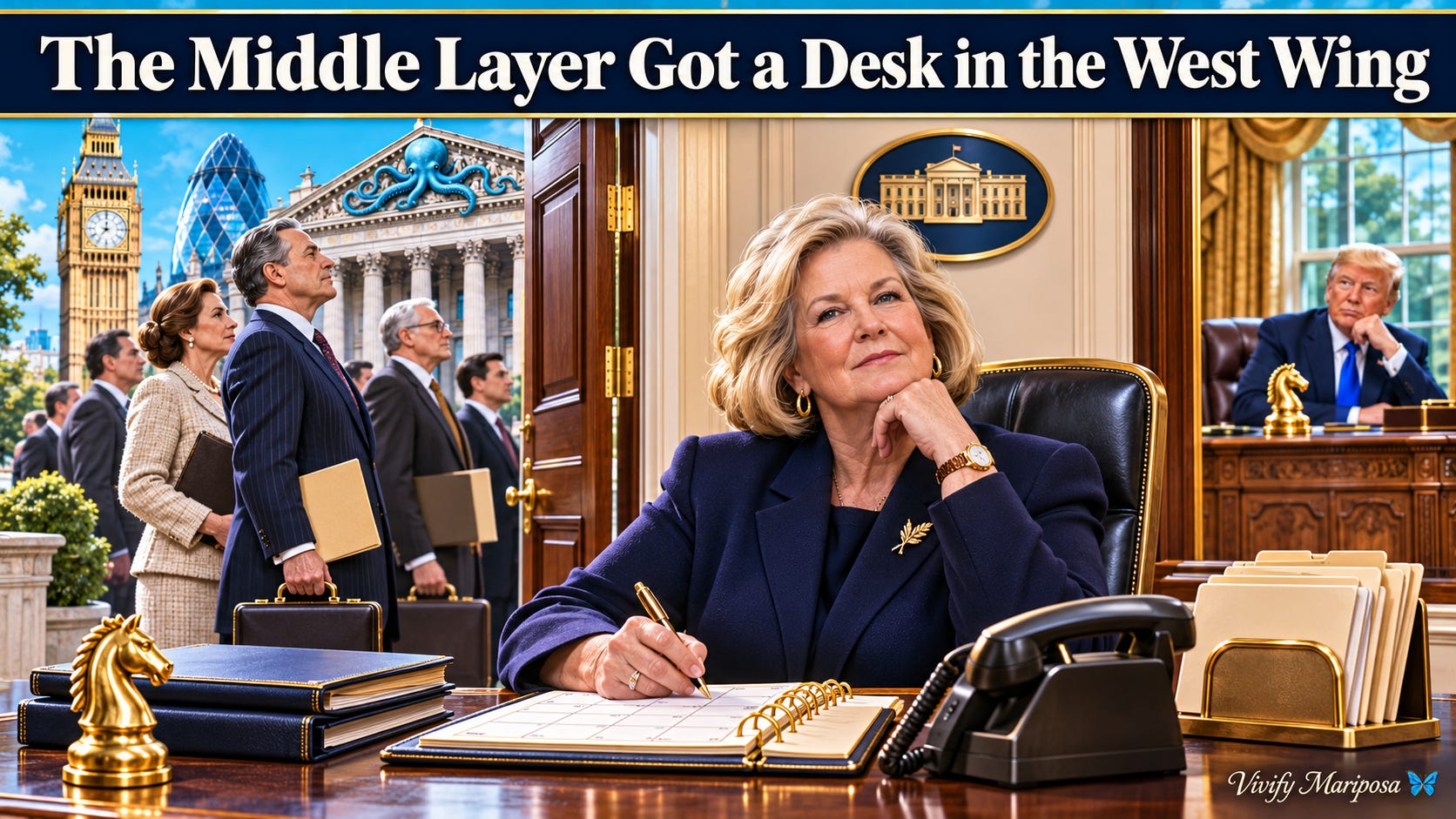
The Middle Layer Got a Desk in the West Wing
​

In Trump, DR, China, Russia, and the Enemy They All Share I followed the stack of small commands that routes around the middle layer, the banks that sat between the government and its own payment rails and collected a toll for standing in the way. Washington has another middle layer, older and better dressed, and it sells what the banks sold, the right to stand between you and the decision. Lobbyists call it access. The fundraiser, the bundle of checks collected from friends and clients, the dinner, the favor, the introduction, all of it is paid in advance for a meeting after the election, and the person who decides who gets that meeting with the President of the United States is the chief of staff, who keeps the calendar, decides which call goes through and which paper lands on the desk.
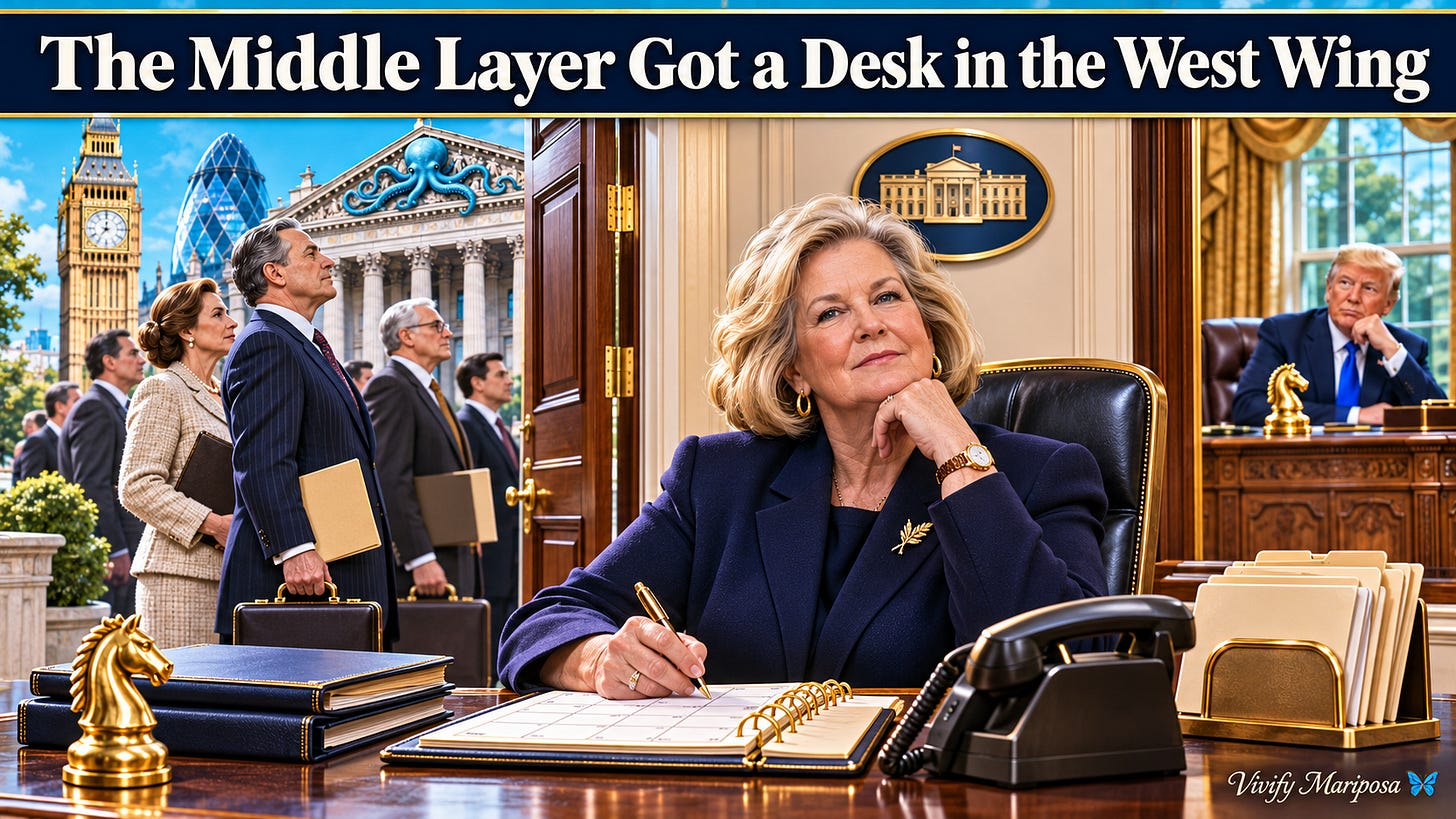


In January 2025 that desk went to Susan Wiles, who came out of the middle layer itself. Six years earlier she had signed a registration with the Justice Department as an agent of a foreign political party, the opposition party of Nigeria, which was paying her firm, Ballard, more than a million dollars a year while Nigerians were choosing their own president, and until the last day of 2024 she worked for Mercury, another lobbying firm, at the same time she was co-chairing Trump’s campaign. The ethics form she signed after she was already sitting at that desk lists the clients of her consulting firm, and the list reads like a map of the layer: the Trump campaign, the Republican National Committee, Ballard, Newsmax, the company that buys political advertising, a data company, a private investment firm, the port of Jacksonville, the City of Jacksonville, all of them paid into one firm and reported as one number, $4,380,178, so that the campaign, the party, the lobbyists and the media share a single line on a federal form and nobody reading it can separate who paid what. The same form says the firm “has ceased all business operations” and will “remain inactive” during her government service, while the table of positions on the same form lists her as its managing member until the present.

Trump did not hire a stranger to the layer. He handed the door to someone the layer trusted, and an industry that trusts the doorkeeper stops climbing through the back window and starts walking through the front, in its own name, with its paperwork filled out.

In December 2025 a magazine published eleven interviews with her, conducted across Trump’s first year back in office, and the sitting chief of staff of the United States described the President as having “an alcoholic’s personality,” called the Vice President “a conspiracy theorist for a decade,” and said the Attorney General “completely whiffed” on the Epstein files. When she saw it in print she called it a “disingenuously framed hit piece,” and Trump defended her and agreed about his own personality, adding that he could not remember a chief of staff giving such a candid interview, “not while you hold the title,” a phrase that put an expiration date on the title the day he said it, and the woman who could not stop talking to a magazine is now, as I said in the opening, someone you will not hear from again.

 

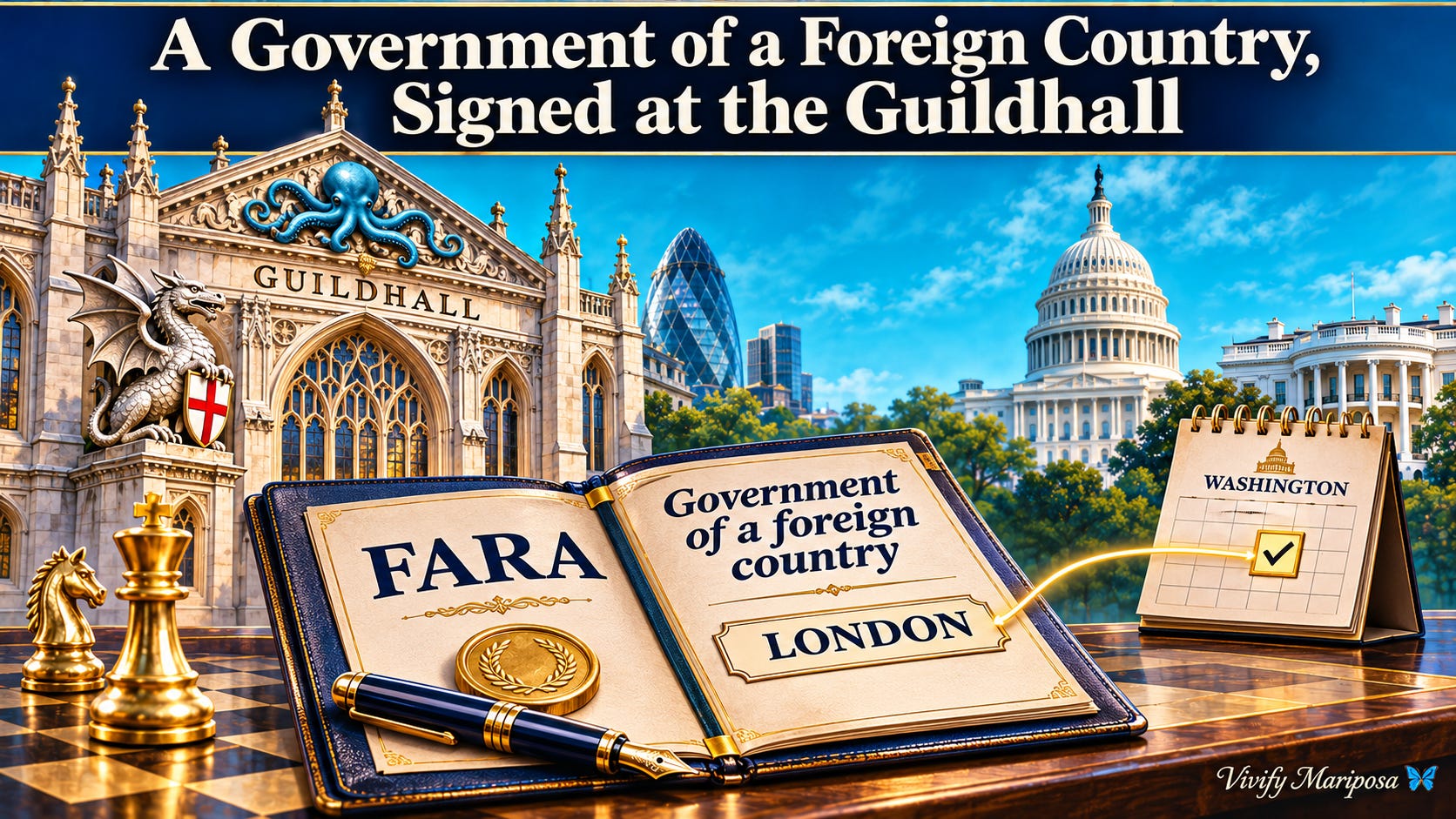
A Government of a Foreign Country, Signed at the Guildhall
​

The City of London walked through the front.

In May 2024, while Trump was the nominee and Wiles was running his campaign, the City of London Corporation registered a company in the United States under the Foreign Agents Registration Act. The owner on the agreement is “The Mayor and Commonalty and Citizens of the City of London,” the address is the Guildhall, and on the federal form, where the registrant must describe its principal, the City checked the box for “Government of a foreign country” and then described itself on the same page as the “municipal governing body of the city of London,” a local council that, in its own handwriting, tells the Department of Justice it is a government. The purpose it wrote down is to promote the City of London in the United States and to aid the relationship between the two countries “through the vector of economic policy,” which is a remarkable sentence for a municipality that supposedly has no foreign policy. Two days before that filing, a man in upstate New York had registered with the same Justice Department for the same principal, describing his work in six words, “Engaging with U.S. policymakers and businesses,” and the City’s own company used the identical six words when it filed. The language was written once, in London, and signed twice in America.


In January 2026 it hired a new managing director, opened an office at 600 14th Street, a short walk from the White House, and began filing the list the law requires, every door it knocked on in six months: the House Financial Services Committee, the Senate Banking Committee, the Treasury more than once, two commissioners of the SEC and its crypto task force, the CFTC, the National Security Council’s senior director for Europe and Russia, the President’s special assistant for international economic relations, and the Treasury official in charge of investment security, the office that decides which foreign money is allowed into the country. The institution I described in The City That Owns Everything and Answers to No One kept no fingerprints for centuries, and in Washington it submitted its calendar.

The same filing asks whether the registrant has distributed informational materials, and the City answered that it had prepared and disseminated press releases and pamphlets but had not filed copies with the Justice Department, while on the very same afternoon a brochure arrived at the Justice Department under its registration number. The brochure is called “The Global City.” A municipal governing body, describing itself to the Americans it lobbies as the global city, explains in that brochure that its American office works inside a partnership that brings together the Office for Investment, His Majesty’s Treasury, the Prudential Regulation Authority, the Financial Conduct Authority and the City of London Corporation. The national treasury, the two regulators of British finance and the Square Mile sit in one sentence as partners, in a file the City handed to the American government only because the law made it.

At home it argues the opposite case. When Britain created its own foreign influence registration in 2023, the City of London Corporation’s own committee papers record that the financial industry’s lobby worked with its partners, including the Corporation, which “undertook Parliamentary briefing,” to persuade the government to narrow it. The same papers note that the new British rules would apply to the City of London Police Commissioner, a reminder that this municipality has its own police force with a foreign influence problem to manage. Registration, in the City’s language, is something that strengthens relationships when it happens in Washington and something to be narrowed when it happens in Westminster.
 

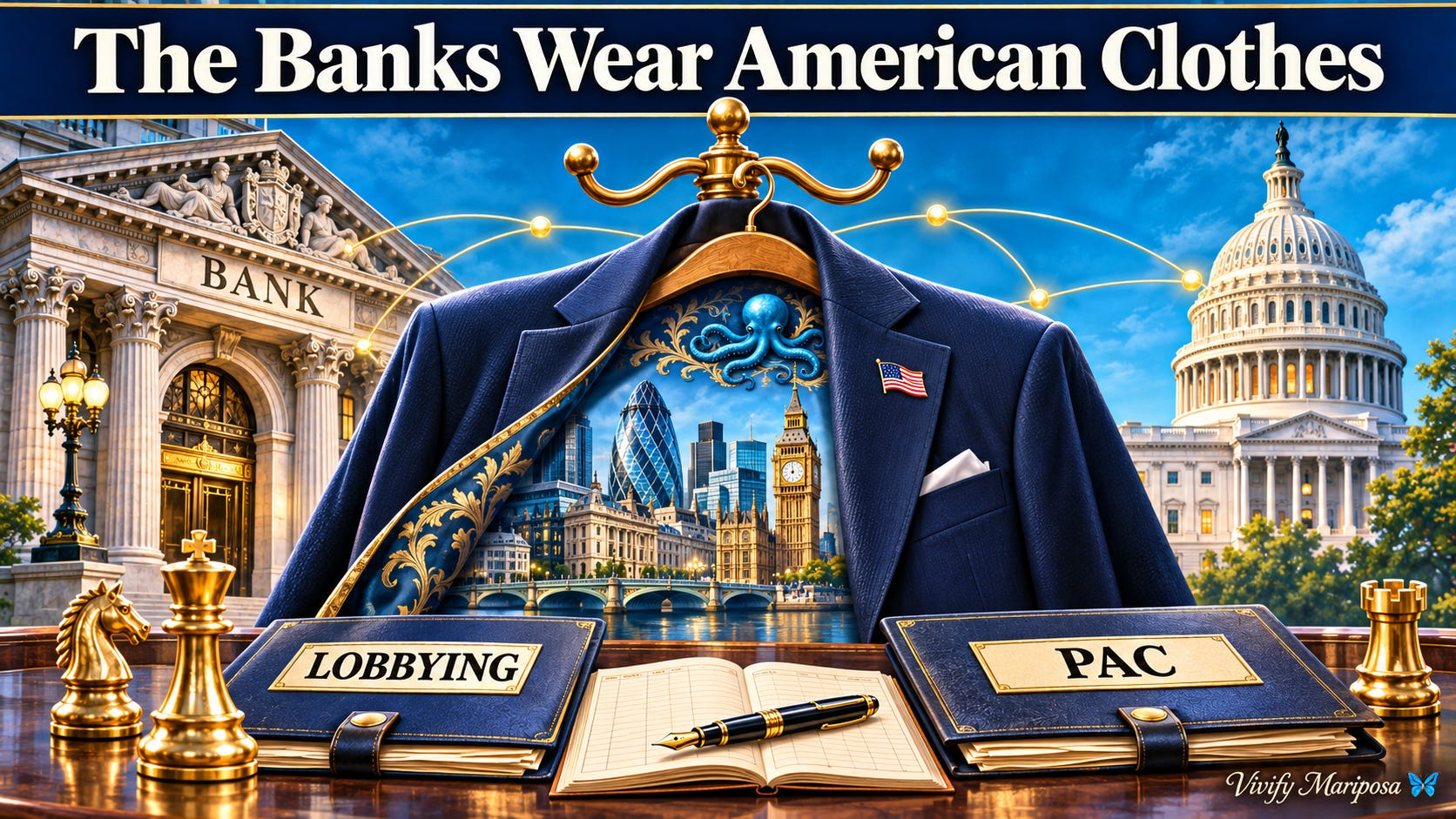
The Banks Wear American Clothes
​

The City needed the foreign agent registry because it filed as a government, and under American law the shortcut is closed to governments. The banks never needed it. The statute lets the agent of a foreign company skip the foreign agent registry by filing as an ordinary lobbyist, and the Justice Department adds one qualification: in no case where a foreign government or a foreign political party is the principal beneficiary will that exemption be recognized. So the company that represents a foreign corporation files in the same lobbying database as a company from Ohio, and the reader who searches the foreign agent registry for London finds one small office with two employees on salary, while the firms that actually move the money of the City appear nowhere in it.

Lloyd’s of London lobbies Congress through Lloyd’s America, and its own filings explain that Lloyd’s of London owns Lloyd’s America and is therefore interested in the issues it lobbies. Barclays runs a political action committee through its American subsidiary, registered with the Federal Election Commission and designated a lobbyist and registrant PAC, and over the years it has written checks to senators and House members of both parties. The law allows it as long as the decisions are made by American citizens or permanent residents and, in the Commission’s language, the funds do not come from a foreign national, a sentence that asks you to believe a subsidiary’s money stops being its parent’s money when it crosses the Atlantic. The language does the work, “domestic subsidiary,” “separate segregated fund,” “connected organization,” each phrase written so that a check from London arrives in a campaign account wearing American clothes.


The report that shows what registered lobbyists gave to candidates during the last four months before the midterm, the semiannual contribution report the lobbying law requires, covers July through December and is due February 1, 2027, three months after you voted. The election commission’s report on lobbyist bundling, the form that names the lobbyists who gathered other people’s checks for a campaign, is required only from candidate committees, leadership committees and party committees, and never from a super PAC, so the money closest to the vote either reaches the public after the result is certified or never reaches it under a lobbyist’s name at all.
 

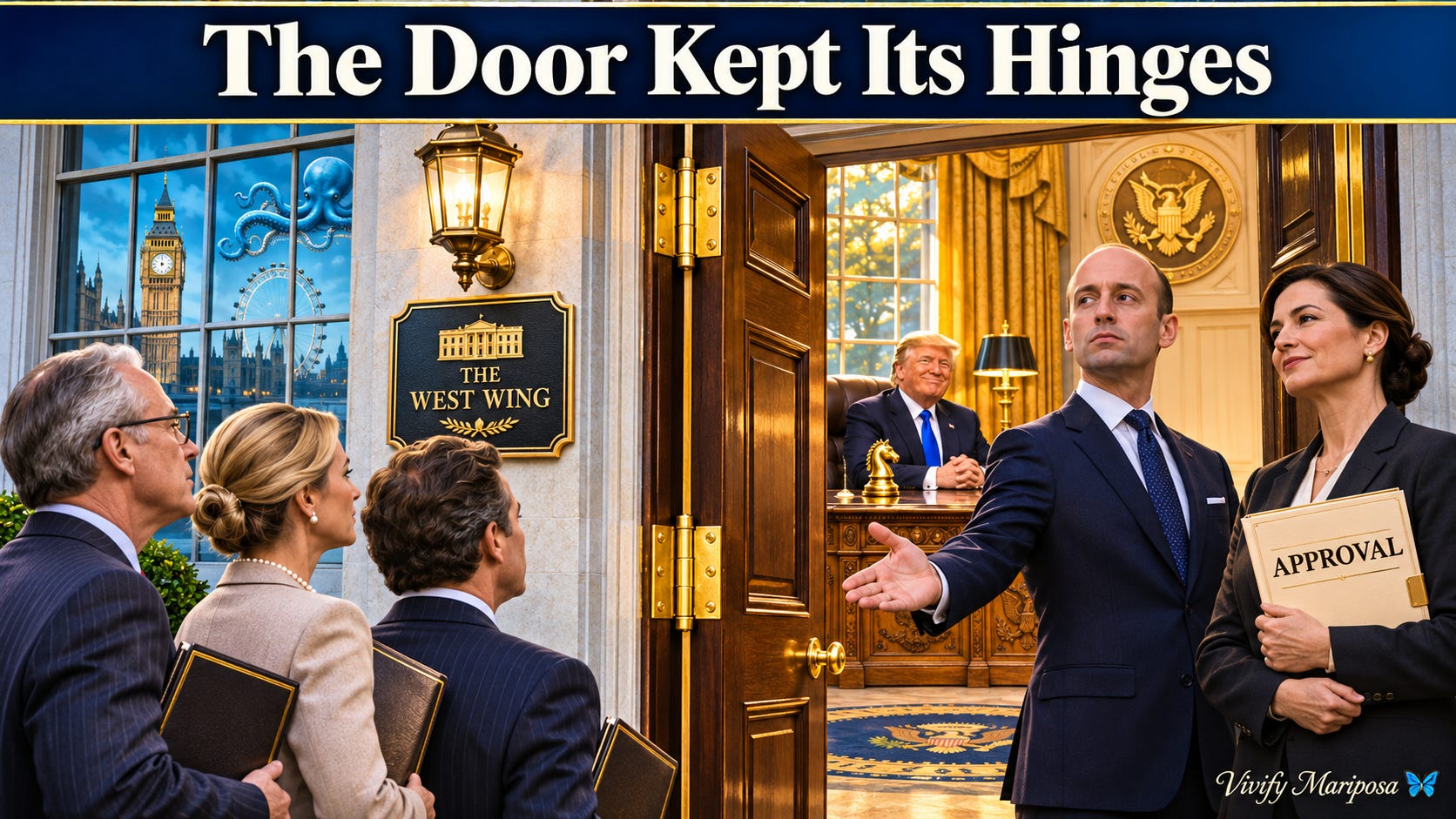
The Door Kept Its Hinges
​

Wiles told the country her plan for the midterm a year before the vote. Midterms are usually local, she said, and the White House usually stays out of them, but not this time, because “we’re going to put him on the ballot.” On November 3 the Democrats took Congress, and the President answered her sentence with his own in a post that night, saying he was not on the ballot and that if he had been, it would have been a landslide. The doorkeeper promised to put him on the ballot, and the President made sure everyone knew he had not been on it. The difference between those two sentences is the difference between an election that belongs to him and one that belongs to the people who managed it.

On November 6 he announced that Wiles was leaving the chief of staff’s desk and that Stephen Miller would sit there on Monday. He praised her and moved her to his political operation, a move that keeps close the one person who knows the name of every visitor who came through the door for twenty-two months.


Miller took the desk on November 9, and by Thursday his office had sent a memo to every White House employee, signed by the director of the Office of the Chief of Staff: no meeting with a registered lobbyist about government policy anywhere on the White House complex without prior approval from the White House Counsel, all lobbyist requests through one office, Public Liaison. The memo used a phrase the layer will not enjoy, saying the staff are expected to dedicate their time unwaveringly to the working people of the nation, and a White House official described it as a much stricter process than before. The layer answered in its own language the same week. Lobbyists told reporters the rule could easily be sidestepped, that it did not ban video calls, that there were other ways to hold a meeting, and every one of those answers describes a side window.

Nobody tore the door down. It now opens only from the inside, with the President’s lawyers holding the handle, while the names of everyone who walked through it during the open season sit in federal filings the visitors wrote themselves. It is the same move I documented with the payment rails, one more command added to the stack on a Thursday.
 
Back
Top