

Bruddah IZ
DA
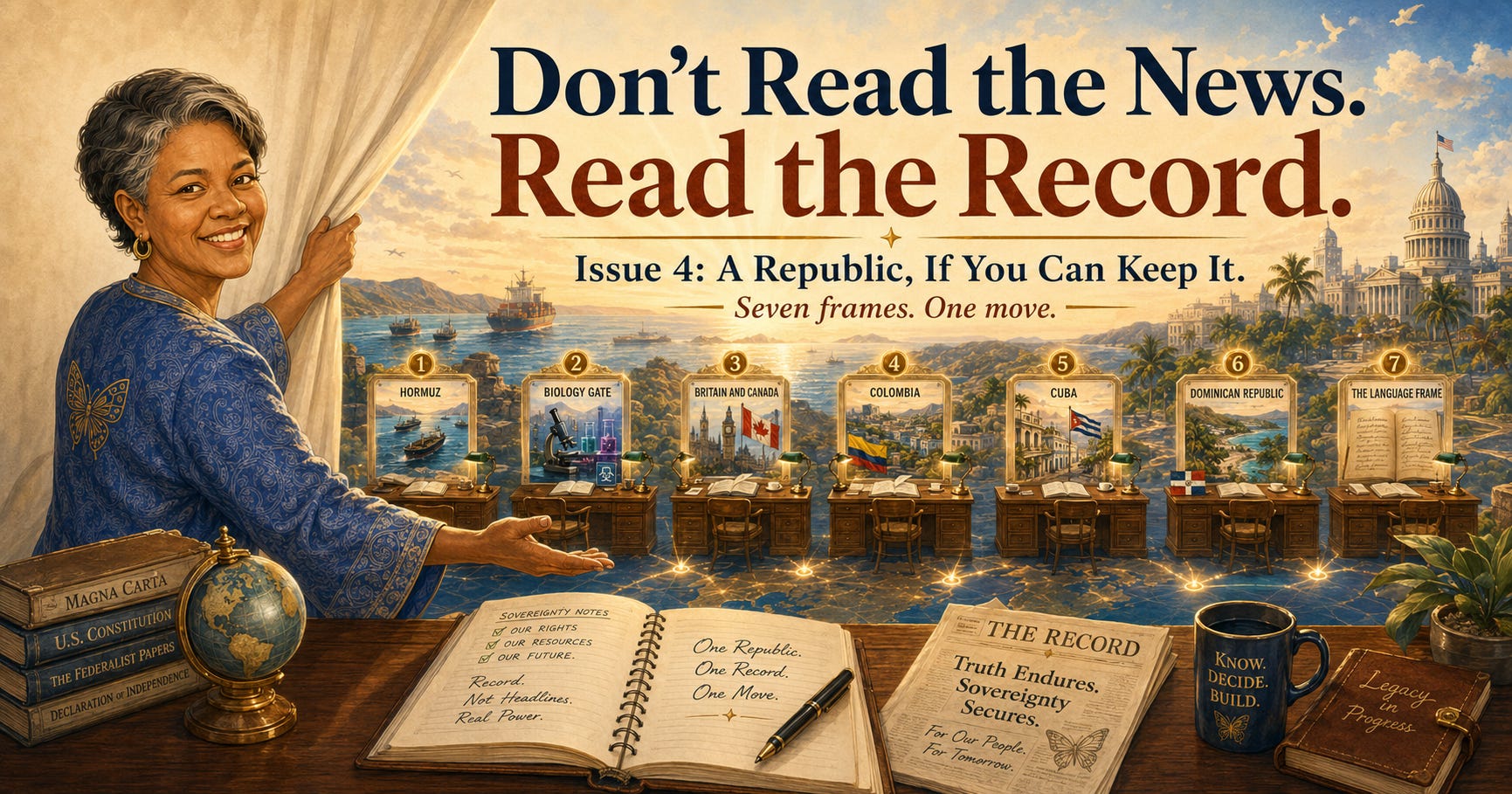
Issue 4: A Republic, If You Can Keep It. News window: the road to America’s 250th, June 16 through June 22, 2026.
Vivify MariposaJun 23, 2026
Don’t Read the News. Read the Record.
By Vivify Mariposa
 No Filter. Just Facts.
A committee in one square mile of London priced a fifth of the world’s oil shut, and then a deal at Versailles moved the pricing pen to Washington. They called it peace.
An intelligence office named the funding channel behind a pandemic. For years they called the people who looked for it foreign assets.
A 219-page report counted Britain’s raped children, and instead the story became London’s seventh prime minister in ten years, while a man who ran the Bank of England now runs Canada and warns of global rupture as the levers move. They call it leadership.
Colombia sorted a contested election by a label before the law could settle it. They called it defending democracy.
Cuba rewrote two hundred laws with its fuel cut off. They called it reform.
My first country wrote its tax law to the creditor and sent a former CIA officer to the embassy to read the field. They called it growth.
And when I handed the last issue to an AI for a reaction, it told me sovereignty is not absolute. They call that international law.
Before the machine, the person reading it to you. I was born in the Dominican Republic. I became a United States citizen the moment I turned 18, by choice, and the first thing I did was register to vote. Then a clerk at a DMV counter changed my party to the other one without asking, and I found it only because I went and read the record myself. I live on Constitution Avenue. I did not plan that. I learned to read this machine in the country I was born in, where it had already been run all the way to the end, so I read the United States the way you can only read a thing from the outside, with two countries’ eyes. That is the whole reason this newsletter is not a flag and not a slogan. It is a record, read by someone who chose the republic on purpose and watched another one get renamed.
So here is what I am actually reading for, three plain questions. Who holds the pen?Who changed the word? And who owns the small country after the big country stops looking?
Because these are not seven stories. They are one move, repeated at seven desks. The City of London is the oldest desk, the one where the move was perfected, and you will meet it first. But it is not a single master villain pulling every string, and saying so would be its own kind of lazy. The IMF is a desk. The embassy is a desk. The election label is a desk. The insurance committee is a desk. The AI you type into is the newest desk. The move is the same at every one of them: rename the thing, move the pen, and call the loss a system.
This is the season the move started losing. The invisible hand, the founding metaphor of British economics from 1776, got fired by name at the Reagan Library, and three weeks later the doctrine that a working country must be rationed got thrown out at the Fed. Two blueprints came out of 1776, the invisible hand and the Declaration, and for a century the British one governed the American one. That is reversing now, at the 250th: the tariff wall back, the External Revenue Service collecting, gold leaving London vaults for American exchanges, the central bank digital currency blocked, the Monroe Doctrine back in the hemisphere under the Donroe label. Every piece is a pen taken back from a desk.
And one word to settle before you read on. Sovereignty is absolute. The dictionary, not the United Nations, defines it: supreme power, freedom from external control. The desks’ only weapon was never an army. It is the rename, and the newest rename is the soft one: that sovereignty is limited, shared, interdependent, that pure self-rule is naive in a connected world. The moment you nod at that, you have handed it over with your own mouth and called it maturity. Watch for that move in every frame. It is the whole game.
So one thing has to be said plainly, because it is the weakness. Americans look inward, and when they finally look out they look at the big ones, China and Russia, the rivals large enough to flatter the worry. And by staring at Beijing and Moscow they miss where China and Russia are actually fighting, in the small countries they were taught to ignore: the Chinese stations seeded across Latin America, the single Russian tanker keeping Cuba alive, the Belt and Road signed in Bogota. The door breaks first where you are not looking. The self-absorbed habit is not pride. It is the opening.
Seven frames. One move. The republic’s 250th as the ruler held against it. Who holds the pen. And was it ever you.