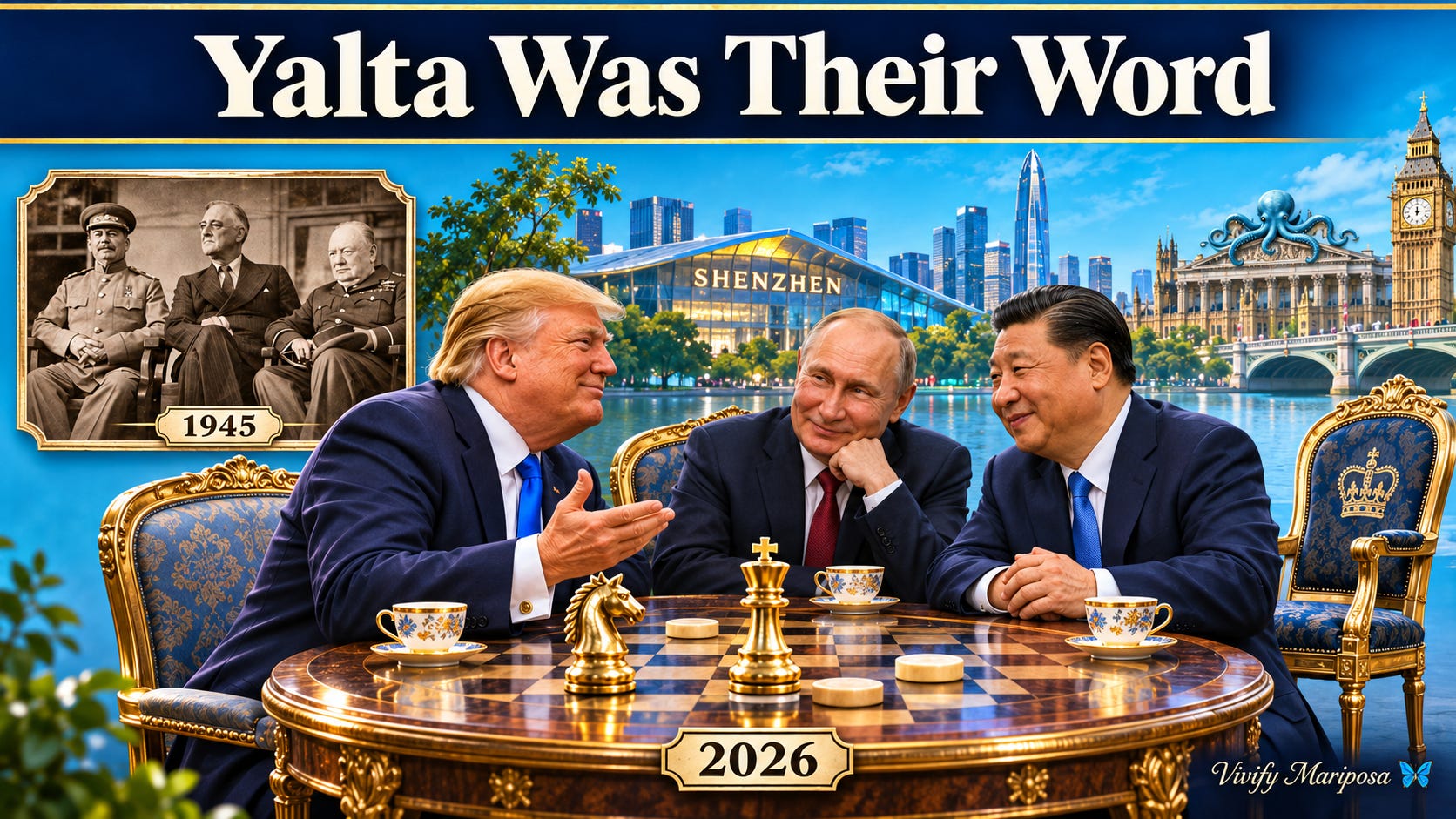
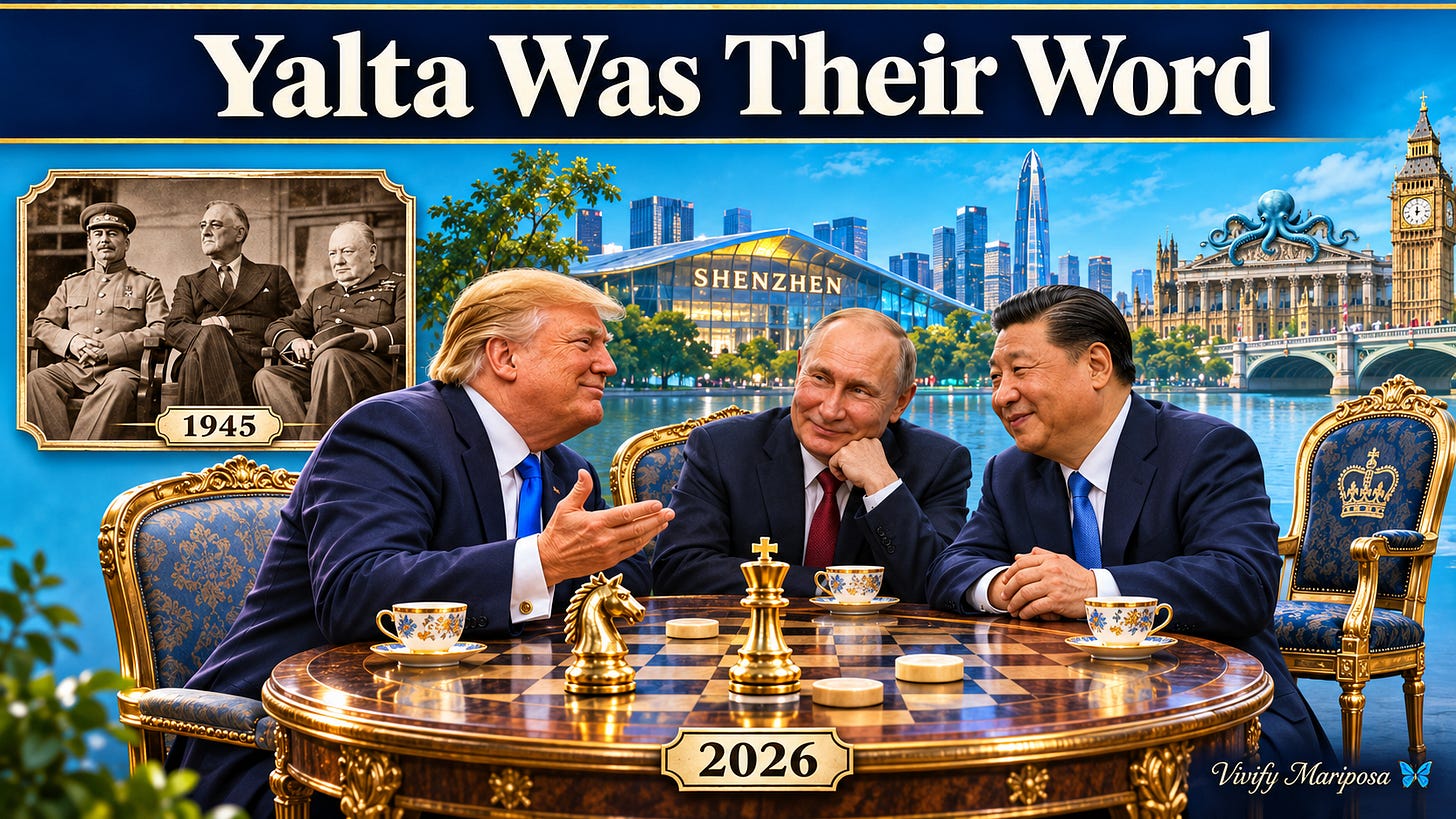
Yalta Was Their Word
Two weeks after the vote, President Trump sat down in Shenzhen with Xi Jinping and Vladimir Putin. In Russia and China Outside the Machine I wrote that London was not in any of those conversations when Washington started talking directly to Moscow and Beijing in Busan and then in Beijing, and Shenzhen put all three at one table, the United States, Russia and China, the ARC, with the three main nuclear powers agreeing they will not escalate and will keep communicating.
The City of London answered the meeting while it was happening. On November 18, the day the leaders gathered in Shenzhen, eight hours ahead of London, its chief executive published “Yalta this is not,” and the headline is the first confession, because nobody writes that something is not Yalta unless Yalta is the comparison keeping them awake. Her own opening paragraph explains why: at Yalta, she wrote, the leaders carved up the world, “though the end of the British Empire was already inevitable.” She put the obituary in the opening of her own article and then went looking for words big enough to cover it. The meeting was “showmanship.” Trump “has most to lose.” The United States “would have been better off had he not gone.” He “surrenders yet again” the card of “leader of the free world.” He carries “the banner of ‘Might Makes Right’” to the summit, to stand beside “two authoritarian leaders he seems to admire.” And then the word she chose for the President of the country that holds the world’s reserve currency, the largest military and the largest oil and gas production on earth: “a supplicant.”
Read as a confession, it is a fair description of the City. That same week, as I recorded in Don’t Read the News. Read the Record. Issue 25, Britain’s debt office sold four blocks of government debt, investors refused the optional extra on three of them, and on November 11 it manufactured £66 million of a gilt overnight, lent it to the dealers and then cancelled it. The supplicant was writing about itself.
The day before she typed that word, the supplicant was standing in Manila beside the Prime Ministers of Japan, India and Australia, and a reporter asked him for his message to China on rare earths, the one card London’s newspapers had spent a year telling everyone Beijing held over Washington. “We are making rare earth at a level that we’ve never made before,” he said. “We’re gonna catch them within 10 months, they say. Everything that we need we’ll have in 10 months.” The four leaders signed a joint statement that same day expressing “grave concerns about economic coercion, including through arbitrary export restrictions,” and Australia, a realm of the Crown and a member of the Commonwealth, put its Prime Minister’s name under that sentence next to Trump’s. The man London called a supplicant flew to Shenzhen with Tokyo, New Delhi and Canberra on paper beside him, saying out loud that in ten months he would not need the card, while London’s chief executive was writing that Chinese competition threatens to annihilate manufacturing in Europe, not in America.
Of the roughly 12,187 nuclear warheads on earth at the start of 2026, Russia and the United States hold about 86 percent between them and China holds about six hundred more, so the table London calls a supplicant’s table holds about nine of every ten nuclear weapons in existence. Add India, whose Prime Minister stood beside Trump in Manila the day before, with 190 more, and the institution handing out the word supplicant writes from a country that holds 225, less than two percent of them.
And the comparison itself is the insult. At Yalta in 1945 three men carved up a defeated continent, and Britain sat at that table as one of the three, with Churchill in the chair London still remembers, even if its own chief executive now admits the end of its empire was already inevitable. Shenzhen is not that. At Yalta the three were dividing the spoils of a war they were about to win in the open. In Shenzhen the three finally know who the enemy is, the one none of them could name before, the one that financed both sides of their wars, insured their ships, priced their oil and their gold, froze their reserves and rated their debt, and London is not at the table because London is the subject. Each of them is cleaning house at home, Washington cutting the wires I followed through this series and Moscow and Beijing building their own rails outside the machine, while in public they keep playing the part of enemies, the tariffs, the warnings, the speeches, so the City keeps waiting for the fight it has always profited from and does not see the three of them closing the door on it together.
Even the pictures people shared to celebrate the meeting count the wrong thing. They put the three of 1945 beside the three of 2026 and announce that Britain went out and China came in, as if only one chair changed. Two changed. In 1945 the American in the middle chair was Roosevelt, the president I followed in
The Band-aid President Series: FDR and the Machine He Left Running, who had already taken the people’s gold and who had walked into Bretton Woods the year before to build the institutions that put American force behind London’s financial architecture for the next eighty years. The United States sat at Yalta as the enforcer, and Britain sat beside it as the owner. In Shenzhen the owner has no chair, and the American in the room is the one cutting the wires the enforcer used to guard.
Two weeks earlier the same institution had published its forecast for the world after the midterm under the headline “After Trump’s midterm defeat, Russia and China will encounter a cooler US,” predicting that they “may seek to exploit the president’s weakness.” Fourteen days later Moscow and Beijing sat down at the same table with the weak president and agreed not to escalate, and London had to write about a meeting it had predicted would not look like this.
For the United Kingdom and the European Union, she wrote, the display is a reminder of “the urgent need to shore up regional alliances, the United Nations, and the rule of international law where possible.” She warned that Europe is “in the crosshairs of all three leaders,” that technological competition from China “threatens to annihilate” European manufacturing, and that “the smaller the country, the more it needs the rule of international law and respect for international institutions.” She closed with the two sentences that give the whole piece away: “Xi, Trump and Putin may gather believing they dominate the world. But their meeting gives others every reason to look for ways to stand together.” Who are the others? Not Beijing, not Moscow and not Washington, the three she had just seated at the table. The others are the ones she addressed two paragraphs earlier, the United Kingdom and the European Union, the City and Brussels, told to stand together because the largest powers on earth sat down without them. Russia and China were already outside the machine, and in Shenzhen the old enforcer pulled up a chair beside them.
Every one of those phrases is a request, from “shore up” to “where possible” to “stand together,” and the sentence about small countries needing institutions is the business model of the City written as advice, because the institutions she asks small countries to respect are the courts, the clearing houses, the insurance desks and the credit ratings I have followed through every installment of the Machine Series, the ones that have always needed small countries to need them. And Europe in the crosshairs is London admitting where the target sits now, on the old continent that was the City’s last reliable enforcer.
She even wrote down the thing that hurts. There is “bitterness among Ukrainian officials,” she wrote, that a Democrat-dominated Congress “is unlikely to send more funds Ukraine’s way.” The war that kept the frozen reserves earning interest, the war I traced in Russia and China Outside the Machine, now has no new American checks coming, and the City’s chief executive put it in writing while the leaders were sitting down.




 Stop fucking lying. It's like one of the leaders at Jonestown getting mad at one of the smart one's that escaped that evil place.


 "